



HCGRP-(8-37)
Based on 2 publication(s) in Google Scholar
HCGRP-(8-37) (Human α-CGRP (8-37)) is a fragment of human calcitonin gene-related peptide (hCGRP) and an antagonist of the CGRP receptor, with an IC50 of 32.1 pM against the CGRP receptor. HCGRP-(8-37) blocks adenylate cyclase activation induced by CGRP receptor ligands and attenuates vascular responses triggered by CGRP. HCGRP-(8-37) reduces capsaicin-induced vasodilation in porcine nasal mucosa and superficial skin. HCGRP-(8-37) serves as a research tool to distinguish effects mediated by CGRP or calcitonin receptors, and to investigate CGRP-induced vascular effects.
For research use only. We do not sell to patients.
- Purity : 99.51%
- CAS No.: 119911-68-1
- Formula: C139H230N44O38
- Molecular Weight:3125.59
-
Storage:
Sealed storage, away from moisture.
Powder -80°C, 2 years , -20°C, 1 year* In solvent : -80°C, 6 months; -20°C, 1 month (sealed storage, away from moisture)


To place orders, for customer services and technical support, please contact: MedChemExpress USA
Tel: 609-228-6898 E-mail: [email protected] [email protected]


-
 Biological Activity
-
Chemical Information
-
Solvent & Solubility
- Purity & Documentation
- References
-
 Help & FAQs


-
HY-P1071
α-CGRP (human)Vasodilator -

HY-P1548
β-CGRP, humanCalcitonin Peptide -
HY-P1070
Amylin, amide, humanGlucoregulatory Hormone -
HY-P0209
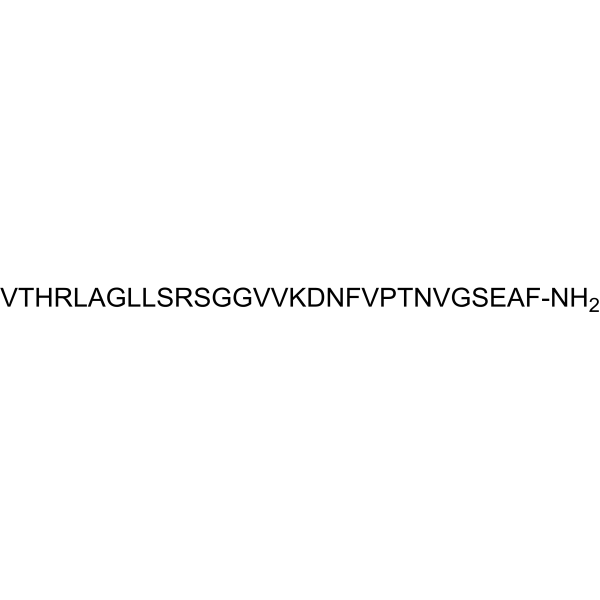
Rat CGRP-(8-37)CGRP Receptor Antagonist -
HY-P4058
Calcitonin gene-related peptide free acidNeuropeptide -
HY-P0090
Calcitonin (salmon)CGRP Receptor Agonist -
HY-P0203
α-CGRP (mouse, rat)Neuropeptide -
HY-10095
OlcegepantCGRP Antagonist -
HY-15498
RimegepantCGRP/AMY1 Receptor Antagonist -
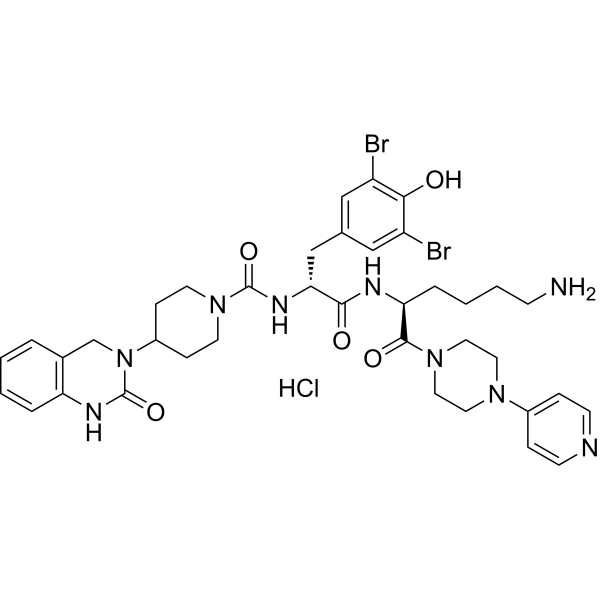
HY-10095A
Olcegepant hydrochlorideCGRP Antagonist -
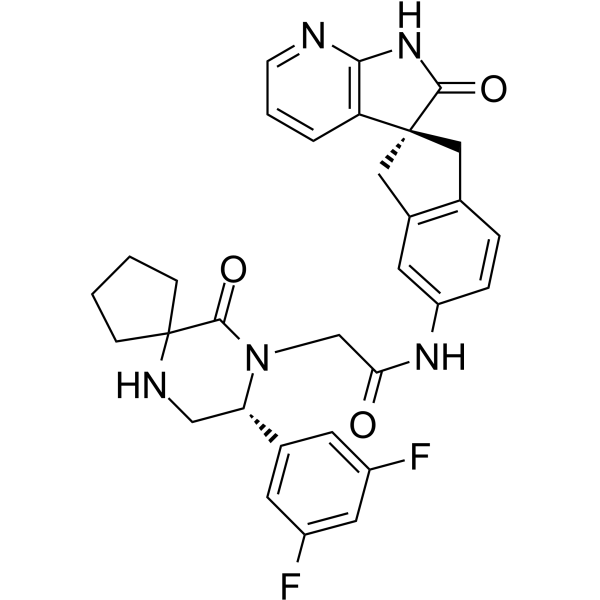
HY-10301
MK-3207CGRP Receptor Antagonist -
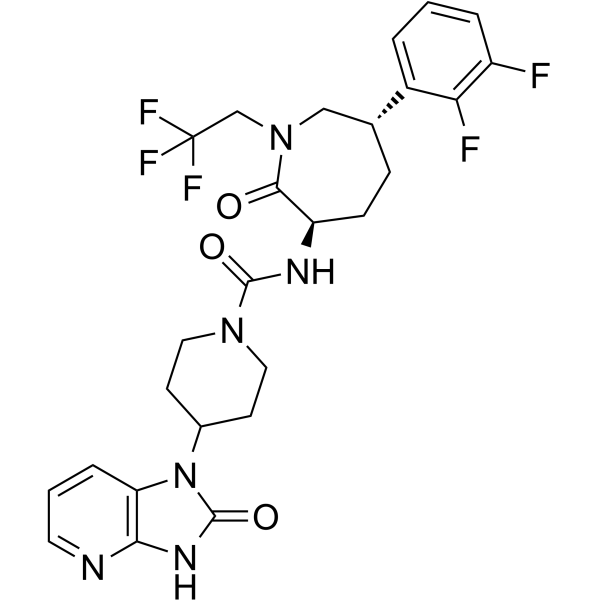
HY-32709
TelcagepantCGRP Antagonist
Publications Citing Use of MedChemExpress (MCE) HCGRP-(8-37)
More

Biological Activity
Description
IC50 & Target
CGRP receptor[1]
In Vitro
HCGRP-(8-37) (10 min at 37°C) acts as a CGRP receptor antagonist in rat liver plasma membranes. It inhibits CGRP- and calcitonin-induced adenylate cyclase activation in a dose-dependent manner, but does not affect basal, epinephrine- or glucagon-stimulated activities[1].
HCGRP-(8-37) (60 min at 37°C) binds to calcitonin receptors in LLC-PK1 porcine kidney cells in a dose-dependent manner[1].
HCGRP-(8-37) (15 min at 37°C) acts as a calcitonin receptor agonist in LLC-PK1 porcine kidney cells, which dose-dependently stimulates cAMP production without antagonizing calcitonin- or CGRP-induced cAMP production[1].
HCGRP-(8-37) potently inhibits CGRP-mediated adenylate cyclase activation in cell-free rat liver plasma membrane preparations[2].
MedChemExpress (MCE) has not independently confirmed the accuracy of these methods. They are for reference only.
In Vivo
MedChemExpress (MCE) has not independently confirmed the accuracy of these methods. They are for reference only.
-
Animal Model:Domestic pigs (either sex, 17-22 kg)[2]
-
Dosage:16 µM
-
Administration:local intra-arterial infusion; 20 minutes
-
Result:Significantly attenuated capsaicin-evoked increases in nasal vascular conductance and decreases in nasal cavity volume.
Significantly reduced capsaicin-evoked superficial skin blood flow when calculated as area under the curve (AUC); capsaicin-induced skin peak blood flow remained unchanged (96% of control, not significant), but the duration of the skin response was significantly reduced to 69% of control .
Significantly reduced CGRP-evoked increases in nasal vascular conductance and decreases in nasal cavity volume.
Significantly attenuated CGRP-evoked superficial skin blood flow, with reductions seen in AUC, peak response, and response duration.


Chemical Information
-
CAS No. 119911-68-1
-
Appearance Solid
-
Molecular Weight 3125.59
-
Formula C139H230N44O38
-
Color White to off-white
-
Synonyms
Human α-CGRP (8-37)
-
Sequence
Val-Thr-His-Arg-Leu-Ala-Gly-Leu-Leu-Ser-Arg-Ser-Gly-Gly-Val-Val-Lys-Asn-Asn-Phe-Val-Pro-Thr-Asn-Val-Gly-Ser-Lys-Ala-Phe
-
Sequence Shortening
VTHRLAGLLSRSGGVVKNNFVPTNVGSKAF
-
Shipping
Room temperature in continental US; may vary elsewhere.
-
Storage
Sealed storage, away from moisture
Powder -80°C 2 years -20°C 1 year * In solvent : -80°C, 6 months; -20°C, 1 month (sealed storage, away from moisture)


Publications (2)
-
Journal Impact Factor
-
Most Recent
-
Mol Med Rep
Calcitonin gene‑related peptide alleviates hyperoxia‑induced human alveolar cell injury via the CGRPR/TRPV1/Ca2+ axis. [Abstract]2024 Jul;30(1):110. PMID: 38695251 -


Solvent & Solubility
In Vitro:
H2O : ≥ 20 mg/mL (6.40 mM)
* "≥" means soluble, but saturation unknown.
Please refer to the solubility information to select the appropriate solvent. Once prepared, please aliquot and store the solution to prevent product inactivation from repeated freeze-thaw cycles.
Storage method and period of stock solution: -80°C, 6 months; -20°C, 1 month (sealed storage, away from moisture). When stored at -80°C, please use it within 6 months. When stored at -20°C, please use it within 1 month.
* Note: If you choose water as the stock solution, please dilute it to the working solution, then filter and sterilize it with a 0.22 μm filter before use.
Please refer to the solubility information to select the appropriate solvent. Once prepared, please aliquot and store the solution to prevent product inactivation from repeated freeze-thaw cycles.
Storage method and period of stock solution: -80°C, 6 months; -20°C, 1 month (sealed storage, away from moisture). When stored at -80°C, please use it within 6 months. When stored at -20°C, please use it within 1 month.
* Note: If you choose water as the stock solution, please dilute it to the working solution, then filter and sterilize it with a 0.22 μm filter before use.
Concentration (start) × Volume (start) = Concentration (final) × Volume (final)
In Vivo:
For the following dissolution methods, please prepare the working solution directly:
It is recommended to prepare fresh solutions and use them promptly within a short period of time.
The percentages shown for the solvents indicate their volumetric ratio in the final prepared solution. If precipitation or phase separation occurs during preparation, heat and/or sonication can be used to aid dissolution.
Add each solvent one by one: PBS
Solubility: 20 mg/mL (6.40 mM); Clear solution; Need ultrasonic


Purity & Documentation
-
Data Sheet (274 KB)
-
SDS (252 KB)
- English - EN (252 KB)
- Français - FR (252 KB)
- Deutsch - DE (252 KB)
- Norwegian - NO (252 KB)
- Español - ES (252 KB)
- Swedish - SV (252 KB)
- Italian - IT (252 KB)
- Korean - KR (252 KB)
- Portuguese - PT (252 KB)
-
Handling Instructions (2659 KB)
References
[1]. Chiba T, et al. Calcitonin gene-related peptide receptor antagonist human CGRP-(8-37). Am J Physiol. 1989 Feb;256(2 Pt 1):E331-5. [Content Brief]
[2]. Rinder J, et al. Effects of hCGRP 8-37 and the NK1-receptor antagonist SR 140.333 on capsaicin-evoked vasodilation in the pig nasal mucosa in vivo. Acta Physiol Scand. 1996;156(2):115-122. [Content Brief]


Complete Stock Solution Preparation Table
Please refer to the solubility information to select the appropriate solvent. Once prepared, please aliquot and store the solution to prevent product inactivation from repeated freeze-thaw cycles.
Storage method and period of stock solution: -80°C, 6 months; -20°C, 1 month (sealed storage, away from moisture). When stored at -80°C, please use it within 6 months. When stored at -20°C, please use it within 1 month.
| Optional Solvent | Concentration Solvent Mass | 1 mg | 5 mg | 10 mg | 25 mg |
|---|---|---|---|---|---|
| H2O | 1 mM | 0.3199 mL | 1.5997 mL | 3.1994 mL | 7.9985 mL |
| 5 mM | 0.0640 mL | 0.3199 mL | 0.6399 mL | 1.5997 mL |
* Note: If you choose water as the stock solution, please dilute it to the working solution, then filter and sterilize it with a 0.22 μm filter before use.


HCGRP-(8-37) Related Classifications
HY-P1014 Related Classifications
 Powered by Bioz