



FGFR2
FGFR2 encodes FGFR2b and FGFR2c isoforms with distinct expression domains and ligand specificity[1]. Mechanistically, FGF/FGFR signaling regulates lineage commitment, differentiation, proliferation, and apoptosis in development and adult homeostasis[2]. In disease models, FGFR2 alterations activate signaling in breast, gastric, cholangiocarcinoma, lung squamous, and oral squamous cancers[1][3][4]. Compared with related isoforms, FGFR2b-to-FGFR2c switching occurs during prostate and bladder cancer progression, linking splice regulation to epithelial-mesenchymal transition[1]. For experimental applications, FGFR2 mutation or amplification supports use of FGFR inhibitors, while extracellular-domain FGFR2 mutations can drive constitutive dimerization and inhibitor-sensitive transformation[1][4].
References:
- [1]. Katoh Y, et al. FGFR2-related pathogenesis and FGFR2-targeted therapeutics (Review). Int J Mol Med. 2009 Mar;23(3):307-11. [Content Brief]
- [2]. Xie Y, et al. FGF/FGFR signaling in health and disease. Signal Transduct Target Ther. 2020 Sep 2;5(1):181. [Content Brief]
- [3]. Egan JB, et al. Molecular Modeling and Functional Analysis of Exome Sequencing-Derived Variants of Unknown Significance Identify a Novel, Constitutively Active FGFR2 Mutant in Cholangiocarcinoma. JCO Precis Oncol. 2017;2017. [Content Brief]
- [4]. Liao RG, et al. Inhibitor-sensitive FGFR2 and FGFR3 mutations in lung squamous cell carcinoma. Cancer Res. 2013 Aug 15;73(16):5195-205. [Content Brief]
All Product Categories
-
FGFR2 Related Products (17)
Related Products (17)

- 1
-
BR-cpd7
 0 ImagesCat. No.: HY-163705Purity: 98.01%BR-cpd7 is an orally active, selective PROTAC degrader targeting FGFR1 and FGFR2, with a DC50 of 2.2 nM against FGFR1. BR-cpd7 reduces FGFR signaling. BR-cpd7 induces cell cycle arrest and selectively blocks the proliferation of FGFR1/FGFR2-dependent tumor cells. BR-cpd7 exhibits significant antitumor efficacy in FGFR1-dependent lung cancer animal models, while achieving complete depletion of FGFR1. BR-cpd7 can be used for cancer-related research.
-
DGY-09-192
 0 ImagesDGY-09-192 is a PROTAC FGFR1/2 degrader (FGFR1: DC50 = 4.35 nM; FGFR2: DC50 = 70 nM). DGY-09-192 preferentially degrades wild-type FGFR1/2 and multiple FGFR2 fusion proteins (including FGFR2-PHGDH and FGFR2-OPTN). DGY-09-192 suppresses downstream FGFR signaling (reducing phosphorylation of FRS2 Y196 and ERK1/2 T202/Y204) in vitro and vivo. DGY-09-192 can be used for the study of FGFR-driven cancers.
-
HuGAL-FR21
 0 ImagesCat. No.: HY-P991584HuGAL-FR21 is a humanized antiFGFR2IIIb IgG1 monoclonal antibody. HuGAL-FR21 can block the binding of FGF2, FGF7, and FGF10 to FGFR2IIIb and inhibit FGF-induced phosphorylation of FGFR2IIIb. HuGAL-FR21 can downregulate the expression of FGFR2 in SNU-16 cells. HuGAL-FR21 shows the significant anti-tumor activity in athymic nude mice bearing gastric cancer xenograft models. HuGAL-FR21 can be used for research on cancer such as gastric cancer.
-
Lavengratinib
 0 ImagesCat. No.: HY-187793CAS No.: 2412854-49-8Synonyms: ABSK061Lavengratinib (ABSK061) is a FGFR2/FGFR3 inhibitor. Lavengratinib selectively inhibits FGFR2 and FGFR3 signaling pathways and reduces the risk of FGFR1-mediated hyperphosphatemia. Lavengratinib is suitable for research on advanced solid tumors (including cholangiocarcinoma, gastric cancer, non-small cell lung cancer, cervical cancer and urothelial cancer).
-
Multi-kinase-IN-15
 0 ImagesCat. No.: HY-131571CAS No.: 1613168-52-7Multi-kinase-IN-15 is an orally active multi-kinase inhibitor. Multi-kinase-IN-15 inhibits the kinase activity of MNK1, MNK2, ABL1, ABL1 T315I, FLT3, VEGFR2, RET, cKIT, FGFR2, PDGFRα, and PDGFRβ. Multi-kinase-IN-15 dose-dependently reduces phosphorylation of eIF4E and phosphorylated Crkl in tumor cells, and decreases phosphorylation of eIF4E in tumor tissues. Multi-kinase-IN-15 inhibits tumor growth. Multi-kinase-IN-15 can be used for research on chronic myeloid leukemia.
-
Dabogratinib (GMP)
 0 ImagesCat. No.: HY-159642GCAS No.: 2800223-30-5Synonyms: TYRA-300 (GMP)Dabogratinib (GMP) is the GMP-grade version of Dabogratinib (HY-159642). Dabogratinib (TYRA-300) is an orally active, selective FGFR3 inhibitor with an IC50 of 11 nM. Dabogratinib exhibits antitumor activity against urothelial carcinoma and solid tumors. Dabogratinib downregulates the FGFR3 and ERK1/2 signaling pathways, and induces tumor growth inhibition and regression in FGFR3-altered xenograft models. Dabogratinib promotes chondrocyte proliferation and differentiation, drives endochondral bone formation and overall body growth, partially restores long bone proportions, and improves craniofacial and spinal morphology. Dabogratinib can be used for the research of metastatic urothelial carcinoma, achondroplasia and hypochondroplasia.
-
FGFR-IN-27
 0 ImagesCat. No.: HY-183780FGFR-IN-27 is an orally active, broad-spectrum FGFR inhibitor, with an IC50 of 0.24 nM against human FGFR1, 0.71 nM against FGFR2, 0.87 nM against FGFR3, and 6.50 nM against FGFR4. FGFR-IN-27 inhibits cancer cell proliferation and blocks tumor growth. FGFR-IN-27 reduces the phosphorylation levels of AKT and ERK, induces apoptosis and ferroptosis, increases ROS levels, and decreases GSH levels. FGFR-IN-27 can be used in the research of hepatocellular carcinoma.
-
FGFR-IN-28
 0 ImagesCat. No.: HY-184250CAS No.: 2634677-16-8FGFR-IN-28 is a FGFR inhibitor with inhibitory activity against multiple subtypes of the FGFR family, with an IC50 of 4.4 nM against FGFR4. FGFR-IN-28 inhibits kinase activity and phosphorylation processes, and blocks the downstream MAPK and AKT signaling pathways. FGFR-IN-28 induces cellular DNA damage, cell cycle arrest, apoptosis and ferroptosis, and reduces the adhesion, invasion and metastasis abilities of cancer cells. FGFR-IN-28 exhibits anti-tumor activity in in vitro experiments on colon cancer cells, and inhibits tumor growth in colon cancer xenograft models. FGFR-IN-28 can be used in colon cancer-related research.
-
FGFR-IN-29
 0 ImagesCat. No.: HY-189241FGFR-IN-29 is an orally active pan-FGFR inhibitor that suppresses the kinase activities of FGFR1, FGFR2, FGFR3, and FGFR4. FGFR-IN-29 blocks the intracellular phosphorylation process of FGFR and arrests downstream tumor cell proliferation signaling. FGFR-IN-29 inhibits tumor growth in solid tumor xenograft mouse models. FGFR-IN-29 is applicable for cancer-related research.
-
PD173074 (GMP)
 0 ImagesCat. No.: HY-10321GCAS No.: 219580-11-7PD173074 GMP is PD173074 (HY-10321) produced by using GMP guidelines. GMP small molecules works appropriately as an auxiliary reagent for cell therapy manufacture. PD173074 is an orally active FGFR inhibitor that targets the transphosphorylation of FGFR1 and FGFR2 and blocks the FGF signaling pathway. By reducing the phosphorylation level of SMAD2 and altering the expression of Nodal/Activin target genes, PD173074 eliminates endothelial differentiation potential, thereby inhibiting the formation of capillary-like structures. PD173074 blocks the proliferation and colony formation of tumor cells and increases intratumoral cell apoptosis. PD173074 successfully reverses FGF-2-induced chemoresistance to enhance the effect of cisplatin (HY-17394) in small cell lung cancer models. PD173074 can be applied to research related to critical limb ischemia and small cell lung cancer.
-
FGFR3-IN-12
 0 ImagesCat. No.: HY-181752CAS No.: 3127143-52-3FGFR3-IN-12 is a selective fibroblast growth factor receptor 3 (FGFR3) inhibitor with an IC50 of 6.8 nM. FGFR3-IN-12 shows an IC50 of 19.2 nM against FGFR3V555M and an IC50 of 16.9 nM against TNK1 (Thirty-eight Negative Kinase 1). FGFR3-IN-12 inhibits cancer cells proliferation and induces caspase-mediated apoptosis. FGFR3-IN-12 exhibits antitumor activity in bladder cancer xenografts mice models. FGFR3-IN-12 can be used for the research of cancer, such as bladder cancer.
-
LC-MG-10
 0 ImagesCat. No.: HY-184322LC-MG-10 is a selective molecular glue degrader targeting FGFR2, with a DC50 of 230.2 nM in KATO III cells. LC-MG-10 induces proteasomal degradation of FGFR2 via a covalent molecular glue mechanism. LC-MG-10 inhibits cancer cell proliferation. LC-MG-10 suppresses FGFR2-mediated PI3K/AKT and MAPK/ERK signaling pathways. LC-MG-10 can be used in studies related to gastric cancer.
-
FGFR-IN-12
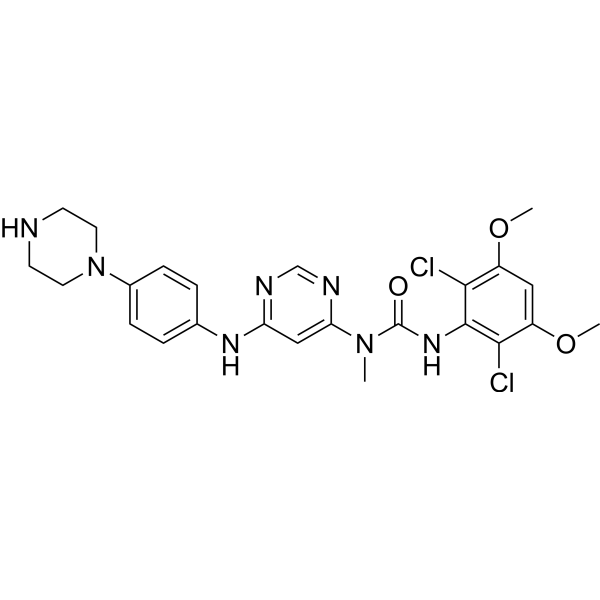 0 ImagesCat. No.: HY-160013CAS No.: 943189-02-4FGFR-IN-12 (example 14), a pyrimidinyl aryl urea derivative, is a potent FGFR inhibitor.
-
FGFR2-IN-4
 0 ImagesCat. No.: HY-189204CAS No.: 3110002-64-4FGFR2-IN-4 is a selective, orally active FGFR2 inhibitor, with IC50 values of 10.0 nM and 5.8 nM against wild-type FGFR2 and the FGFR2V565F mutant, respectively. FGFR2-IN-4 induces necroptosis in FGFR2-driven tumor cells. FGFR2-IN-4 induces tumor regression in xenograft models harboring FGFR2 inhibitor-resistant mutations without altering serum phosphate levels. FGFR2-IN-4 is used to investigate FGFR2-driven malignancies, including intrahepatic cholangiocarcinoma and gastric cancer.
-
LC-MG-5
 0 ImagesCat. No.: HY-184321LC-MG-5 is a selective molecular glue degrader targeting FGFR2, with a DC50 of 231.7 nM in KATO III cells. LC-MG-5 induces proteasomal degradation of FGFR2 in a DCAF16-dependent manner via a covalent molecular glue mechanism. LC-MG-5 inhibits cancer cell proliferation. LC-MG-5 suppresses PI3K/AKT and MAPK/ERK signaling pathways mediated by FGFR2. LC-MG-5 can be used in the research of gastric cancer.
-
CYB-5067
 0 ImagesCat. No.: HY-184598CYB-5067 is a FGFR molecular glue degrader with a DC50 of 27 nM against FGFR2. CYB-5067 inhibits FGFR1, FGFR3, FGFR4 and downstream FGFR signaling pathways, induces antiproliferative activity in vitro, and exhibits sustained target protein inhibition in vivo without obvious hook effect. CYB-5067 shows significant tumor growth inhibitory activity in the ETV6-FGFR2 fusion Ba/F3 xenograft model. CYB-5067 can be used for the research of FGFR-driven cancers.
-
GP369
 0 ImagesCat. No.: HY-P991583GP369 is a humanized FGFR2-IIIb-specific antibody. GP369 significantly inhibits the proliferation of tumor cells. GP369 can significantly inhibit phosphorylation of FGFR2 and downstream signaling pathways. GP369 can be used for research on cancer such as gastric cancer and breast cancer.
- 1



