ALK7
ALK7 (ACVR1C) is a human type I receptor serine/threonine kinase in the TGF-β receptor system[1]. Mechanistically, activin isoforms signal through ALK7, and activin C activates SMAD2/3 signaling through ALK7 in differentiated adipocytes[2][3]. In pancreatic islets, activin B receptor ALK7 negatively regulates β-cell function, and ALK7 activation induces pancreatic β-cell apoptosis through Akt suppression and the SMAD2-caspase-3 cascade[4][5]. In adipose models, GDF3-ALK7 signaling regulates adipose-tissue homeostasis under nutrient overload, while ALK7 dysfunction increases lipolysis and reduces fat accumulation[6][7]. In cancer models, ALK7 signaling functions as a suppressive tissue barrier to tumorigenesis and metastasis, and activin B-ALK7 activation induces apoptosis in neoplastic cells[8]. Compared with related isoforms, placental ALK7 transcripts include full-length, truncated, and soluble variants generated by alternative splicing, which distinguishes receptor-bound signaling from potential soluble or truncated forms[9]. For experimental applications, SB-431542 inhibits the highly related ALK4, ALK5, and ALK7 kinases, so it supports pathway blockade but does not isolate ALK7-specific biology[10].- ALK7 links activin-family signaling to SMAD2/3, β-cell regulation, adipose lipid metabolism, and apoptosis.- SB-431542 blocks ALK4/5/7 together, requiring isoform-aware controls in ALK7-focused experiments.
References:
- [1]. Bondestam J, et al. cDNA cloning, expression studies and chromosome mapping of human type I serine/threonine kinase receptor ALK7 (ACVR1C). Cytogenet Cell Genet. 2001;95(3-4):157-62. [Content Brief]
- [2]. Tsuchida K, et al. Activin isoforms signal through type I receptor serine/threonine kinase ALK7. Mol Cell Endocrinol. 2004 May 31;220(1-2):59-65. [Content Brief]
- [3]. Goebel EJ, et al. The orphan ligand, activin C, signals through activin receptor-like kinase 7. Elife. 2022 Jun 23;11:e78197. [Content Brief]
- [4]. Bertolino P, et al. Activin B receptor ALK7 is a negative regulator of pancreatic beta-cell function. Proc Natl Acad Sci U S A. 2008 May 20;105(20):7246-51. [Content Brief]
- [5]. Zhang N, et al. Activin receptor-like kinase 7 induces apoptosis of pancreatic beta cells and beta cell lines. Diabetologia. 2006 Mar;49(3):506-18. [Content Brief]
- [6]. Andersson O, et al. Growth/differentiation factor 3 signals through ALK7 and regulates accumulation of adipose tissue and diet-induced obesity. Proc Natl Acad Sci U S A. 2008 May 20;105(20):7252-6. [Content Brief]
- [7]. Yogosawa S, et al. Activin receptor-like kinase 7 suppresses lipolysis to accumulate fat in obesity through downregulation of peroxisome proliferator-activated receptor γ and C/EBPα. Diabetes. 2013 Jan;62(1):115-23. [Content Brief]
- [8]. Michael IP, et al. ALK7 Signaling Manifests a Homeostatic Tissue Barrier That Is Abrogated during Tumorigenesis and Metastasis. Dev Cell. 2019 May 6;49(3):409-424.e6. [Content Brief]
- [9]. Roberts HJ, et al. Identification of novel isoforms of activin receptor-like kinase 7 (ALK7) generated by alternative splicing and expression of ALK7 and its ligand, Nodal, in human placenta. Biol Reprod. 2003 May;68(5):1719-26. [Content Brief]
- [10]. Inman GJ, et al. SB-431542 is a potent and specific inhibitor of transforming growth factor-beta superfamily type I activin receptor-like kinase (ALK) receptors ALK4, ALK5, and ALK7. Mol Pharmacol. 2002 Jul;62(1):65-74. [Content Brief]
All Product Categories
-
ALK7 Related Products (7)
Related Products (7)

-
Recombinant Proteins (6)
-
SB-431542
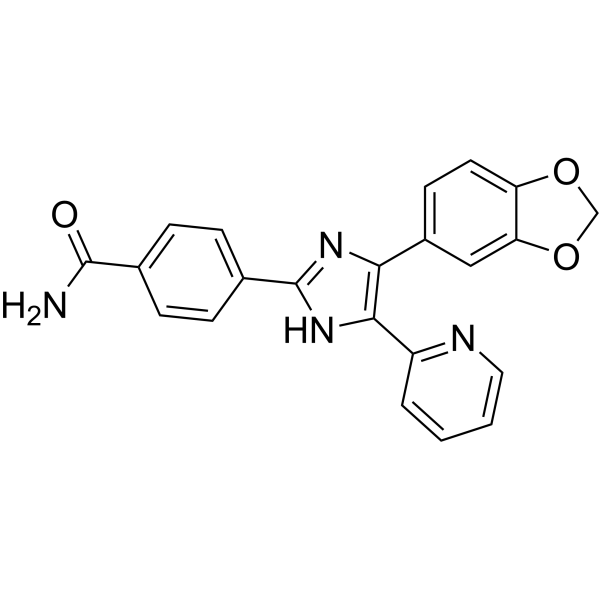 0 ImagesSB-431542 is a TGF-β receptor kinase inhibitor (TRKI). SB-431542 has inhibitory activity for ALK4, ALK5 and ALK7 with IC50 values of 1 μM, 0.75 μM and 2 μM, respectively. SB-431542 also inhibits TGF-β-induced transcription, gene expression, apoptosis, and growth suppression. SB-431542 can be used for the research of cancer and signal transduction pathways.
-
SB-431542 (GMP)
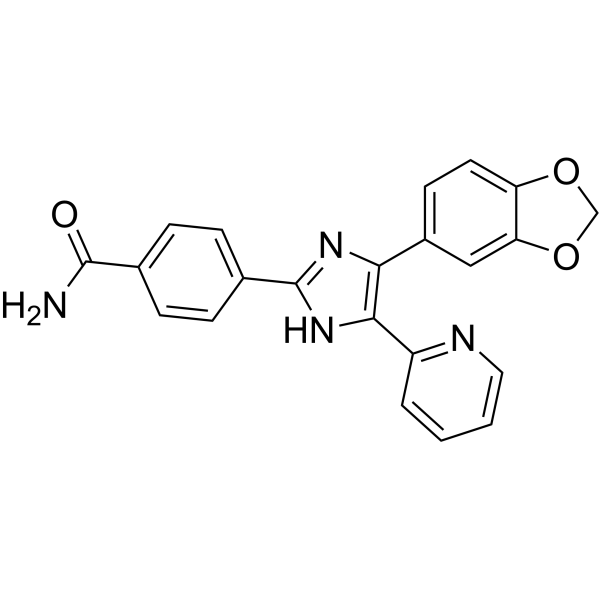 0 ImagesCat. No.: HY-10431GCAS No.: 301836-41-9SB-431542 (GMP) is SB-431542 (HY-10431) produced by using GMP guidelines. GMP small molecules works appropriately as an auxiliary reagent for cell therapy manufacture. SB-431542 is a TGF-β receptor kinase inhibitor (TRKI) in SMAD signaling.
-
A 83-01 (Standard)
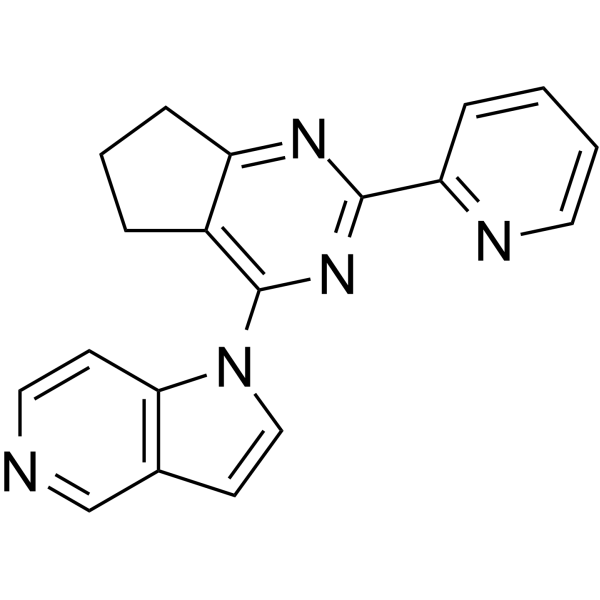
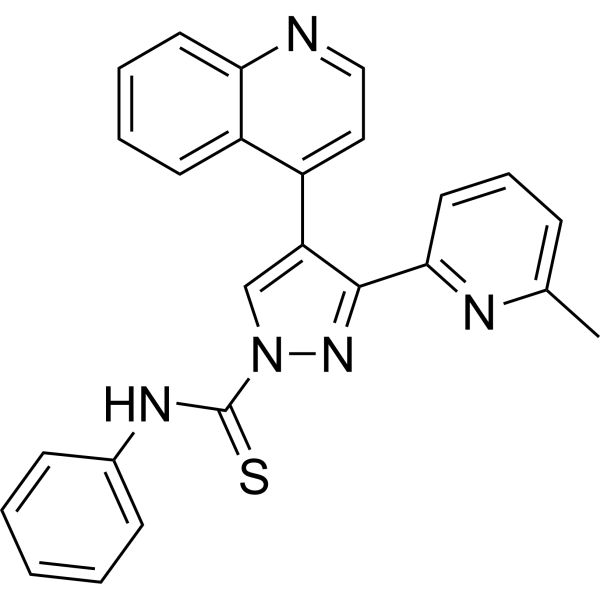
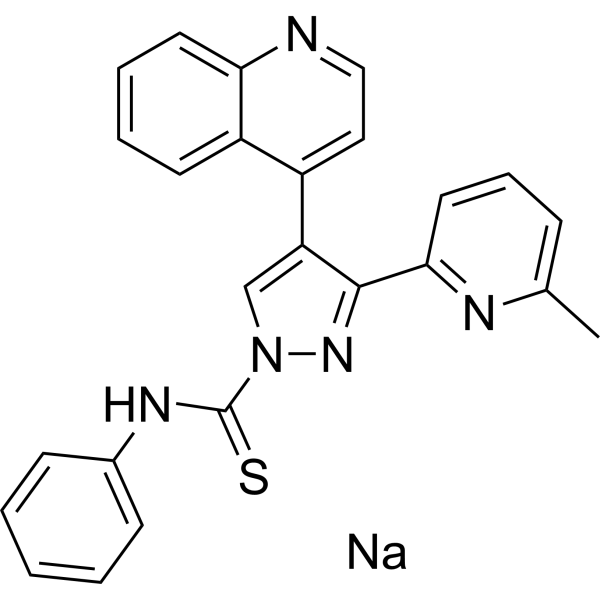
 0 ImagesCat. No.: HY-10432RCAS No.: 909910-43-6A 83-01 (Standard) is the analytical standard of A 83-01 (HY-10432). This product is intended for research and analytical applications. A 83-01 is a potent inhibitor of TGF-β type I receptor ALK5 kinase, type I nodal receptor ALK4 and type I nodal receptor ALK7, with IC50s of 12 nM, 45 nM and 7.5 nM against the transcription induced by ALK5, ALK4 and ALK7, respectively.
-
HM-279
 0 ImagesCat. No.: HY-185430CAS No.: 3039954-64-5HM-279 is a potent and orally active ALK5 inhibitor with an IC50 of 4.7 nM. HM-279 shows cross-reactivity with ALK7 (IC50 = 6.8 nM), but HM-279 has fair to good selectivity against other TGF-β receptor family kinases, with 4.5-693-fold selectivity. HM-279 demonstrates antitumor activity in vivo through CD8+ T cell immunity. HM-279 can be used for the research of colon cancer.