



Cyclophilin E
Cyclophilin E (CypE/PPIE/Cyp33) is a nuclear cyclophilin with peptidyl-prolyl cis-trans isomerase activity and an N-terminal RNA-recognition motif, distinguishing it from many single-domain cyclophilin isoforms[1]. Mechanistically, CypE links RNA binding to proline isomerization because human Cyp33 binds specifically to mRNA, and mRNA binding stimulates its PPIase activity[2]. In spliceosome biology, proteomic and functional studies identify PPIE among human spliceosomal complexes, supporting its use as a target for pre-mRNA splicing research[3][4]. In chromatin regulation, Cyp33 binds the MLL1 PHD3 region and connects H3K4 methylation readout to HDAC-mediated repression, making it relevant to epigenetic gene-expression models[5][6]. In disease-related models, CypE negatively regulates influenza virus replication by impairing viral ribonucleoprotein complex formation, while CypE promotes osteoblast differentiation through Runx2 transcriptional activity[7][8]. Compared with related cyclophilins, CypE is defined by its combined RRM and catalytic cyclophilin domain, whereas family-wide studies show that isoform-specific surfaces support selective ligand design[9]. For experimental applications, subtype-selective CypE inhibitors exploit S2-pocket interactions and reversible covalent binding, enabling CypE-focused studies without broad pan-cyclophilin inhibition[10].
Verweise:
- [1]. Mi H, et al. A nuclear RNA-binding cyclophilin in human T cells. FEBS Lett. 1996 Dec 2;398(2-3):201-5. [Content Brief]
- [2]. Wang Y, et al. Human CyP33 binds specifically to mRNA and binding stimulates PPIase activity of hCyP33. FEBS Lett. 2008 Mar 5;582(5):835-9. [Content Brief]
- [3]. Jurica MS, et al. Purification and characterization of native spliceosomes suitable for three-dimensional structural analysis. RNA. 2002 Apr;8(4):426-39. [Content Brief]
- [4]. Bessonov S, et al. Characterization of purified human Bact spliceosomal complexes reveals compositional and morphological changes during spliceosome activation and first step catalysis. RNA. 2010 Dec;16(12):2384-403. [Content Brief]
- [5]. Wang Z, et al. Pro isomerization in MLL1 PHD3-bromo cassette connects H3K4me readout to CyP33 and HDAC-mediated repression. Cell. 2010 Jun 25;141(7):1183-94. [Content Brief]
- [6]. Park S, et al. The PHD3 domain of MLL acts as a CYP33-regulated switch between MLL-mediated activation and repression . Biochemistry. 2010 Aug 10;49(31):6576-86. [Content Brief]
- [7]. Wang Z, et al. Cyclophilin E functions as a negative regulator to influenza virus replication by impairing the formation of the viral ribonucleoprotein complex. PLoS One. 2011;6(8):e22625. [Content Brief]
- [8]. Piao M, et al. Cyclophilin E (CypE) Functions as a Positive Regulator in Osteoblast Differentiation by Regulating the Transcriptional Activity of Runx2. Cells. 2023 Oct 31;12(21):2549. [Content Brief]
- [9]. Davis TL, et al. Structural and biochemical characterization of the human cyclophilin family of peptidyl-prolyl isomerases. PLoS Biol. 2010 Jul 27;8(7):e1000439. [Content Brief]
- [10]. Peterson AA, et al. Discovery and molecular basis of subtype-selective cyclophilin inhibitors. Nat Chem Biol. 2022 Nov;18(11):1184-1195. [Content Brief]
All Product Categories
-
Cyclophilin E Verwandte Produkte (3)
Verwandte Produkte (3)

-
CypD-IN-4
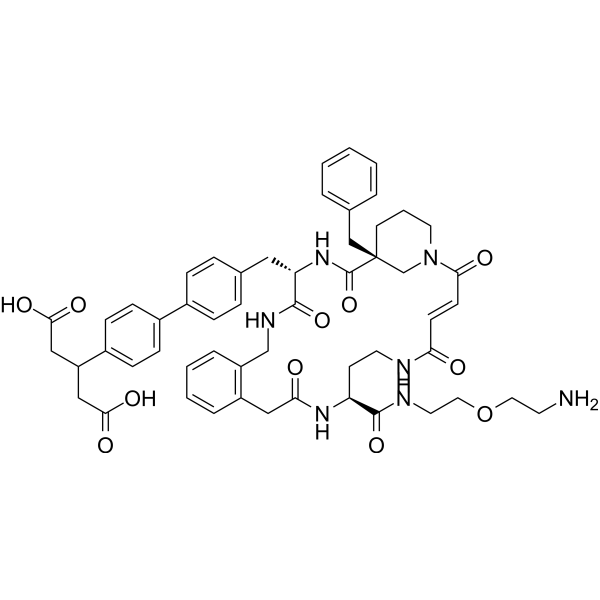 0 ImagesArt. -Nr.: HY-151488CAS. Nr.: 3023438-19-6CypD-IN-4 is a potent and subtype-selective cyclophilin D (CypD) inhibitor. CypD-IN-4 has CypD affinity with an IC50 value of 0.057 μM. CypD-IN-4 can be used for the research of several diseases including oxidative stress, neurodegenerative disorders, liver diseases, aging, autophagy and diabetes.
-
CypD-IN-3
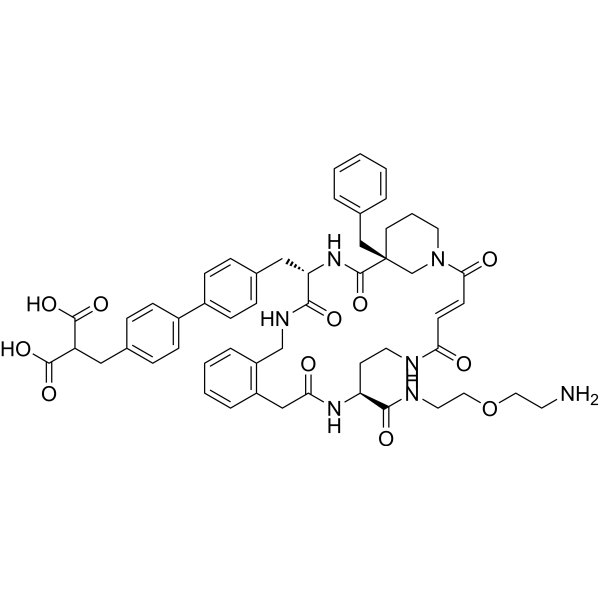 0 ImagesArt. -Nr.: HY-151487CAS. Nr.: 2651994-75-9CypD-IN-3 is a potent and subtype-selective cyclophilin D (CypD) inhibitor. CypD-IN-3 has CypD affinity with an IC50 value of 0.01 μM. CypD-IN-3 can be used for the research of several diseases including oxidative stress, neurodegenerative disorders, liver diseases, aging, autophagy and diabetes.
-
CypE-IN-1
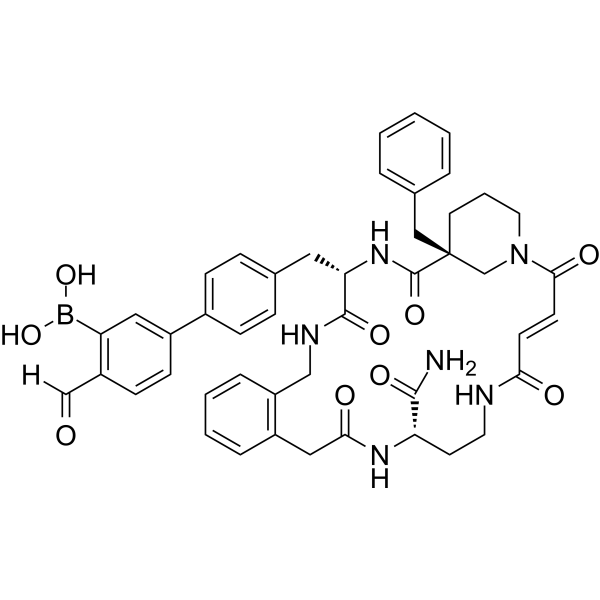 0 ImagesArt. -Nr.: HY-151489CAS. Nr.: 3023438-33-4CypE-IN-1 is a potent and subtype-selective cyclophilin E (CypE) inhibitor. CypE-IN-1 has CypE affinity with IC50 and Ki values of 0.013 μM and 0.072 μM, respectively. CypE-IN-1 can be used for the research of several diseases including oxidative stress, neurodegenerative disorders, liver diseases, aging, autophagy and diabetes.



