



Drug Intermediate
Drug Iintermediate
Drug intermediates are used as raw materials for the production of bulk drugs, or they can refer to a material produced during synthesis of an API that must undergo further molecular change or processing before it becomes an API. Drug intermediates are hygienically formulated using high grade raw materials and they are used in the pharmaceutical and cosmetic industry[1][2].
References:
- [1]. Ma HC, et al. Homochiral Covalent Organic Framework for Catalytic Asymmetric Synthesis of a Drug Intermediate. J Am Chem Soc. 2020 Jul 22;142(29):12574-12578. [Content Brief]
- [2]. Ramachary D B, et al. Development of pharmaceutical drugs, drug intermediates and ingredients by using direct organo‐click reactions[J]. 2008.
All Product Categories
-
Drug Intermediate Related Products (4608)
Related Products (4608)

-
2-Methylanisole
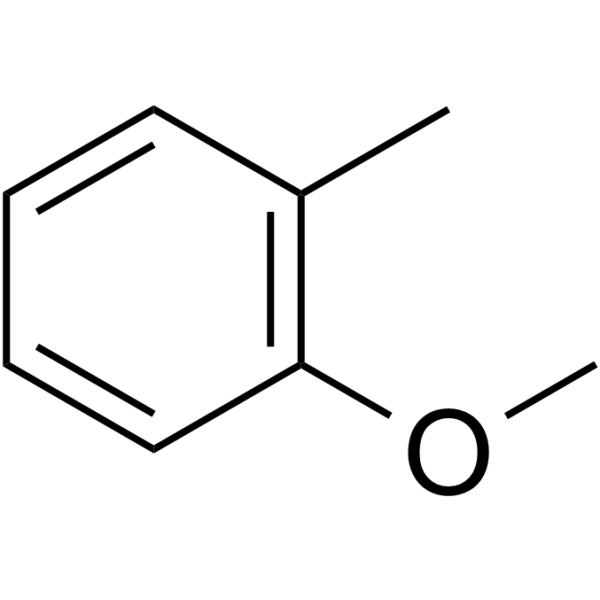 0 Images2-Methylanisole is a monomethoxybenzene and acts as an intermediate for the preparation of compounds with methylhydroquinone core .
-
1-(4-Chlorophenyl)piperazine
 0 Images1-(4-Chlorophenyl)piperazine is a chemical intermediate, and can be used for synthesis of D2R ligand.
-
(S)-Pregabalin methyl ester hydrochloride (Standard)
 0 ImagesCat. No.: HY-W101682RCAS No.: 714230-22-5
-
2-Nitroamino-2-imidazoline
 0 Images2-Nitroamino-2-imidazoline is an intermediate in the synthesis of the neonicotinoid insecticide Imidacloprid (HY-B0838).
-
Benzyl tetrahydro-1H-pyrrolo[3,4-c]isoxazole-5(3H)-carboxylate
![Benzyl tetrahydro-1H-pyrrolo[3,4-c]isoxazole-5(3H)-carboxylate](https://file.medchemexpress.com/product_pic/hy-75071.gif "Click to View Benzyl tetrahydro-1H-pyrrolo[3,4-c]isoxazole-5(3H)-carboxylate Product Detail") 0 ImagesCat. No.: HY-75071CAS No.: 1174730-77-8Benzyl tetrahydro-1H-pyrrolo[3,4-c]isoxazole-5(3H)-carboxylate is a drug intermediate for synthesis of various active compounds.
0 ImagesCat. No.: HY-75071CAS No.: 1174730-77-8Benzyl tetrahydro-1H-pyrrolo[3,4-c]isoxazole-5(3H)-carboxylate is a drug intermediate for synthesis of various active compounds.
-
Naproxen impurity 1
 0 ImagesNaproxen impurity 1 is an impurity of Naproxen.
-
2,6-Dichlorocapronic acid xylidide
 0 ImagesCat. No.: HY-W328520CAS No.: 1037184-07-82,6-Dichloro-N-(2,6-dimethylphenyl)hexanamide is a Bupivacaine (HY-B0405) impurity.
-
2-Naphthaldehyde (Standard)
 0 Images2-Naphthaldehyde (Standard) is the analytical standard of 2-Naphthaldehyde (HY-Y0075). This product is intended for research and analytical applications. 2-Naphthaldehyde is a naphthalene-based bi-aromatic aldehyde compound. 2-Naphthaldehyde scavenges DPPH and ABTS+ free radicals, and exerts reductive effects by donating hydrogen atoms to terminate free radical chain reactions. 2-Naphthaldehyde inhibits the growth and proliferation of colon cancer cells. 2-Naphthaldehyde serves as a substrate for NAD+-dependent salicylaldehyde dehydrogenase from Pseudomonas strain C6 and is catalytically oxidized to 2-naphthoic acid. 2-Naphthaldehyde acts as a precursor material for the chemical synthesis of antioxidant Schiff bases.
-
Gabapentin acid impurity 1
 0 ImagesCat. No.: HY-W013814CAS No.: 1076198-17-8Synonyms: Gabapentin impurity DGabapentin acid impurity 1 (Gabapentin impurity D) is an impurity of Gabapentin acid.
-
Clevidipine butyrate impurity 1
 0 ImagesCat. No.: HY-33013CAS No.: 123853-39-4Clevidipine butyrate impurity 1 is an impurity of Clevidipine butyrate.
-
rel-Bedaquiline
 0 ImagesCat. No.: HY-I1031CAS No.: 654653-93-7rel-Bedaquiline is a drug impurity.
-
2-Thiazolemethanamine, α-(phenylmethyl)-, (R)-
 0 Images2-Thiazolemethanamine, α-(phenylmethyl)-, (R)- is a drug intermediate for synthesis of various active compounds.

-
5,6,7,8-Tetrahydro-2-quinolone
 0 ImagesCat. No.: HY-123029CAS No.: 54802-19-6Synonyms: NSC 990065,6,7,8-Tetrahydro-2-quinolone (NSC 99006) is a synthetic intermediate useful for pharmaceutical synthesis.
-
Bazedoxifene impurity 2
 0 ImagesCat. No.: HY-Z1046CAS No.: 479075-72-4
-
Isoprenaline impurity 1 hydrochloride
 0 ImagesCat. No.: HY-Z9102CAS No.: 16899-81-3Isoprenaline impurity 1 hydrochloride is an impurity of Isoprenaline hydrochloride (HY-B0468).
-
2,3-Dihydrobenzofuran-6-ol
 0 Images2,3-Dihydrobenzofuran-6-ol is a drug impurity.

-
4-Amino benzamidoxime
 0 ImagesSynonyms: 4-Amino-N'-hydroxybenzenecarboximidamide4-Amino benzamidoxime (4-Amino-N'-hydroxybenzenecarboximidamide) is a synthetic intermediate useful for pharmaceutical synthesis.
-
Chloropretadalafil
 0 ImagesCat. No.: HY-W098292CAS No.: 171489-59-1



