



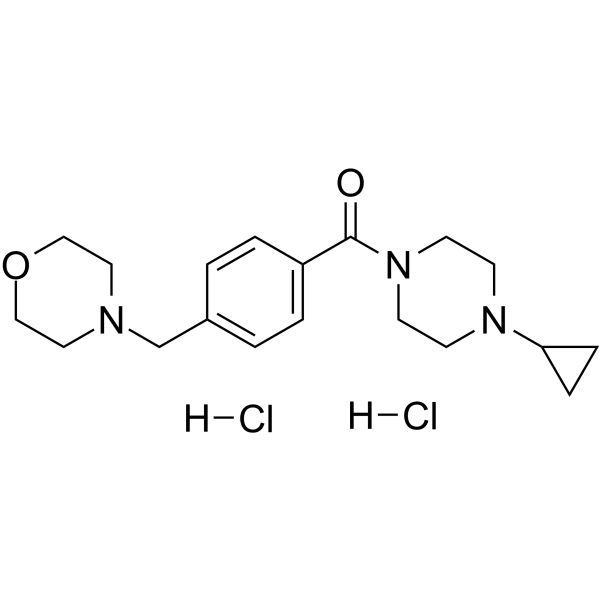
Bavisant dihydrochloride
Bavisant (JNJ-31001074) dihydrochloride is an orally active, potent, brain-penetrating and highly selective antagonist of the histamine H3 receptor. Bavisant dihydrochloride can be used for attention-deficit hyperactivity disorder (ADHD) research.
Nur für Forschungszwecke. Wir verkaufen nicht an Patienten.
- CAS. Nr.: 929622-09-3
- Formel: C19H29Cl2N3O2
- Molecular Weight:402.36
-
Speicherung:
Please store the product under the recommended conditions in the Certificate of Analysis.

To place orders, for customer services and technical support, please contact: MedChemExpress USA
Tel: 609-228-6898 E-mail: [email protected] [email protected]


-
 Biologische Aktivität
-
Chemical Information
- Reinheit & Dokumentation
- Verweise
-
 Help & FAQs


Alle Histamine Receptor Isoform-spezifische Produkte anzeigen
More

Biologische Aktivität
|
H3 receptor |
MedChemExpress (MCE) has not independently confirmed the accuracy of these methods. They are for reference only.


Chemical Information
-
CAS. Nr. 929622-09-3
-
Molecular Weight 402.36
-
Formel C19H29Cl2N3O2
-
SMILES
O=C(N1CCN(C2CC2)CC1)C(C=C3)=CC=C3CN4CCOCC4.[H]Cl.[H]Cl
-
Synonyms
JNJ-31001074 dihydrochloride
-
Versand
Room temperature in continental US; may vary elsewhere.
-
Speicherung
Please store the product under the recommended conditions in the Certificate of Analysis.


Reinheit & Dokumentation
Verweise
[1]. Hudkins RL, et al. Discovery and characterization of 6-{4-[3-(R)-2-methylpyrrolidin-1-yl)propoxy]phenyl}-2H-pyridazin-3-one (CEP-26401, irdabisant): a potent, selective histamine H3 receptor inverse agonist. J Med Chem. 2011 Jul 14;54(13):4781-92. [Content Brief]
[2]. Weisler RH, et al. Randomized clinical study of a histamine H3 receptor antagonist for the treatment of adults with attention-deficit hyperactivity disorder. CNS Drugs. 2012 May 1;26(5):421-34. [Content Brief]
[3]. Ghoshal A, et al. Identification of novel β-lactams and pyrrolidinone derivatives as selective Histamine-3 receptor (H3R) modulators as possible anti-obesity agents. Eur J Med Chem. 2018 May 25;152:148-159. [Content Brief]
[4]. Ghamari N, et al. Histamine H3 receptor antagonists/inverse agonists: Where do they go? Pharmacol Ther. 2019 Aug;200:69-84. [Content Brief]

Calculators
Konzentration (Stammlösung) × Volumen (Stammlösung) = Konzentration (Ziellösung) × Volumen (Ziellösung)


Bavisant dihydrochloride Related Classifications
HY-14880A Related Classifications
 Powered by Bioz