



MEDICA16

Based on 1 Customer Validation
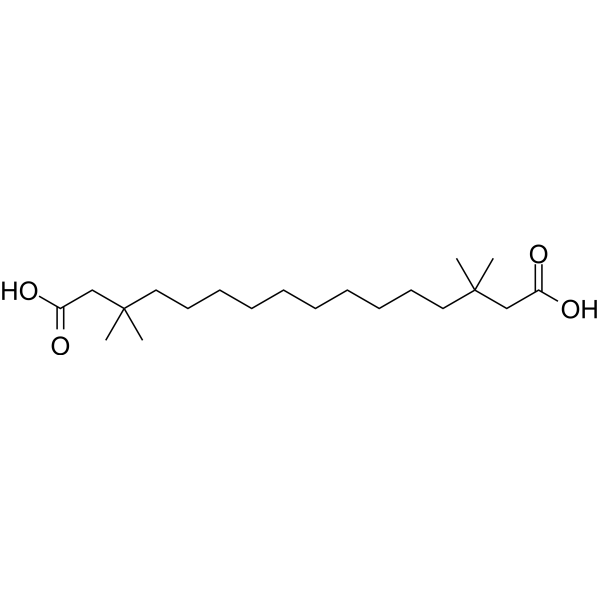
MEDICA16 is an orally active acetyl-CoA carboxylase and ATP-citrate lyase inhibitor. MEDICA16 limits the acetyl-CoA supply for acetyl-CoA carboxylase, inhibits acetyl-CoA carboxylase activity, exerts citrate-competitive inhibitory effects on ATP-citrate lyase, and reduces hepatic AMPK activity. MEDICA16 can be used in research related to insulin resistance, hyperlipidemia, and obesity.
Nur für Forschungszwecke. Wir verkaufen nicht an Patienten.
- Reinheit: 98.0%
- CAS. Nr.: 87272-20-6
- Formel: C20H38O4
- Molecular Weight:342.51
-
Speicherung:Powder -20°C, 3 years , 4°C, 2 years ; In solvent -80°C, 6 months , -20°C, 1 month

To place orders, for customer services and technical support, please contact: MedChemExpress USA
Tel: 609-228-6898 E-mail: [email protected] [email protected]


-
 Biologische Aktivität
-
Chemical Information
-
Lösungsmittel & Löslichkeit
- Reinheit & Dokumentation
- Verweise
-
 Help & FAQs
-

GPCR/G Protein Compound Library
HY-L006
-
Metabolism/Protease Compound Library
HY-L012
-
Lipid Compound Library
HY-L043
-
Orally Active Compound Library
HY-L061
-
Anti-Cancer Metabolism Compound Library
HY-L083
-
Anti-Obesity Compound Library
HY-L087
-
Lipid Metabolism Compound Library
HY-L091
-
Human Metabolite Library
HY-L123
-
Metabolic Enzyme Compound Library
HY-L146
-
Membrane Protein-targeted Compound Library
HY-L149
-
Membrane Receptor-targeted Compound Library
HY-L150
-
Anti-Drug-Resistant Compound Library
HY-L169
-
Multi-Target Compound Library
HY-L176
-
Bioactive Compound Library Max
HY-L181
-
MCE Bioactive Compound Library
HY-L001V
-
Bioactive Compound Library
HY-L001
-
Fatty Acids Compound Library
HY-L182
-
Non-Alcoholic Fatty Liver Disease (NAFLD) Compound Library
HY-L199
-
High-Throughput Bioactive Compound Library
HY-L205
-
Lactylation Compound Library
HY-L249




Biologische Aktivität
|
Cell Line

|
Type | Value | Description | References |
|---|---|---|---|---|
| Hepatocyte | IC50 |
0.08 mM
Compound: 4d
|
Inhibition of lipid synthesis, by incorporation of 3H20 into 3-beta-hydroxysterols in cultured rat hepatocytes
Inhibition of lipid synthesis, by incorporation of 3H20 into 3-beta-hydroxysterols in cultured rat hepatocytes
|
[PMID: 2788743] |
| Hepatocyte | IC50 |
0.08 mM
Compound: 4d
|
Inhibition of lipid synthesis, by incorporation of 3H20 into saponified fatty acids in cultured rat hepatocytes
Inhibition of lipid synthesis, by incorporation of 3H20 into saponified fatty acids in cultured rat hepatocytes
|
[PMID: 2788743] |
MEDICA16 (20-120 μM; 45 min preincubation, 3 min equilibration) competitively inhibits citrate activation of purified rat liver acetyl-CoA carboxylase with an apparent Ki of ~70 μM, while inducing formation of the avidin-resistant (polymeric) enzyme form[2].
MEDICA16 (up to 0.5 mM; 45 min preincubation) induces formation of the avidin-resistant (polymeric) form of rat liver cytosolic acetyl-CoA carboxylase in vitro[2].
MEDICA16 (100 μM; 10 min) activates ERK activity in doxycycline-induced T-REx GPR40 cells, with greater potency than in Flp-in GPR120 cells[3].
MEDICA16 (10-6-10-4 M) acts as a selective agonist for GPR40, inducing potent, dose-dependent [Ca2+]i mobilization in doxycycline-induced T-REx GPR40 cells and only weak mobilization in Flp-in GPR120 cells[3].
MEDICA16 (10-30 μM; 1 h) does not induce significant GLP-1 secretion from STC-1 cells, consistent with its low activity at endogenous GPR120 in these cells[3].
MedChemExpress (MCE) has not independently confirmed the accuracy of these methods. They are for reference only.
-
Cell Line:doxycycline-induced T-REx GPR40 cells, Flp-in GPR120 cells
-
Concentration:100 μM
-
Incubation Time:10 min
-
Result:Increased ERK activity in doxycycline-induced T-REx GPR40 cells, with a more potent effect than in Flp-in GPR120 cells.
MEDICA16 (0.25% (w/w); oral (diet incorporation); once daily; 5 days) produces a dose-dependent hypolipidemic effect in meal-fed rats on a fat-free, high-sucrose diet, including 50-70% reduced plasma VLDL lipids, 90% inhibited liver lipogenesis and cholesterogenesis, and 3-fold lower liver malonyl-CoA[2].
MedChemExpress (MCE) has not independently confirmed the accuracy of these methods. They are for reference only.
-
Animal Model:JCR:LA-cp (homozygous cp/cp, male, 6-12 weeks old, leptin receptor mutation-induced insulin resistance)[1]
-
Dosage:0.25% in food
-
Administration:oral; daily; 6 weeks
-
Result:Decreased hepatic acetyl-CoA carboxylase (ACC) activity to levels matching lean age-matched controls.
Decreased hepatic AMP-activated protein kinase (AMPK) activity significantly.
Reduced plasma insulin levels to 1,120.0 pmol/l, which was significantly lower than untreated JCR:LA-cp rats but higher than lean controls.
Left plasma glucose levels unchanged at 12.4 mmol/l.
Caused no significant changes in skeletal muscle ACC and AMPK activity.
Reduced intracellular triglyceride content in gastrocnemius muscle significantly.
Increased insulin sensitivity significantly.
Reduced plasma triacylglycerol concentrations by 80%.
Blunted the development of insulin resistance in the model.
-
Animal Model:meal-fed rats (140-160 g)[2]
-
Dosage:0.25% (w/w)
-
Administration:oral (diet incorporation); once daily; 5 days
-
Result:Inhibited the incorporation of ^3H2O or labelled acetate into esterified fatty acids and cholesterol by 90%.
Decreased liver acetyl-CoA levels by 50%.
Reduced liver malonyl-CoA content 3-fold (approaching fasting levels).
Increased the ratio of avidin-resistant to total acetyl-CoA carboxylase to 0.88.
Reduced plasma VLDL-triacylglycerol and VLDL-cholesterol by 50-70% in a dose-dependent, acute, reversible manner sustained during treatment.


Chemical Information
-
CAS. Nr. 87272-20-6
-
Appearance Solid
-
Molecular Weight 342.51
-
Formel C20H38O4
-
Color Light yellow to yellow
-
SMILES
O=C(O)CC(C)(C)CCCCCCCCCCC(C)(C)CC(O)=O
-
Versand
Room temperature in continental US; may vary elsewhere.
-
Speicherung
Powder -20°C 3 years 4°C 2 years In solvent -80°C 6 months -20°C 1 month


Lösungsmittel & Löslichkeit
DMSO : 100 mg/mL (291.96 mM; Need ultrasonic; Hygroscopic DMSO has a significant impact on the solubility of product, please use newly opened DMSO)
Please refer to the solubility information to select the appropriate solvent. Once prepared, please aliquot and store the solution to prevent product inactivation from repeated freeze-thaw cycles.
Storage method and period of stock solution: -80°C, 6 months; -20°C, 1 month. When stored at -80°C, please use it within 6 months. When stored at -20°C, please use it within 1 month.
Please refer to the solubility information to select the appropriate solvent. Once prepared, please aliquot and store the solution to prevent product inactivation from repeated freeze-thaw cycles.
Storage method and period of stock solution: -80°C, 6 months; -20°C, 1 month. When stored at -80°C, please use it within 6 months. When stored at -20°C, please use it within 1 month.
Konzentration (Stammlösung) × Volumen (Stammlösung) = Konzentration (Ziellösung) × Volumen (Ziellösung)
Select the appropriate dissolution method based on your experimental animal and administration route.
- For the following dissolution methods, please ensure to first prepare a clear stock solution using an In Vitro approach and then sequentially add co-solvents:
- To ensure reliable experimental results, the clarified stock solution can be appropriately stored based on storage conditions. As for the working solution for In Vivo experiments, it is recommended to prepare freshly and use it on the same day.
- The percentages shown for the solvents indicate their volumetric ratio in the final prepared solution. If precipitation or phase separation occurs during preparation, heat and/or sonication can be used to aid dissolution.
Please enter the basic information of animal experiments:
-
-
-
-
Recommended: Prepare an additional quantity of animals to account for potential losses during experiments.
Please enter your animal formula composition:
-
%DMSO +
Recommended: Keep the proportion of DMSO in working solution below 2% if your animal is weak.
-
%+
-
+%Tween-80 + +
-
%Saline +
The co-solvents required include: DMSO, . All of co-solvents are available by MedChemExpress (MCE). , Tween 80. All of co-solvents are available by MedChemExpress (MCE).
Working solution concentration: 0.22 mg/mL
Method for preparing stock solution: mg drug dissolved in μL DMSO. Stock solution concentration: mg/mL.
1. Take μL DMSO stock solution;
2. Add μL .
μL , mix evenly;
3. Then add μL Tween 80, mix evenly;
4. Then add μL
Please ensure that the stock solution in the first step is dissolved to a clear state, and add co-solvents in sequence. You can use ultrasonic heating (ultrasonic cleaner, recommended frequency 20-40 kHz), vortexing, etc. to assist dissolution.


Reinheit & Dokumentation
-
Data Sheet (273 KB)
-
SDS (251 KB)
- English - EN (251 KB)
- Français - FR (251 KB)
- Deutsch - DE (251 KB)
- Norwegian - NO (251 KB)
- Español - ES (251 KB)
- Swedish - SV (251 KB)
- Italian - IT (251 KB)
- Korean - KR (251 KB)
- Portuguese - PT (251 KB)
-
Handling Instructions (2659 KB)
Verweise
[1].
Laura L Atkinson, et al. MEDICA 16 inhibits hepatic acetyl-CoA carboxylase and reduces plasma triacylglycerol levels in insulin-resistant JCR: LA-cp rats. Diabetes. 2002 May;51(5):1548-55.
[Content Brief]
[2]. Rose-Kahn G, et al. Inhibition of rat liver acetyl-CoA carboxylase by beta, beta'-tetramethyl-substituted hexadecanedioic acid (MEDICA 16). Biochim Biophys Acta. 1990;1042(2):259-264. [Content Brief]
[3]. Atkinson LL, et al. MEDICA 16 inhibits hepatic acetyl-CoA carboxylase and reduces plasma triacylglycerol levels in insulin-resistant JCR: LA-cp rats. Diabetes. 2002 May;51(5):1548-55. [Content Brief]


Complete Stock Solution Preparation Table
Please refer to the solubility information to select the appropriate solvent. Once prepared, please aliquot and store the solution to prevent product inactivation from repeated freeze-thaw cycles.
Storage method and period of stock solution: -80°C, 6 months; -20°C, 1 month. When stored at -80°C, please use it within 6 months. When stored at -20°C, please use it within 1 month.
| Optional Solvent | Concentration Solvent Mass | 1 mg | 5 mg | 10 mg | 25 mg |
|---|---|---|---|---|---|
| DMSO | 1 mM | 2.9196 mL | 14.5981 mL | 29.1962 mL | 72.9906 mL |
| 5 mM | 0.5839 mL | 2.9196 mL | 5.8392 mL | 14.5981 mL | |
| 10 mM | 0.2920 mL | 1.4598 mL | 2.9196 mL | 7.2991 mL | |
| 15 mM | 0.1946 mL | 0.9732 mL | 1.9464 mL | 4.8660 mL | |
| 20 mM | 0.1460 mL | 0.7299 mL | 1.4598 mL | 3.6495 mL | |
| 25 mM | 0.1168 mL | 0.5839 mL | 1.1678 mL | 2.9196 mL | |
| 30 mM | 0.0973 mL | 0.4866 mL | 0.9732 mL | 2.4330 mL | |
| 40 mM | 0.0730 mL | 0.3650 mL | 0.7299 mL | 1.8248 mL | |
| 50 mM | 0.0584 mL | 0.2920 mL | 0.5839 mL | 1.4598 mL | |
| 60 mM | 0.0487 mL | 0.2433 mL | 0.4866 mL | 1.2165 mL | |
| 80 mM | 0.0365 mL | 0.1825 mL | 0.3650 mL | 0.9124 mL | |
| 100 mM | 0.0292 mL | 0.1460 mL | 0.2920 mL | 0.7299 mL |


MEDICA16 Related Classifications
HY-P1123 Related Classifications
 Powered by Bioz
- MEDICA16
- 87272-20-6
- MEDICA 16
- MEDICA-16
- ATP Citrate Lyase
- Free Fatty Acid Receptor
- Acetyl-CoA Carboxylase
- AMPK
- ATP-citrate lyase
- rodent models
- triacylglycerol
- GPR40-expressing cells
- mouse enteroendocrine STC-1 cells
- VLDL cholesterol
- JCR:LA-cp rats
- acetyl-CoA carboxylase
- rat liver acetyl-CoA carboxylase
- Inhibitor
- inhibitor
- inhibit