



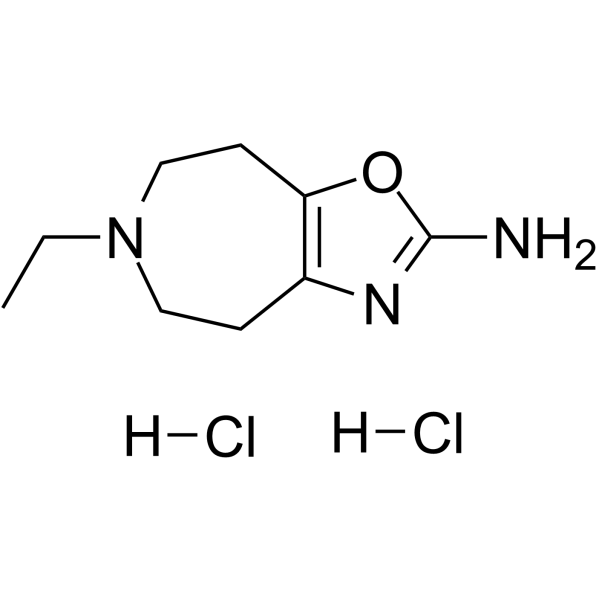
Azepexole dihydrochloride
Azepexole (B-HT 933) dihydrochloride is a potent and selective alpha 2-adrenoceptor agonist with pKis of 8.3, 7.6, and 7.5 for α2A-, α2B- and α2C-adrenoceptor subtypes, resepctively. Azepexole dihydrochloride causes concentration-dependent inhibition of peristaltic contractions (IC50= 78.72 nM).
For research use only. We do not sell to patients.
- CAS No.: 36067-72-8
- Formula: C9H17Cl2N3O
- Molecular Weight:254.16
-
Storage:
Please store the product under the recommended conditions in the Certificate of Analysis.

To place orders, for customer services and technical support, please contact: MedChemExpress USA
Tel: 609-228-6898 E-mail: [email protected] [email protected]


-
 Biological Activity
-
Chemical Information
- Protocols
- Purity & Documentation
- References
-
 Help & FAQs


All Adrenergic Receptor Isoforms
More

Biological Activity
Description
IC50 & Target
|
α adrenergic receptor |
In Vitro
In normoglycemic rats, the sympathetically-induced vasopressor responses are dose-dependently inhibited by 1 and 3 μg/kg.min (i.v.) Azepexole dihydrochloride, with 10 and 30 μg/kg.min Azepexole dihydrochloride producing no further inhibition. In diabetic rats, the electrically-induced vasopressor responses are: (i) unchanged by 1 and 3 μg/kg.min Azepexole dihydrochloride; (ii) significantly inhibited at all frequencies of stimulation by 10 μg/kg.min B-HT 933 dihydrochloride; and (iii) similarly inhibited (i.e. supramaximal inhibition) by 30 μg/kg.min Azepexole dihydrochloride[1].
MedChemExpress (MCE) has not independently confirmed the accuracy of these methods. They are for reference only. Further protocols information, click here.


Chemical Information
-
CAS No. 36067-72-8
-
Molecular Weight 254.16
-
Formula C9H17Cl2N3O
-
SMILES
NC(O1)=NC2=C1CCN(CC)CC2.[H]Cl.[H]Cl
-
Synonyms
B-HT 933 dihydrochloride; Oxazoloazepin dihydrochloride
-
Shipping
Room temperature in continental US; may vary elsewhere.
-
Storage
Please store the product under the recommended conditions in the Certificate of Analysis.

Protocols
-
Cell Cytotoxicity Assay
Cytotoxicity assays are usually based on the assessment of cell membrane damage, which can also be indirectly detected by measuring cell viability. Detection methods include MTT assay, CKK-8 assay, LDH assay and ATP assay, etc.


Purity & Documentation
References

Calculators
Concentration (start) × Volume (start) = Concentration (final) × Volume (final)


Azepexole dihydrochloride Related Classifications
HY-103212 Related Classifications
 Powered by Bioz