



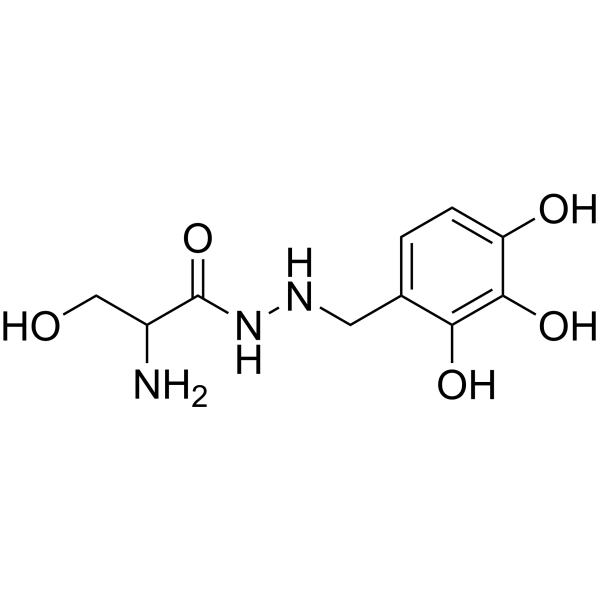
Benserazide
Based on 8 publication(s) in Google Scholar
Benserazide is an aromatic L-amino acid decarboxylase (AADC) and L-DOPA decarboxylase inhibitor. Benserazide is also a PKM2 inhibitor. Benserazide directly binds to and blocks PKM2 enzyme activity, leading to inhibition of aerobic glycolysis concurrent up-regulation of OXPHOS. Benserazide can be used for the study of Parkinson's disease and melanoma.
For research use only. We do not sell to patients.
- Purity : 98.43%
- CAS No.: 322-35-0
- Formula: C10H15N3O5
- Molecular Weight:257.24
-
Storage:Powder -20°C, 3 years , 4°C, 2 years ; In solvent -80°C, 6 months , -20°C, 1 month

To place orders, for customer services and technical support, please contact: MedChemExpress USA
Tel: 609-228-6898 E-mail: [email protected] [email protected]


-
 Biological Activity
-
Chemical Information
-
Solvent & Solubility
- Protocols
- Purity & Documentation
- References
-
 Help & FAQs


Publications Citing Use of MedChemExpress (MCE) Benserazide
More- Nat Commun. 2026 Oct 1.
- CNS Neurosci Ther. 2023 Oct;29(10):2925-2939. [Abstract]
- Gene Ther. 2024 Nov;31(11-12):614-624. [Abstract]
- Nutrients. 2022 Nov 4;14(21):4678. [Abstract]
- Microbiol Spectr. 2025 Nov 12;13(12):e0337924. [Abstract]
- SLAS Discov. 2020 Sep;25(8):895-905. [Abstract]
- J Stroke Cerebrovasc Dis. 2025 Jan;34(1):108101. [Abstract]
- Biochem Genet. 2025 Feb 11. [Abstract]


Biological Activity
Description
In Vitro
Benserazide and Levodopa (LD) individually and in combination (Benserazide + LD) (25 μM; 0 hour, 12 hours, 24 hours and 168 hours; SH-SY5Y) treatment inhibit protein aggregation and have the ability to minimise the amyloid-induced cytotoxicity in human neuroblastoma cell line. Benserazide and LD both can act as efficient inhibitors of the formation of cytotoxic HSA aggregates, and the inhibitory effects are more pronounced when both of these drugs are added simultaneously[2].
MedChemExpress (MCE) has not independently confirmed the accuracy of these methods. They are for reference only.
-
Cell Line:SH-SY5Y cells
-
Concentration:25 μM
-
Incubation Time:0 hour, 12 hours, 24 hours and 168 hours
-
Result:Enhanced cell viability, and inhibited the formation of cytotoxic human serum albumin (HSA) aggregates.
In Vivo
MedChemExpress (MCE) has not independently confirmed the accuracy of these methods. They are for reference only.
-
Animal Model:Male Wistar rats with 6-hydroxydopamine (6-OHDA) (8 Ag/4 Al)[1]
-
Dosage:5 mg/kg, 10 mg/kg or 50 mg/kg (Pharmacokinetic study)
-
Administration:Intraperitoneal injection
-
Result:Increased in exogenous L-DOPA-derived extracellular DA levels, the time to reach the peak DA levels were significantly prolonged in a dose-dependent fashion. The AADC activity in the denervated striatal tissues showed a significant decreased by 10 mg/kg and 50 mg/kg.
Clinical Trial
| NCT Number | Sponsor | Condition | Start Date |
Phase

|
|---|---|---|---|---|
| NCT01329991 | 2011-05 | PHASE1 |


Chemical Information
-
CAS No. 322-35-0
-
Appearance Solid
-
Molecular Weight 257.24
-
Formula C10H15N3O5
-
Color Light yellow to orange
-
SMILES
NC(C(NNCC1=CC=C(C(O)=C1O)O)=O)CO
-
Synonyms
Ro 4-4602
-
Shipping
Room temperature in continental US; may vary elsewhere.
-
Storage
Powder -20°C 3 years 4°C 2 years In solvent -80°C 6 months -20°C 1 month


Publications (8)
-
Journal Impact Factor
-
Most Recent
-
-
CNS Neurosci Ther
Amphiregulin blockade decreases the levodopa-induced dyskinesia in a 6-hydroxydopamine Parkinson's disease mouse model. [Abstract]2023 Oct;29(10):2925-2939. PMID: 37101388 -
Gene Ther
Targeting serum response factor (SRF) deactivates ΔFosB and mitigates Levodopa-induced dyskinesia in a mouse model of Parkinson's disease. [Abstract]2024 Nov;31(11-12):614-624. PMID: 39384937 -
Nutrients
Neuroprotective Effects of Bifidobacterium breve CCFM1067 in MPTP-Induced Mouse Models of Parkinson's Disease. [Abstract]2022 Nov 4;14(21):4678. PMID: 36364939 -
Microbiol Spectr
Neuroprotective effects of hypoactive Akkermansia muciniphila in MPTP-induced mouse models of Parkinson's disease. [Abstract]2025 Nov 12;13(12):e0337924. PMID: 41223008 -
SLAS Discov
2020 Sep;25(8):895-905. PMID: 32567455 -
J Stroke Cerebrovasc Dis
Dopamine receptor agonist pramipexole exerts neuroprotection on global cerebral ischemia/reperfusion injury by inhibiting ferroptosis. [Abstract]2025 Jan;34(1):108101. PMID: 39490461 -
Biochem Genet
Amino Acid Metabolism-Related Gene Kynureninase (KYNU) as a Prognostic Predictor and Regulator of Diffuse Large B-Cell Lymphoma. [Abstract]2025 Feb 11. PMID: 39932613


Solvent & Solubility
In Vitro:
DMSO : 50 mg/mL (194.37 mM; Need ultrasonic; Hygroscopic DMSO has a significant impact on the solubility of product, please use newly opened DMSO)
Please refer to the solubility information to select the appropriate solvent. Once prepared, please aliquot and store the solution to prevent product inactivation from repeated freeze-thaw cycles.
Storage method and period of stock solution: -80°C, 6 months; -20°C, 1 month. When stored at -80°C, please use it within 6 months. When stored at -20°C, please use it within 1 month.
Please refer to the solubility information to select the appropriate solvent. Once prepared, please aliquot and store the solution to prevent product inactivation from repeated freeze-thaw cycles.
Storage method and period of stock solution: -80°C, 6 months; -20°C, 1 month. When stored at -80°C, please use it within 6 months. When stored at -20°C, please use it within 1 month.
Concentration (start) × Volume (start) = Concentration (final) × Volume (final)


Purity & Documentation
-
Data Sheet (274 KB)
-
SDS (393 KB)
- English - EN (393 KB)
- Français - FR (393 KB)
- Deutsch - DE (393 KB)
- Norwegian - NO (393 KB)
- Español - ES (393 KB)
- Swedish - SV (393 KB)
- Italian - IT (393 KB)
- Korean - KR (393 KB)
- Portuguese - PT (393 KB)
-
Handling Instructions (2659 KB)
References
[1]. Zhou Y, et al. Benserazide is a novel inhibitor targeting PKM2 for melanoma treatment. Int J Cancer. 2020 Jul 1;147(1):139-151. [Content Brief]
[2]. Shen H, et al. Effects of benserazide on L-DOPA-derived extracellular dopamine levels and aromatic L-amino acid decarboxylase activity in the striatum of 6-hydroxydopamine-lesioned rats. Tohoku J Exp Med. 2003 Mar;199(3):149-59. [Content Brief]
[3]. Chandel TI, et al. A multiparametric analysis of the synergistic impact of anti-Parkinson's drugs on the fibrillation of human serum albumin. Biochim Biophys Acta Proteins Proteom. 2019 Mar;1867(3):275-285. [Content Brief]


Complete Stock Solution Preparation Table
Please refer to the solubility information to select the appropriate solvent. Once prepared, please aliquot and store the solution to prevent product inactivation from repeated freeze-thaw cycles.
Storage method and period of stock solution: -80°C, 6 months; -20°C, 1 month. When stored at -80°C, please use it within 6 months. When stored at -20°C, please use it within 1 month.
| Optional Solvent | Concentration Solvent Mass | 1 mg | 5 mg | 10 mg | 25 mg |
|---|---|---|---|---|---|
| DMSO | 1 mM | 3.8874 mL | 19.4371 mL | 38.8742 mL | 97.1855 mL |
| 5 mM | 0.7775 mL | 3.8874 mL | 7.7748 mL | 19.4371 mL | |
| 10 mM | 0.3887 mL | 1.9437 mL | 3.8874 mL | 9.7186 mL | |
| 15 mM | 0.2592 mL | 1.2958 mL | 2.5916 mL | 6.4790 mL | |
| 20 mM | 0.1944 mL | 0.9719 mL | 1.9437 mL | 4.8593 mL | |
| 25 mM | 0.1555 mL | 0.7775 mL | 1.5550 mL | 3.8874 mL | |
| 30 mM | 0.1296 mL | 0.6479 mL | 1.2958 mL | 3.2395 mL | |
| 40 mM | 0.0972 mL | 0.4859 mL | 0.9719 mL | 2.4296 mL | |
| 50 mM | 0.0777 mL | 0.3887 mL | 0.7775 mL | 1.9437 mL | |
| 60 mM | 0.0648 mL | 0.3240 mL | 0.6479 mL | 1.6198 mL | |
| 80 mM | 0.0486 mL | 0.2430 mL | 0.4859 mL | 1.2148 mL | |
| 100 mM | 0.0389 mL | 0.1944 mL | 0.3887 mL | 0.9719 mL |


Benserazide Related Classifications
HY-121275 Related Classifications
 Powered by Bioz