



Bepotastine tosylate
Based on 1 publication(s) in Google Scholar
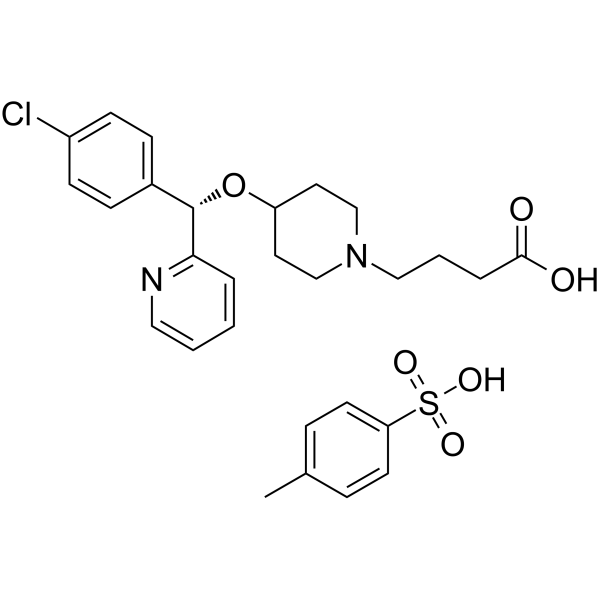
Bepotastine tosylate is a selective and orally active second-generation histamine H1 receptor antagonist. Bepotastine tosylate can suppress the expression of nerve growth factor (NGF). Bepotastine tosylate can be used in studies of allergic rhinitis, allergic conjunctivitis and urticaria/pruritus.
For research use only. We do not sell to patients.
- CAS No.: 1160415-45-1
- Formula: C28H33ClN2O6S
- Molecular Weight:561.09
-
Storage:
Please store the product under the recommended conditions in the Certificate of Analysis.

To place orders, for customer services and technical support, please contact: MedChemExpress USA
Tel: 609-228-6898 E-mail: [email protected] [email protected]


-
 Biological Activity
-
Chemical Information
- Protocols
- Purity & Documentation
- References
-
 Help & FAQs


Publications Citing Use of MedChemExpress (MCE) Bepotastine tosylate
MoreAll Histamine Receptor Isoforms
More

Biological Activity
Description
IC50 & Target
In Vitro
Bepotastine tosylate (10, 100, 1000 µM; preincubates for 120 min) decreases the release of histamine induced by A23187 treatment, which reaches a statistically significant reduces level at 1000 µM[1].
Bepotastine tosylate (50 µM; 1 h) suppresses the expression of NGF mRNA in NHEKs[2].
MedChemExpress (MCE) has not independently confirmed the accuracy of these methods. They are for reference only. Further protocols information, click here.
-
Cell Line:RPMCs
-
Concentration:10, 100, 1000 µM
-
Incubation Time:120 min (preincubate)
-
Result:Decreased the release of histamine.
-
Cell Line:NHEKs
-
Concentration:50 µM (preincubation)
-
Incubation Time:1 h
-
Result:Suppressed the expression of NGF mRNA in NHEKs.
In Vivo
Bepotastine tosylate (3 mg/kg; p.o.; once) suppresses scratching behavior to a frequency of 59.0 and a duration of 14.57 seconds, which are almost the same levels compares with the control[3].
Bepotastine tosylate (10 mg/kg; p.o.; once) significantly suppresses serum LTB 4 levels to 711.3 pg/mL at 1 h and 858.8 pg/mL at 2 h in NC/Nga mice with a rash[3].
MedChemExpress (MCE) has not independently confirmed the accuracy of these methods. They are for reference only.
-
Animal Model:Guinea pigs (6-week-old)[1].
-
Dosage:10 g/L (1.0% (w/v)) for 10 µL.
-
Administration:Eye drop; 3 times at intervals of 20 min (in one eye)
-
Result:Inhibited PAF-induced conjunctival eosinophil infiltration.
-
Animal Model:Male BALB/c mice(12-week-old); NC/Nga mice[3].
-
Dosage:3, 10 mg/kg
-
Administration:Oral administration; once (1 h before induces scratching behavior of Male BALB/c mice).
-
Result:Significantly inhibited histamine-mediated scratching behavior in male BALB/c mice.
Significantly suppressed serum LTB 4 levels in NC/Nga mice with a rash.


Chemical Information
-
CAS No. 1160415-45-1
-
Molecular Weight 561.09
-
Formula C28H33ClN2O6S
-
SMILES
O=S(C1=CC=C(C)C=C1)(O)=O.O=C(O)CCCN2CCC(CC2)O[C@H](C3=NC=CC=C3)C(C=C4)=CC=C4Cl
-
Shipping
Room temperature in continental US; may vary elsewhere.
-
Storage
Please store the product under the recommended conditions in the Certificate of Analysis.


Publications (1)
-
Journal Impact Factor
-
Most Recent
-
J Med Chem
Development of an In Silico Prediction Model for P-glycoprotein Efflux Potential in Brain Capillary Endothelial Cells toward the Prediction of Brain Penetration. [Abstract]2021 Mar 11;64(5):2725-2738. PMID: 33619967

Protocols
-
PC12 NGF-Induced Neuronal Differentiation Culture
PC12 cells are a rat adrenal pheochromocytoma clonal line that responds to NGF by stopping proliferation and extending branching neurite-like processes; after longer NGF exposure, cells develop long processes and neuronal-like ultrastructural and functional features. NGF-induced differentiation is read out mainly by neurite outgrowth, reduced proliferation, microtubule assembly, and neuronal differentiation-associated proteins such as MAPs, tau, GAP-43, and synapsin-1.
-
RNA extraction experimental
By lysing cells, releasing RNA, and removing impurities such as proteins and DNA, high-purity RNA products are finally obtained. The commonly used traditional method is the guanidine isothiocyanate/phenol/chloroform method (Trizol), which is suitable for a variety of animal materials including animal tissues, microorganisms, cultured cells, etc., and most plant materials.
-
PC12 NGF-induced neuronal-like differentiation
PC12 cells are a rat adrenal pheochromocytoma-derived clonal cell line that responds to nerve growth factor by stopping proliferation and extending neurites, producing a sympathetic neuron-like phenotype used to study neuronal differentiation and neurite outgrowth. NGF acts through TrkA-dependent signaling, and neurite outgrowth is associated with ERK/Akt signaling, microtubule organization, neuronal-marker expression, and increased electrophysiological neuronal features such as sodium-channel density. The main assay readout is morphological differentiation, usually measured as the percentage of neurite-bearing cells, neurite length, neurite number, or total neurite length per cell. Additional readouts include GAP-43, tyrosine hydroxylase, βIII-tubulin, neurofilament, synapsin I, synaptophysin, ERK phosphorylation, Akt phosphorylation, and sodium-channel current density.


Purity & Documentation
References
[1]. Kida T, et al. Bepotastine besilate, a highly selective histamine H(1) receptor antagonist, suppresses vascular hyperpermeability and eosinophil recruitment in in vitro and in vivo experimental allergic conjunctivitis models. Exp Eye Res. 2010 Jul;91(1):8 [Content Brief]
[2]. Kamata Y, et al. Bepotastine besilate downregulates the expression of nerve elongation factors in normal human epidermal keratinocytes. J Dermatol Sci. 2018 Apr 23:S0923-1811(18)30186-5. [Content Brief]
[3]. Tanizaki H, et al. Oral administration of bepotastine besilate suppressed scratching behavior of atopic dermatitis model NC/Nga mice. Int Arch Allergy Immunol. 2008;145(4):277-82. [Content Brief]
[4]. Jon I Williams, et al. Non-clinical pharmacology, pharmacokinetics, and safety findings for the antihistamine bepotastine besilate. Curr Med Res Opin. 2010 Oct;26(10):2329-38. [Content Brief]

Calculators
Concentration (start) × Volume (start) = Concentration (final) × Volume (final)


Bepotastine tosylate Related Classifications
HY-I0021A Related Classifications
 Powered by Bioz