



Bisphenol A-d4

Based on 1 Customer Validation
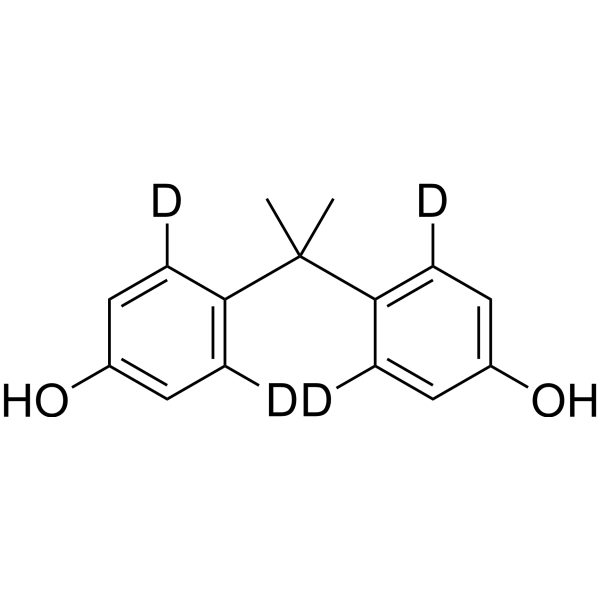
Bisphenol A-d4 is the deuterium labeled Bisphenol A. Bisphenol A is a phenolic, organic synthetic compound widely used in the production of polycarbonate plastics and epoxy resins. Bisphenol A is a reproductive, developmental, and systemic toxicant, often classified as an endocrine-disrupting compound (EDC). Bisphenol A is associated with many diseases, including cardiovascular diseases, respiratory diseases, diabetes, kidney diseases, obesity, and reproductivedisorders.
Nos produits utilisent uniquement pour la recherche. Nous ne vendons pas aux patients.
- CAS No.: 102438-62-0
- Formule: C15H12D4O2
- Masse moléculaire:232.31
-
Stockage:Powder -20°C, 3 years , 4°C, 2 years ; In solvent -80°C, 6 months , -20°C, 1 month

To place orders, for customer services and technical support, please contact: MedChemExpress USA
Tel: 609-228-6898 E-mail: [email protected] [email protected]


-
 Activité biologique
-
Chemical Information
- Protocole
- Pureté et documentation
- Références
-
 Help & FAQs


Voir tous les produits spécifiques à Isoform Endogenous Metabolite
More

Activité biologique
Description
Cellular Effect
|
Cell Line

|
Type | Value | Description | References |
|---|---|---|---|---|
| B16 | IC50 |
0.0086 M
Compound: BAP
|
Compound was tested for the in vitro growth inhibition of B-16 melanoma cells after incubation for 3 days (cytotoxicity), the dose that failed to inhibit cell growth by more than 50% was determined
Compound was tested for the in vitro growth inhibition of B-16 melanoma cells after incubation for 3 days (cytotoxicity), the dose that failed to inhibit cell growth by more than 50% was determined
|
[PMID: 9288164] |
| HEK293 | EC50 |
>10000 nM
Compound: 3; BPA
|
Agonist activity at FLAG-tagged ERalpha (unknown origin) expressed in HEK293 cells assessed as induction of ER-alpha-mediated transcriptional activity by luciferase reporter gene assay
Agonist activity at FLAG-tagged ERalpha (unknown origin) expressed in HEK293 cells assessed as induction of ER-alpha-mediated transcriptional activity by luciferase reporter gene assay
|
[PMID: 30940565] |
| HEK293 | EC50 |
1689 nM
Compound: 3; BPA
|
Selective estrogen receptor down-regulator activity at FLAG-tagged ERalpha (unknown origin) expressed in HEK293 cells assessed as induction of ERalpha degradation by luciferase reporter gene assay
Selective estrogen receptor down-regulator activity at FLAG-tagged ERalpha (unknown origin) expressed in HEK293 cells assessed as induction of ERalpha degradation by luciferase reporter gene assay
|
[PMID: 30940565] |
| HEK293 | IC50 |
>10000 nM
Compound: 3; BPA
|
Antagonist activity at FLAG-tagged ERalpha (unknown origin) expressed in HEK293 cells assessed as reduction in E2-induced ER-alpha-mediated transcriptional activity by luciferase reporter gene assay
Antagonist activity at FLAG-tagged ERalpha (unknown origin) expressed in HEK293 cells assessed as reduction in E2-induced ER-alpha-mediated transcriptional activity by luciferase reporter gene assay
|
[PMID: 30940565] |
| HeLa | EC50 |
757 nM
Compound: BPA
|
Agonist activity at ERbeta (unknown origin) expressed in human HeLa cells assessed as transcriptional activation measured after 24 hrs by luciferase reporter gene assay
Agonist activity at ERbeta (unknown origin) expressed in human HeLa cells assessed as transcriptional activation measured after 24 hrs by luciferase reporter gene assay
|
[PMID: 31879182] |
| HeLa | EC50 |
797 nM
Compound: BPA
|
Agonist activity at ERalpha (unknown origin) expressed in human HeLa cells assessed as transcriptional activation measured after 24 hrs by luciferase reporter gene assay
Agonist activity at ERalpha (unknown origin) expressed in human HeLa cells assessed as transcriptional activation measured after 24 hrs by luciferase reporter gene assay
|
[PMID: 31879182] |
| HT-22 | IC50 |
97 μM
Compound: 33
|
Cytotoxicity against mouse HT-22 cells assessed as reduction in cell viability incubated for 48 hrs by MTS assay
Cytotoxicity against mouse HT-22 cells assessed as reduction in cell viability incubated for 48 hrs by MTS assay
|
[PMID: 36876904] |
| MCF7 | EC50 |
0.29 μM
Compound: 4; BPA
|
Agonist activity at estrogen receptor in human MCF7 cells assessed as ERE-mediated transcriptional activity after 24 hrs by luciferase assay
Agonist activity at estrogen receptor in human MCF7 cells assessed as ERE-mediated transcriptional activity after 24 hrs by luciferase assay
|
[PMID: 26905830] |
In Vitro
Stable heavy isotopes of hydrogen, carbon, and other elements have been incorporated into drug molecules, largely as tracers for quantitation during the drug development process. Deuteration has gained attention because of its potential to affect the pharmacokinetic and metabolic profiles of drugs[1].
MedChemExpress (MCE) has not independently confirmed the accuracy of these methods. They are for reference only. Further protocols information, click here.
Application
1. This compound can be used as a tracer
2. This compound can be used as an internal standard for quantitative analysis by NMR, GC-MS, or LC-MS.


Chemical Information
-
CAS No. 102438-62-0
-
Unlabeled CAS 80-05-7
-
Appearance Solid
-
Masse moléculaire 232.31
-
Formule C15H12D4O2
-
Color White to off-white
-
SMILES
CC(C1=C([2H])C=C(C=C1[2H])O)(C2=C([2H])C=C(C=C2[2H])O)C
-
Livraison
Room temperature in continental US; may vary elsewhere.
-
Stockage
Powder -20°C 3 years 4°C 2 years In solvent -80°C 6 months -20°C 1 month

Protocole
-
Research Protocol for Metabolic Diseases
AMP-activated protein kinase, AMPK, is a conserved cellular energy sensor that responds to reduced cellular energy status and coordinates metabolism by increasing ATP-generating catabolic pathways while suppressing ATP-consuming anabolic processes. In metabolic disease research, the AMPK pathway is experimentally relevant because it regulates hepatic lipid synthesis, fatty acid oxidation, glucose production, skeletal-muscle glucose disposal, mTORC1-linked biosynthesis, autophagy, mitochondrial homeostasis, and whole-body energy balance. The central pathway logic is that energy stress, metformin, exercise-like stimulation, or direct AMPK activators increase AMPKα Thr172 phosphorylation and downstream substrate phosphorylation, including ACC and RAPTOR. Phosphorylation of ACC suppresses lipogenesis and supports fatty acid oxidation, whereas phosphorylation of RAPTOR suppresses mTORC1 signaling and links cellular energy status to growth and protein synthesis control. The pathway is linked


Pureté et documentation
Références
[1]. Russak EM, et al. Impact of Deuterium Substitution on the Pharmacokinetics of Pharmaceuticals. Ann Pharmacother. 2019 Feb;53(2):211-216. [Content Brief]
[2]. Huang M, et al. Bisphenol A and its analogues bisphenol S, bisphenol F and bisphenol AF induce oxidative stress and biomacromolecular damage in human granulosa KGN cells. Chemosphere. 2020 Apr 9;253:126707. [Content Brief]
[3]. Rubin BS, et al. Bisphenol A: an endocrine disruptor with widespread exposure and multiple effects. J Steroid Biochem Mol Biol. 2011 Oct;127(1-2):27-34. [Content Brief]

Calculators
Concentration (start) × Volume (start) = Concentration (final) × Volume (final)


Bisphenol A-d4 Related Classifications
HY-18260S4 Related Classifications
 Powered by Bioz