



3'-Hydroxypterostilbene
Based on 1 publication(s) in Google Scholar
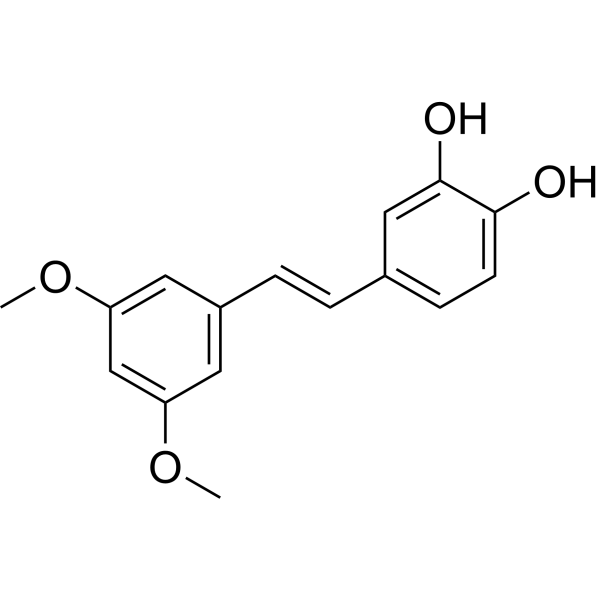
3'-Hydroxypterostilbene is a Pterostilbene (HY-N0828) analogue. 3'-Hydroxypterostilbene inhibits the growth of COLO 205, HCT-116 and HT-29 cells with IC50s of 9.0, 40.2 and 70.9 μM, respectively. 3'-Hydroxypterostilbene significantly down-regulates PI3K/Akt and MAPKs signaling pathways and effectively inhibits the growth of human colon cancer cells by inducing apoptosis and autophagy. 3'-Hydroxypterostilbene can be used for the research of cancer.
Nos produits utilisent uniquement pour la recherche. Nous ne vendons pas aux patients.
- Pureté: 99.89%
- CAS No.: 475231-21-1
- Formule: C16H16O4
- Masse moléculaire:272.30
-
Stockage:
4°C, protect from light
* In solvent : -80°C, 2 years; -20°C, 1 year (protect from light)

To place orders, for customer services and technical support, please contact: MedChemExpress USA
Tel: 609-228-6898 E-mail: [email protected] [email protected]


-
 Activité biologique
-
Chemical Information
-
Solvant et solubilité
- Pureté et documentation
- Références
-
 Help & FAQs
-

Apoptosis Compound Library
HY-L003
-
Natural Product Library
HY-L021
-
Anti-Cancer Compound Library
HY-L025
-
Autophagy Compound Library
HY-L029
-
Phenols Library
HY-L057
-
Anti-Colorectal Cancer Compound Library
HY-L103
-
Anti-Cancer Natural Product Library
HY-L107
-
Plant-Sourced Natural Product Library
HY-L115
-
Cell Death Library
HY-L162
-
Bioactive Compound Library Max
HY-L181
-
Natural Product Library Plus
HY-L021P
-
Natural Product and Natural Product-Like Compound Library
HY-L021M
-
Bioactive Compound Library
HY-L001
-
Non-Alcoholic Fatty Liver Disease (NAFLD) Compound Library
HY-L199
-
RO5 Drug-like Natural Product Library
HY-L200
-
High-Throughput Bioactive Compound Library
HY-L205
-
High-Throughput Natural Product Library
HY-L206
-
Mass Spectrometry Natural Product Library
HY-L262


Publications Citing Use of MedChemExpress (MCE) 3'-Hydroxypterostilbene
More

Activité biologique
IC50: 9.0 μM (COLO 205),40.2 μM (HCT-116), 70.9 μM (HT-29)[1]
|
Cell Line

|
Type | Value | Description | References |
|---|---|---|---|---|
| HL-60 | IC50 |
0.8 μM
Compound: 12d
|
In vitro inhibitory concentration against proliferation of HL60 cells
In vitro inhibitory concentration against proliferation of HL60 cells
|
[PMID: 12877593] |
3'-Hydroxypterostilbene (5-50 μM; 24 h) affects cell proliferation of COLO 205, HCT-116 and HT-29[1]. 3'-Hydroxypterostilbene (5-100 μM; 24 h) induces cell apoptosis and the concentration of ROS plays an important role as an early mediator in 3'-Hydroxypterostilbene-induces apoptosis[1]. 3'-Hydroxypterostilbene (5-50 μM; 24 h) induces caspase-9 cleavage, increases caspase-3 activity and inhibits the mTOR/p70S6K, PI3K/Akt and MAPKs signaling pathways in COLO 205 cells[1]. 3'-Hydroxypterostilbene (25-50 μM; 24 h) induces autophagy in COLO 205 cells[1].
MedChemExpress (MCE) has not independently confirmed the accuracy of these methods. They are for reference only.
-
Cell Line:COLO 205, HCT-116 and HT-29 cell lines
-
Concentration:5, 10, 25 and 50 μM
-
Incubation Time:24 hours
-
Result:Inhibited cell proliferation of COLO 205, HCT-116 and HT-29 cells with IC50s of 9.0, 40.2 and 70.9 μM, respectively.
-
Cell Line:COLO 205 cells
-
Concentration:5-100 μM
-
Incubation Time:24 hours
-
Result:Induced apoptosis in human colorectal carcinoma cells.
-
Cell Line:COLO 205 cells
-
Concentration:5-50 μM
-
Incubation Time:24 hours
-
Result:Degraded 116 kDa PARP into 85 kDa fragments and induced DFF-45 protein degradation and increased the amounts of LC3B I/II proteins than pterostilbene. Markedly decreased phosphorylation of mTOR, p70S6K (Thr389), PI3K, Akt and p38 MAPK in cells.
-
Cell Line:COLO 205 cells
-
Concentration:25 and 50 μM
-
Incubation Time:24 hours
-
Result:Showed an inducing effect on autophagy than pterostilbene in COLO 205 cells.
MedChemExpress (MCE) has not independently confirmed the accuracy of these methods. They are for reference only.
-
Animal Model:3-4 week old BALB/c nude mice with human colorectal carcinoma COLO 205 tumor xenografts[1]
-
Dosage:10 mg/kg
-
Administration:Intraperitoneal injection; 10 mg/kg once per day for 15 days
-
Result:Significantly inhibited tumor volume and tumor weight after 15 days treatment compared with the pterostilbene-treated mice, and decreased the protein levels of COX-2, MMP-9, VEGF, cyclin D1 and pro-caspase-3 in mice.


Chemical Information
-
CAS No. 475231-21-1
-
Appearance Solid
-
Masse moléculaire 272.30
-
Formule C16H16O4
-
Color Off-white to gray
-
SMILES
COC1=CC(/C=C/C2=CC=C(O)C(O)=C2)=CC(OC)=C1
-
Structure Classification
-
Initial Source
-
Livraison
Room temperature in continental US; may vary elsewhere.
-
Stockage
4°C, protect from light
* In solvent : -80°C, 2 years; -20°C, 1 year (protect from light)


Publications (1)
-
Journal Impact Factor
-
Most Recent
-
Biomed Chromatogr
High-resolution mass spectrometry-based methodology for the identification of the metabolites of pterostilbene produced by rat, dog and human hepatocytes. [Abstract]2021 Sep;35(9):e5138. PMID: 33830523


Solvant et solubilité
DMSO : 125 mg/mL (459.05 mM; Need ultrasonic; Hygroscopic DMSO has a significant impact on the solubility of product, please use newly opened DMSO)
Please refer to the solubility information to select the appropriate solvent. Once prepared, please aliquot and store the solution to prevent product inactivation from repeated freeze-thaw cycles.
Storage method and period of stock solution: -80°C, 2 years; -20°C, 1 year (protect from light). When stored at -80°C, please use it within 2 years. When stored at -20°C, please use it within 1 year.
Please refer to the solubility information to select the appropriate solvent. Once prepared, please aliquot and store the solution to prevent product inactivation from repeated freeze-thaw cycles.
Storage method and period of stock solution: -80°C, 2 years; -20°C, 1 year (protect from light). When stored at -80°C, please use it within 2 years. When stored at -20°C, please use it within 1 year.
Concentration (start) × Volume (start) = Concentration (final) × Volume (final)
Select the appropriate dissolution method based on your experimental animal and administration route.
- For the following dissolution methods, please ensure to first prepare a clear stock solution using an In Vitro approach and then sequentially add co-solvents:
- To ensure reliable experimental results, the clarified stock solution can be appropriately stored based on storage conditions. As for the working solution for In Vivo experiments, it is recommended to prepare freshly and use it on the same day.
- The percentages shown for the solvents indicate their volumetric ratio in the final prepared solution. If precipitation or phase separation occurs during preparation, heat and/or sonication can be used to aid dissolution.
Add each solvent one by one: 10% DMSO 40% PEG300 5% Tween-80 45% Saline
Solubility: ≥ 2.08 mg/mL (7.64 mM); Clear solution
This protocol yields a clear solution of ≥ 2.08 mg/mL (saturation unknown).
Taking 1 mL working solution as an example, add 100 μL DMSO stock solution (20.8 mg/mL) to 400 μL PEG300, and mix evenly; then add 50 μL Tween-80 and mix evenly; then add 450 μL Saline to adjust the volume to 1 mL.
Preparation of Saline: Dissolve 0.9 g sodium chloride in ddH₂O and dilute to 100 mL to obtain a clear Saline solution.
Add each solvent one by one: 10% DMSO 90% (20% SBE-β-CD in Saline)
Solubility: ≥ 2.08 mg/mL (7.64 mM); Clear solution
This protocol yields a clear solution of ≥ 2.08 mg/mL (saturation unknown).
Taking 1 mL working solution as an example, add 100 μL DMSO stock solution (20.8 mg/mL) to 900 μL 20% SBE-β-CD in Saline, and mix evenly.
Preparation of 20% SBE-β-CD in Saline (4°C, storage for one week): 2 g SBE-β-CD powder is dissolved in 10 mL Saline, completely dissolve until clear.
Please enter the basic information of animal experiments:
-
-
-
-
Recommended: Prepare an additional quantity of animals to account for potential losses during experiments.
Please enter your animal formula composition:
-
%DMSO +
Recommended: Keep the proportion of DMSO in working solution below 2% if your animal is weak.
-
%+
-
+%Tween-80 + +
-
%Saline +
The co-solvents required include: DMSO, . All of co-solvents are available by MedChemExpress (MCE). , Tween 80. All of co-solvents are available by MedChemExpress (MCE).
Working solution concentration: 0.22 mg/mL
Method for preparing stock solution: mg drug dissolved in μL DMSO. Stock solution concentration: mg/mL. * In solvent : -80°C, 2 years; -20°C, 1 year (protect from light)
1. Take μL DMSO stock solution;
2. Add μL .
μL , mix evenly;
3. Then add μL Tween 80, mix evenly;
4. Then add μL
Please ensure that the stock solution in the first step is dissolved to a clear state, and add co-solvents in sequence. You can use ultrasonic heating (ultrasonic cleaner, recommended frequency 20-40 kHz), vortexing, etc. to assist dissolution.


Pureté et documentation
-
Fiche technique (277 KB)
-
SDS (393 KB)
- English - EN (393 KB)
- Français - FR (393 KB)
- Deutsch - DE (393 KB)
- Norwegian - NO (393 KB)
- Español - ES (393 KB)
- Swedish - SV (393 KB)
- Italian - IT (393 KB)
- Korean - KR (393 KB)
- Portuguese - PT (393 KB)
-
Instruction de manipulation (2659 KB)
Références


Complete Stock Solution Preparation Table
Please refer to the solubility information to select the appropriate solvent. Once prepared, please aliquot and store the solution to prevent product inactivation from repeated freeze-thaw cycles.
Storage method and period of stock solution: -80°C, 2 years; -20°C, 1 year (protect from light). When stored at -80°C, please use it within 2 years. When stored at -20°C, please use it within 1 year.
| Optional Solvent | Concentration Solvent Mass | 1 mg | 5 mg | 10 mg | 25 mg |
|---|---|---|---|---|---|
| DMSO | 1 mM | 3.6724 mL | 18.3621 mL | 36.7242 mL | 91.8105 mL |
| 5 mM | 0.7345 mL | 3.6724 mL | 7.3448 mL | 18.3621 mL | |
| 10 mM | 0.3672 mL | 1.8362 mL | 3.6724 mL | 9.1811 mL | |
| 15 mM | 0.2448 mL | 1.2241 mL | 2.4483 mL | 6.1207 mL | |
| 20 mM | 0.1836 mL | 0.9181 mL | 1.8362 mL | 4.5905 mL | |
| 25 mM | 0.1469 mL | 0.7345 mL | 1.4690 mL | 3.6724 mL | |
| 30 mM | 0.1224 mL | 0.6121 mL | 1.2241 mL | 3.0604 mL | |
| 40 mM | 0.0918 mL | 0.4591 mL | 0.9181 mL | 2.2953 mL | |
| 50 mM | 0.0734 mL | 0.3672 mL | 0.7345 mL | 1.8362 mL | |
| 60 mM | 0.0612 mL | 0.3060 mL | 0.6121 mL | 1.5302 mL | |
| 80 mM | 0.0459 mL | 0.2295 mL | 0.4591 mL | 1.1476 mL | |
| 100 mM | 0.0367 mL | 0.1836 mL | 0.3672 mL | 0.9181 mL |


3'-Hydroxypterostilbene Related Classifications
HY-N6002 Related Classifications
 Powered by Bioz