



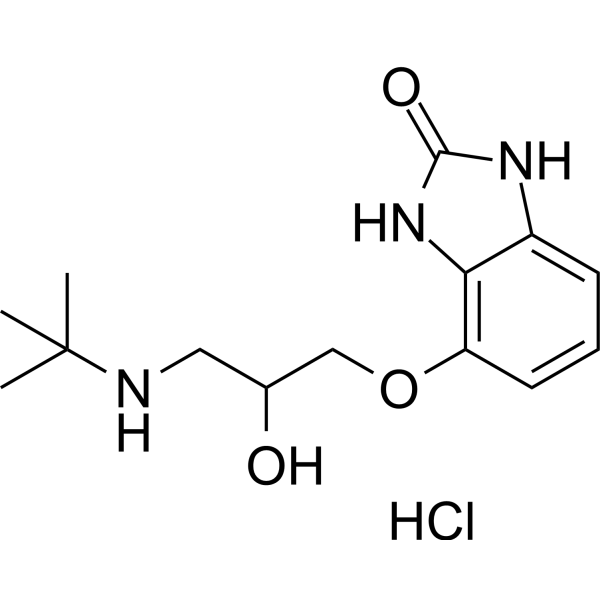
CGP 12177 hydrochloride

Based on 1 Customer Validation
CGP 12177 ((±)-CGP 12177) hydrochloride is a β-Adrenergic receptor (β-AR) ligand. CGP 12177 hydrochloride is a β3-AR (Ki = 88 nM) agonist with β1/β2-AR (Ki = 0.9 nM for β1; Ki = 4 nM for β2) antagonist action. CGP 12177 hydrochloride exhibits partial agonist properties for α1-AR in rat pulmonary artery. CGP 12177 hydrochloride regulates the expression of ucp and leptin genes in NMRI mice adipose tissues. CGP 12177 hydrochloride can be used for cardiovascular and metabolic disease research[1][2][3][4].
For research use only. We do not sell to patients.
- Purity : 99.57%
- CAS No.: 64208-32-8
- Formula: C14H22ClN3O3
- Molecular Weight:315.80
-
Storage:
-20°C, sealed storage, away from moisture
* In solvent : -80°C, 6 months; -20°C, 1 month (sealed storage, away from moisture)

To place orders, for customer services and technical support, please contact: MedChemExpress USA
Tel: 609-228-6898 E-mail: [email protected] [email protected]


-
 Biological Activity
-
Chemical Information
-
Solvent & Solubility
- Purity & Documentation
- References
-
 Help & FAQs


All Adrenergic Receptor Isoforms
More

Biological Activity
Description
IC50 & Target
[1][4]|
Beta-1 adrenergic receptor 0.9 nM (Ki) |
Beta-2 adrenergic receptor 4 nM (Ki) |
Beta-3 adrenergic receptor 88 nM (Ki) |
α1-adrenergic receptor |
In Vitro
CGP 12177 (0.01-100 μM) hydrochloride enhances tension induced by 3 μM Prostaglandin F2α (PGF2α) (HY-12956) in rat intralobar pulmonary arteries in a concentration-dependent manner, while inducing concentration-dependent relaxation when arteries precontracted with 30 nM Phenylephrine (PHE) (HY-B0769)[1].
CGP 12177 (0.01-100 μM) hydrochloride exerts only minor effect on rat intralobar pulmonary arteries under basal tone, but elicits contractile effects and markedly potentiates PHE-induced contraction in the presence of PGF2α (3 μM)[1].
CGP 12177 (1-100 μM) hydrochloride induces an increase in intracellular calcium concentration in rat pressurized arteries loaded with Fura pentakisester-3 (PE-3) and precontracted with PGF2α[1].
CGP 12177 (100 μM, 15 min) hydrochloride exhibits no significant effect on the basal tone in rat intralobar pulmonary arteries, but shifts the concentration-response curve to PHE to the right without any changes in the maximal response[1].
CGP 12177 (1–100 μM) hydrochloride-induced contractions in PGF2α-precontracted arteries are suppressed by Phentolamine (1 μM), Phenoxybenzamine (1 μM), SR 59230A (3 μM), and Bupranolol (5 μM) in rat intralobar pulmonary arteries[1].
CGP 12177 hydrochloride fully and concentration-dependently displaces [3H]prazosin-specific binding, with a pKi value of 5.22[1].
CGP 12177 (0-10 μM, 30 min) hydrochloride does not stimulate the internalization of GFP-tagged human β2-adrenoceptors in CHO-K1 cells[2].
CGP 12177 hydrochloride acts as a high-affinity partial agonist for cyclic AMP accumulation and cAMP response element (CRE)-mediated gene transcription in CHO-K1 cells expressing the human β2-adrenoceptor[2].
MedChemExpress (MCE) has not independently confirmed the accuracy of these methods. They are for reference only.
In Vivo
MedChemExpress (MCE) has not independently confirmed the accuracy of these methods. They are for reference only.
-
Animal Model:Male NMRI mice (4-weeks old)[3]
-
Dosage:0.05, 0.2, 0.5 and 1mg/kg
-
Administration:s.c., daily for 15 days
-
Result:Significantly decreased expression of the mRNAs for UCP1, UCP2 and UCP3 in brown adipose tissue (BAT) at the lower doses compared to control.
Slightly increased expression of the mRNAs for UCP1, UCP2 and UCP3 in brown adipose tissue (BAT) at the higher doses compared to control.
Markedly enhanced UCP1 mRNA expression in both white adipose tissue (WAT) depots (inguinal IWAT and epididymal EWAT) in a dose-dependent manner, the increase was from low (and variable) basal levels in IWAT and from undetectable levels in EWAT of control animals.
Upregulated UCP3 mRNA expression in WAT especially in EWAT and, to a lesser extent, in IWAT.
Did not upregulated UCP2 mRNA expression in any WAT depot.
Showed a decreased expression of UCP2 mRNA at doses lower than 1mg/kg in both IWAT and EWAT.
Regulated leptin mRNA levels in a tissue-dependent manner.
Showed no effect on leptin mRNA levels in EWAT at any dose.
Showed a 3-fold increase of leptin mRNA levels in BAT at 0.5 and 1mg/kg.
Resulted in a maximum of 2-fold stimulation in IWAT at 0.5 mg/kg.
Did not have any apparent effect on food intake, body weight or the weight of the analysed fat depots at any dose tested.


Chemical Information
-
CAS No. 64208-32-8
-
Appearance Solid
-
Molecular Weight 315.80
-
Formula C14H22ClN3O3
-
Color White to off-white
-
SMILES
O=C1NC2=C(OCC(O)CNC(C)(C)C)C=CC=C2N1.Cl
-
Synonyms
(±)-CGP 12177 hydrochloride
-
Shipping
Room temperature in continental US; may vary elsewhere.
-
Storage
-20°C, sealed storage, away from moisture
* In solvent : -80°C, 6 months; -20°C, 1 month (sealed storage, away from moisture)


Solvent & Solubility
In Vitro:
DMSO : 10 mg/mL (31.67 mM; Need ultrasonic; Hygroscopic DMSO has a significant impact on the solubility of product, please use newly opened DMSO)
Please refer to the solubility information to select the appropriate solvent. Once prepared, please aliquot and store the solution to prevent product inactivation from repeated freeze-thaw cycles.
Storage method and period of stock solution: -80°C, 6 months; -20°C, 1 month (sealed storage, away from moisture). When stored at -80°C, please use it within 6 months. When stored at -20°C, please use it within 1 month.
Please refer to the solubility information to select the appropriate solvent. Once prepared, please aliquot and store the solution to prevent product inactivation from repeated freeze-thaw cycles.
Storage method and period of stock solution: -80°C, 6 months; -20°C, 1 month (sealed storage, away from moisture). When stored at -80°C, please use it within 6 months. When stored at -20°C, please use it within 1 month.
Concentration (start) × Volume (start) = Concentration (final) × Volume (final)


Purity & Documentation
-
Data Sheet (281 KB)
-
SDS (252 KB)
- English - EN (252 KB)
- Français - FR (252 KB)
- Deutsch - DE (252 KB)
- Norwegian - NO (252 KB)
- Español - ES (252 KB)
- Swedish - SV (252 KB)
- Italian - IT (252 KB)
- Korean - KR (252 KB)
- Portuguese - PT (252 KB)
-
Handling Instructions (2659 KB)
References
[1]. Leblais V, et al. Role of alpha-adrenergic receptors in the effect of the beta-adrenergic receptor ligands, CGP 12177, bupranolol, and SR 59230A, on the contraction of rat intrapulmonary artery. J Pharmacol Exp Ther. 2004 Apr;309(1):137-45. [Content Brief]
[2]. Baker JG, et al. Pharmacological characterization of CGP 12177 at the human beta(2)-adrenoceptor. Br J Pharmacol. 2002 Oct;137(3):400-8. [Content Brief]
[3]. Oliver P, et al. In vivo effects of CGP-12177 on the expression of leptin and uncoupling protein genes in mouse brown and white adipose tissues. Int J Obes Relat Metab Disord. 2000 Apr;24(4):423-8. [Content Brief]
[4]. Strosberg AD, et al. Function and regulation of the beta 3-adrenoceptor. Trends Pharmacol Sci. 1996 Oct;17(10):373-81. [Content Brief]


Complete Stock Solution Preparation Table
Please refer to the solubility information to select the appropriate solvent. Once prepared, please aliquot and store the solution to prevent product inactivation from repeated freeze-thaw cycles.
Storage method and period of stock solution: -80°C, 6 months; -20°C, 1 month (sealed storage, away from moisture). When stored at -80°C, please use it within 6 months. When stored at -20°C, please use it within 1 month.
| Optional Solvent | Concentration Solvent Mass | 1 mg | 5 mg | 10 mg | 25 mg |
|---|---|---|---|---|---|
| DMSO | 1 mM | 3.1666 mL | 15.8328 mL | 31.6656 mL | 79.1640 mL |
| 5 mM | 0.6333 mL | 3.1666 mL | 6.3331 mL | 15.8328 mL | |
| 10 mM | 0.3167 mL | 1.5833 mL | 3.1666 mL | 7.9164 mL | |
| 15 mM | 0.2111 mL | 1.0555 mL | 2.1110 mL | 5.2776 mL | |
| 20 mM | 0.1583 mL | 0.7916 mL | 1.5833 mL | 3.9582 mL | |
| 25 mM | 0.1267 mL | 0.6333 mL | 1.2666 mL | 3.1666 mL | |
| 30 mM | 0.1056 mL | 0.5278 mL | 1.0555 mL | 2.6388 mL |


CGP 12177 hydrochloride Related Classifications
HY-101393A Related Classifications
 Powered by Bioz