

30 Results for "

quality control

" in MedChemExpress (MCE) Product Catalog:
Products (30)

30 Results for "quality control" in MCE Product Catalog:

1
1 Cited Publications
Cat. No.: HY-N0478
CAS No.: 466-26-2
Synonyms: Bullatine B
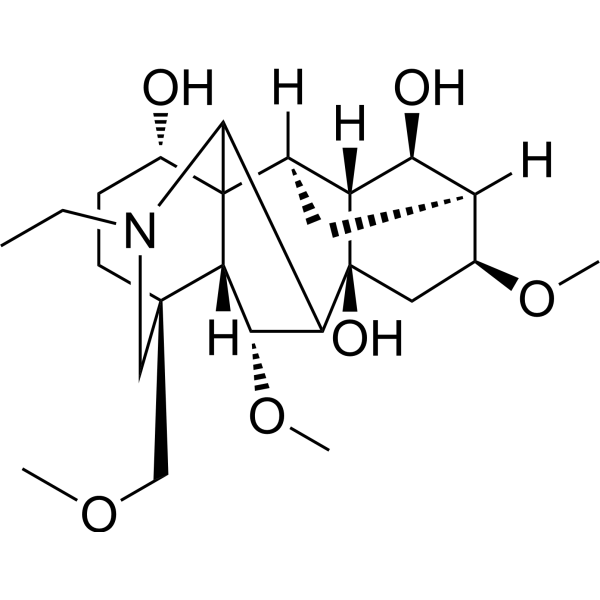
Neoline (Bullatine B) is the active ingredient of the active ingredient (PA), which can be used to cure the disease. Neoline Flow Suppression Nav1.7 Electrical Flow Control (VGSC), improve diabetes mechanical pain sensitivity. Neoline has a list of compounds that can be used, research on its use, and the quality of its processing during processing in pain .
loading...
    loading...
1
1 Cited Publications
Cat. No.: HY-P2799A
CAS No.: 9001-15-4
Synonyms: CK, CPK, Creatine Phosphokinase
Creatine Kinase (CPK/CK), Bovine Heart (CK) is a creatine kinase derived from bovine heart. Creatine Kinase (CPK/CK), Bovine Heart catalyzes the reversible phosphate transfer reaction between phosphocreatine and ADP, and is widely used in myocardial energy metabolism research and quality control of clinical biochemical tests .
loading...
    loading...
1
1 Cited Publications
Cat. No.: HY-N7026
CAS No.: 1807732-38-2
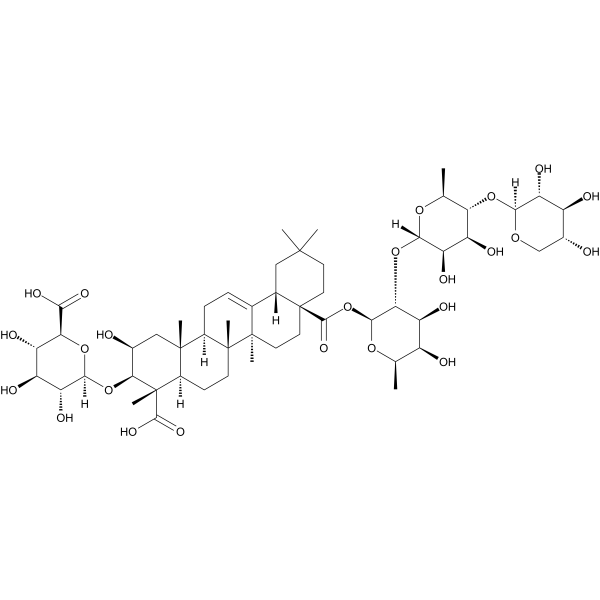
Celosin I, an oleanane-type triterpenoid saponin isolated from the seeds of Celosia argentea L, could be used as chemical markers for the quality control of C. argentea seeds. Celosin I exhibits significant hepatoprotective effect on carbon tetrachloride-induced and N,N-dimethylformamide-induced hepatotoxicity in mice .
loading...
    loading...
Cat. No.: HY-145149
CAS No.: 2124210-34-8
Purity:  99.76%
Target:  

ADC Payloads

Research Areas:  

Cancer

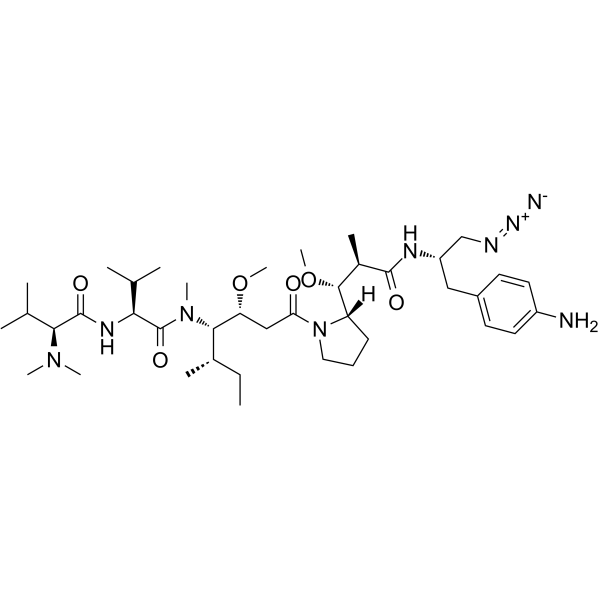
Duostatin 5 is a ADC Cytotoxin designed based on MMAF (HY-15579) and can be used to synthesize ADCs. The preparation of Duostatin 5 has the advantages of fewer synthetic steps, simple operation, less difficulty in quality control, and more stable chemical synthesis process. Duostatin 5 can be linked to the antibody targeting 5T4 (ZV05) by cross-linking with interchain cysteines through a disubstituted C-Lock linker. Duostatin 5 is a click chemistry reagent. It contains an azide group and can undergo copper-catalyzed azide-alkyne cycloaddition (CuAAc) with molecules containing alkyne groups. It can also undergo ring strain-driven alkyne-azide cycloaddition (SPAAC) with molecules containing DBCO or BCN groups[1][2].
loading...
    loading...
Cat. No.: HY-124482
CAS No.: 25516-15-8
Target:  

Others

Research Areas:  

Others

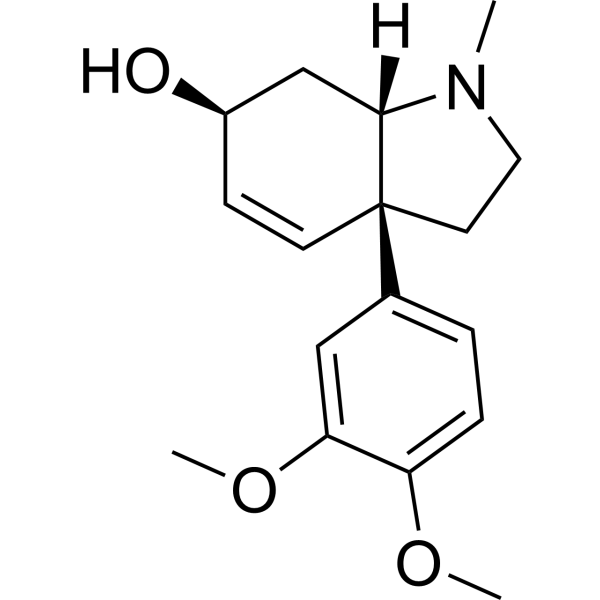
Mesembrenol (Chemotype c) is an alkaloid widely found in plants. Mesembrenol has potential application in quality control of raw materials and products of S.tortuosum .
loading...
    loading...
Cat. No.: HY-177569
Research Areas:  

Others

NVS1.1 is a potent, orally active and brain-penetrant readthrough promoter. NVS1.1 triggers the degradation of eRF1 by activating the ribosome-related quality control pathways (involving GCN1, RNF14, and RNF25), thereby facilitating the reading through of premature termination codons. NVS1.1 can be used for the research of genetic diseases caused by nonsense mutations .
loading...
    loading...
Cat. No.: HY-177757
CAS No.: 1831092-94-4
Research Areas:  

Others

NVS2.1 is a potent, orally active and brain-penetrant readthrough promoter. NVS2.1 triggers the degradation of eRF1 by activating the ribosome-related quality control pathways (involving GCN1, RNF14, and RNF25), thereby facilitating the reading through of premature termination codons. NVS2.1 can be used for the research of genetic diseases caused by nonsense mutations .
loading...
    loading...
Cat. No.: HY-N0624
CAS No.: 146501-37-3
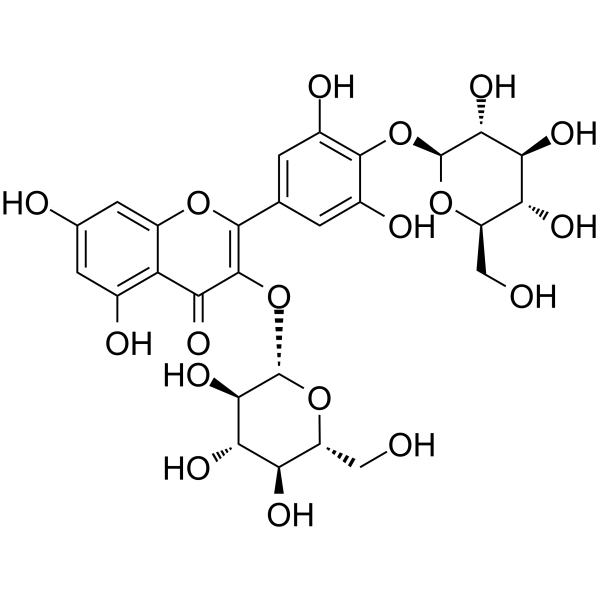
Complanatoside A is a flavonol glycoside isolated from Astragalus complanatus, and currently it is used as a quality control index for A. complanatus in the 2010 edition of the Chinese Pharmacopoeia.
loading...
    loading...
Cat. No.: HY-P10416
Synonyms: Q14 peptide
Research Areas:  

Others Neurological Disease

Q14 is a polypeptide derived from the USP30 (ubiquitin specific peptidase 30) transmembrane (TM) domain with the ability to inhibit the deubiquitination activity of USP30 (IC50=57.2 nM). Q14 reduces USP30 activity by inhibiting the interaction between the USP30 transmembrane domain and its catalytic domain. Q14 peptide contains the LC3 interaction region (LIR) motif, which enables it to bind to the LC3 and accelerate the formation of autophagosomes, thereby promoting mitophagy. Q14 can be used in the study of neurodegenerative diseases as well as mitochondrial quality control and cell metabolism .
loading...
    loading...
Cat. No.: HY-P4890
CAS No.: 1158181-62-4
Relaxin H3 (human) is a relaxin peptide with anti-inflammatory, anti-apoptotic, anti-pyroptotic, anti-migratory, protective and anti-fibrotic activities. Relaxin H3 (human) acts on RXFP1 to generate cAMP and reduce the levels of ATP and ROS. Relaxin H3 (human) inhibits renal inflammatory pyroptosis (pyroptosis), NLRP3 inflammasome activation, caspase-1 activation, IL-1β/IL-18 secretion, collagen synthesis, TGF-β1 signaling pathway, Smad2 phosphorylation, myofibroblast differentiation, TIMP expression, and HRMEC migration. Relaxin H3 (human) activates AMPK, upregulates MFN2 expression, improves mitochondrial quality control and membrane potential, inhibits apoptosis (apoptosis) and pyroptosis, restores retinal ultrastructure, and reverses excessive left ventricular collagen expression. Relaxin H3 (human) can be used in studies related to kidney stones, nephrocalcinosis, diabetic cardiomyopathy, fibrotic cardiomyopathy, and diabetic retinopathy .
loading...
    loading...
Cat. No.: HY-118615
CAS No.: 676495-11-7
Target:  

Opioid Receptor

Research Areas:  

Neurological Disease

LY2048978 is a non-selective opioid receptor antagonist with Ki of 0.287, 0.471 and 1.05 nM for human mu, kappa and delta opioid receptors in vitro, respectively. LY2048978 can be used in the research of major depressive disorder and alcohol use disorder .
loading...
    loading...
Cat. No.: HY-W488109
CAS No.: 97-16-5
Target:  

Insecticide

Genite is a highly effective pesticide with strong insecticidal activity. Genite can effectively control the number of various pests and is widely used in agricultural production. The use of Genite can significantly increase the yield and quality of crops.
loading...
    loading...
Cat. No.: HY-W774918
CAS No.: 153197-14-9
Target:  

Fungal

Oxaziclomefone is a broad-spectrum pesticide with fungal activity. Oxaziclomefone effectively controls a variety of crop diseases and has significant effects against plant pathogenic fungi. Oxaziclomefone is widely used in agriculture to protect crops from diseases and improve crop yield and quality.
loading...
    loading...
Cat. No.: HY-112101R
CAS No.: 158474-72-7
Synonyms: n-Propyl dihydrojasmonate (Standard)
Research Areas:  

Others

Oxaziclomefone (Standard) is the analytical standard of Oxaziclomefone. This product is intended for research and analytical applications. Oxaziclomefone is a broad-spectrum pesticide with fungal activity. Oxaziclomefone effectively controls a variety of crop diseases and has significant effects against plant pathogenic fungi. Oxaziclomefone is widely used in agriculture to protect crops from diseases and improve crop yield and quality.
loading...
    loading...
Cat. No.: HY-W774918R
CAS No.: 153197-14-9
Oxaziclomefone (Standard) is the analytical standard of Oxaziclomefone. This product is intended for research and analytical applications. Oxaziclomefone is a broad-spectrum pesticide with fungal activity. Oxaziclomefone effectively controls a variety of crop diseases and has significant effects against plant pathogenic fungi. Oxaziclomefone is widely used in agriculture to protect crops from diseases and improve crop yield and quality.
loading...
    loading...
Cat. No.: HY-P4890A
Relaxin H3 (human) TFA is a relaxin peptide with anti-inflammatory, anti-apoptotic, anti-pyroptotic, anti-migratory, protective and anti-fibrotic activities. Relaxin H3 (human) TFA acts on RXFP1 to generate cAMP and reduce the levels of ATP and ROS. Relaxin H3 (human) TFA inhibits renal inflammatory pyroptosis (pyroptosis), NLRP3 inflammasome activation, caspase-1 activation, IL-1β/IL-18 secretion, collagen synthesis, TGF-β1 signaling pathway, Smad2 phosphorylation, myofibroblast differentiation, TIMP expression, and HRMEC migration. Relaxin H3 (human) TFA activates AMPK, upregulates MFN2 expression, improves mitochondrial quality control and membrane potential, inhibits apoptosis (apoptosis) and pyroptosis, restores retinal ultrastructure, and reverses excessive left ventricular collagen expression. Relaxin H3 (human) TFA can be used in studies related to kidney stones, nephrocalcinosis, diabetic cardiomyopathy, fibrotic cardiomyopathy, and diabetic retinopathy .
loading...
    loading...
Cat. No.: HY-L0095V
270,000 compounds
OTAVAchemicals Screening Collection contains about 270,000 re-supply compounds for prompt delivery. All compounds have undergone quality control to confirm their chemical structures.
Cat. No.: HY-181764
Target:  

Ser/Thr Protease

Research Areas:  

Cancer

LZL50 is an orally effective human caseinolytic protease P (hClpP) activator with an EC50 of 0.29 μM. LZL50 activates hClpP, a serine protease that mediates mitochondrial quality control by degrading damaged or misfolded mitochondrial proteins. LZL50 exhibits antitumor activity in a breast cancer xenograft mouse model. LZL50 can be used in research related to breast cancer .
loading...
    loading...
Cat. No.: HY-Z17392
CAS No.: 856436-17-4
Target:  

Drug Intermediate

Research Areas:  

Others

Sunitinib impurity 61 (Compound 5h) is an intermediate. Sunitinib impurity 61 is a synthetic intermediate or impurity of Sunitinib (HY-10255A) and can be used as a reference standard for purity analysis and quality control .
loading...
    loading...
Cat. No.: HY-K2004

MCE Trypan Blue Staining Solution (0.4%) is suitable for viability assessment of most adherent and suspension cell lines. It is commonly used for cell culture quality control, evaluation of cellular responses following drug treatment, and viability measurements after cell thawing and recovery.

loading...
    loading...

