



25516-15-8
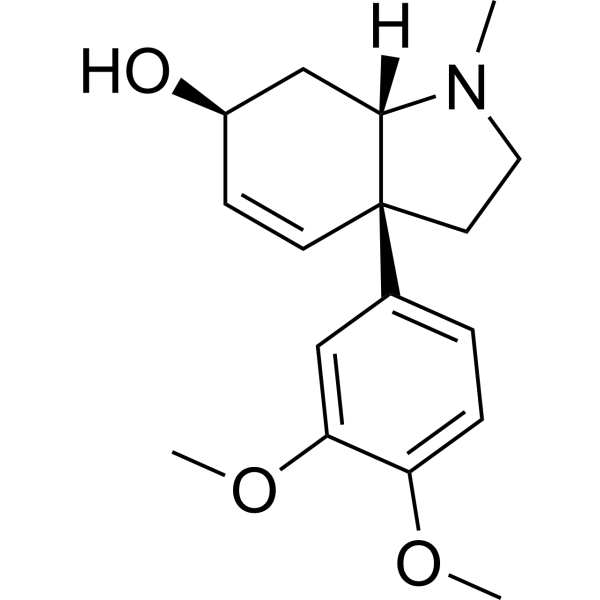
Chemical Structure
Mesembrenol
- CAS No.: 25516-15-8
- Formula:C17H23NO3
- Molecular Weight:289.37
IUPAC Name: (3aR,6S,7aS)-3a-(3,4-dimethoxyphenyl)-1-methyl-2,3,3a,6,7,7a-hexahydro-1H-indol-6-ol
InChIKey: PQBHZMSTECYZLH-COXVUDFISA-N
SMILES: O[C@@H]1C=C[C@]2(CCN([C@]2(C1)[H])C)C3=CC=C(C(OC)=C3)OC
Biological Activity: Mesembrenol, an alkaloid, is an AMPA receptor antagonist and a serotonin reuptake inhibitor. Mesembrenol binds to the serotonin transporter (SERT) with a Ki of 63 nM and inhibits PDE4B with an IC50 of 16 μM. Mesembrenol attenuates hippocampal glutamatergic transmission and population spike amplitude. Mesembrenol can be used in research on epilepsy, anxiety, and Parkinson's disease[1][2][3][4].
| Cat. No. | Product Name | Purity | Description | Pricing | |||||||||||||||||||
|---|---|---|---|---|---|---|---|---|---|---|---|---|---|---|---|---|---|---|---|---|---|---|---|
|
|
Mesembrenol | Mesembrenol, an alkaloid, is an AMPA receptor antagonist and a serotonin reuptake inhibitor. Mesembrenol binds to the serotonin transporter (SERT) with a Ki of 63 nM and inhibits PDE4B with an IC50 of 16 μM. Mesembrenol attenuates hippocampal glutamatergic transmission and population spike amplitude. Mesembrenol can be used in research on epilepsy, anxiety, and Parkinson's disease. | |||||||||||||||||||||
|
loading...
/
|
|||||||||||||||||||||||
References
- [1]. Dimpfel W, et al. Effect of Zembrin and four of its alkaloid constituents on electric excitability of the rat hippocampus. Journal of ethnopharmacology. 2018 Sep 15;223:135-141.
- [2]. Gericke J, et al. Sceletium tortuosum-derived mesembrine significantly contributes to the anxiolytic effect of Zembrin®, but its anti-depressant effect may require synergy of multiple plant constituents. Journal of ethnopharmacology. 2024 Jan 30;319(Pt 1):117113.
- [3]. Krstenansky JL, et al. Mesembrine alkaloids: Review of their occurrence, chemistry, and pharmacology. Journal of ethnopharmacology. 2017 Jan 04;195:10-19. [Content Brief]
- [4]. Lepule K, et al. Zembrin® Mitigates Reserpine-Induced Motor Dysfunction and Oxidative Stress in Parkinson's Disease: In Vivo and In Silico Analyses. Molecules. 2026 Jul 5;31(13):2369.



