



Chitobiose
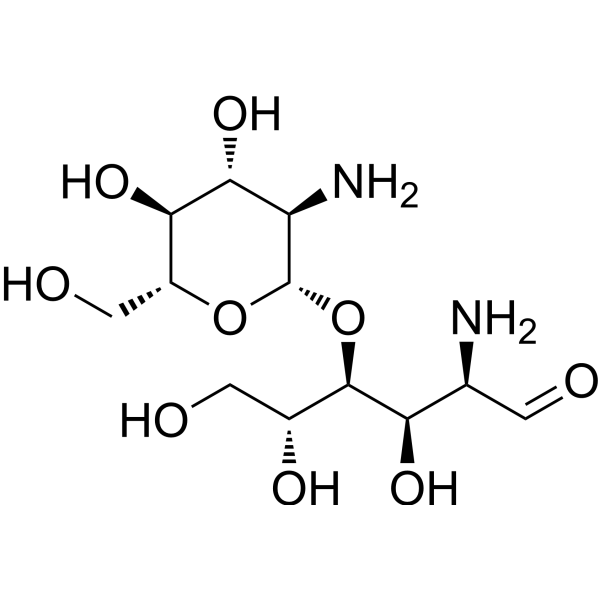
Chitobiose is an orally active chitosan oligosaccharide (degree of polymerization 2). Chitobiose shows hepatoprotective activity and counteracts CCl4-induced elevation of plasma aspartate transaminase and alanine transaminase activities in rats. Chitobiose can be used for the research of carbon tetrachloride-induced acute hepatotoxicity.
Nur für Forschungszwecke. Wir verkaufen nicht an Patienten.
- CAS. Nr.: 577-76-4
- Formel: C12H24N2O9
- Molecular Weight:340.33
-
Speicherung:
Please store the product under the recommended conditions in the Certificate of Analysis.

To place orders, for customer services and technical support, please contact: MedChemExpress USA
Tel: 609-228-6898 E-mail: [email protected] [email protected]


-
 Biologische Aktivität
-
Chemical Information
- Protokoll
- Reinheit & Dokumentation
- Verweise
-
 Help & FAQs




Biologische Aktivität
Beschreibung
In Vitro
Chitobiose (100 μM; 24 h prior to LPS stimulation) exhibits no anti-inflammatory activity in LPS (HY-D1056)-stimulated RAW264.7 cells, as it does not alter levels of IL-1β, IL-10, IL-17A, or IFN-γ[1].
MedChemExpress (MCE) has not independently confirmed the accuracy of these methods. They are for reference only. Further protocols information, click here.
-
Cell Line:RAW264.7 macrophage cells
-
Concentration:100 μM
-
Incubation Time:24 h (prior to 6 h LPS stimulation)
-
Result:Showed no significant effect on the levels of IL-1β, IL-10, IL-17A, and IFN-γ compared to the control group (p > 0.05).
In Vivo
MedChemExpress (MCE) has not independently confirmed the accuracy of these methods. They are for reference only.
-
Animal Model:CCl4-induced acute hepatotoxicity Wistar (male, 7 weeks old, 165-185 g)[2]
-
Dosage:300 mg/kg
-
Administration:p.o.; twice (30 minutes before and 3 hours after CCl4 exposure)
-
Result:Significantly suppressed the CCl4-induced increase in the sum of malondialdehyde and 4-hydroxy-2-alkenals in both plasma and liver at 24 hours post-CCl4 treatment.
Significantly reduced the elevated plasma aspartate transaminase (AST) and alanine transaminase (ALT) activities at both 6 hours and 24 hours post-CCl4 treatment.


Chemical Information
-
CAS. Nr. 577-76-4
-
Molecular Weight 340.33
-
Formel C12H24N2O9
-
SMILES
N[C@H]([C@H]([C@@H]([C@@H](CO)O)O[C@@H]1O[C@@H]([C@H]([C@@H]([C@H]1N)O)O)CO)O)C=O
-
Structure Classification
-
Initial Source
-
Versand
Room temperature in continental US; may vary elsewhere.
-
Speicherung
Please store the product under the recommended conditions in the Certificate of Analysis.

Protokoll
-
Hepatotoxicity Study
This protocol evaluates hepatotoxicity using complementary in vivo mouse APAP acute liver injury and in vitro hepatocyte-based cytotoxicity readouts. In vivo APAP injury is assessed by serum ALT/AST, liver histology, hepatic glutathione, protein adducts, necrosis, inflammation, and regeneration-related endpoints. In vitro hepatotoxicity is assessed by loss of viability, leakage of ALT/AST/LDH, oxidative-stress markers, mitochondrial function, nuclear morphology, intracellular calcium, and high-content imaging endpoints.


Reinheit & Dokumentation
Verweise
[1]. Zhao Q, et al. Chitoheptaose Promotes Heart Rehabilitation in a Rat Myocarditis Model by Improving Antioxidant, Anti-Inflammatory, and Antiapoptotic Properties. Oxid Med Cell Longev. 2020;2020:2394704. Published 2020 Apr 11. [Content Brief]
[2]. Chen AS, et al. Effect of chitobiose and chitotriose on carbon tetrachloride-induced acute hepatotoxicity in rats. Biol Pharm Bull. 2005;28(10):1971-1973. [Content Brief]

Calculators
Konzentration (Stammlösung) × Volumen (Stammlösung) = Konzentration (Ziellösung) × Volumen (Ziellösung)


Chitobiose Related Classifications
HY-N7697F Related Classifications
 Powered by Bioz