



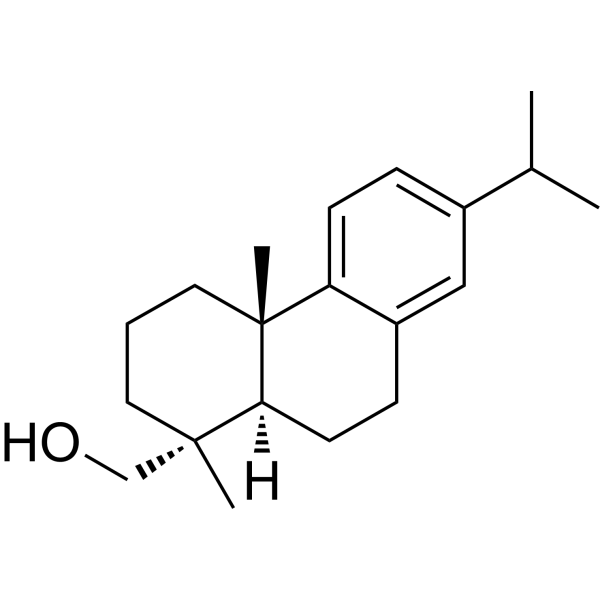
Dehydroabietinol

Based on 1 Customer Validation
Dehydroabietinol is a SYK inhibitor with an IC50 of 46.4 μM. Dehydroabietinol inhibits the growth of Trypanosoma cruzi epimastigotes, Leishmania braziliensis promastigotes and Leishmania infantum promastigotes. Dehydroabietinol indirectly inhibits the growth of Plasmodium falciparum, alters the erythrocyte membrane, and induces spherostomatocyte transformation and endovesicle formation. Dehydroabietinol can be used in studies related to immune-mediated diseases, Chagas disease, leishmaniasis and malaria.
Nos produits utilisent uniquement pour la recherche. Nous ne vendons pas aux patients.
- Pureté : 98.90%
- CAS No.: 3772-55-2
- Formule: C20H30O
- Masse moléculaire:286.45
-
Stockage:
4°C, protect from light
* In solvent : -80°C, 6 months; -20°C, 1 month (protect from light)

To place orders, for customer services and technical support, please contact: MedChemExpress USA
Tel: 609-228-6898 E-mail: [email protected] [email protected]


-
 Activité biologique
-
Chemical Information
- Pureté et documentation
- Références
-
 Help & FAQs




Activité biologique
Description
Cellular Effect
|
Cell Line

|
Type | Value | Description | References |
|---|---|---|---|---|
| A549 | IC50 |
44.14 μM
Compound: 2; DHO
|
Antiproliferative activity against human A549 cells assessed as reduction in cell viability measured for 24 hrs by MTT assay
Antiproliferative activity against human A549 cells assessed as reduction in cell viability measured for 24 hrs by MTT assay
|
[PMID: 37122546] |
| Erythrocyte | IC50 |
28 μM
Compound: 131
|
Cytotoxicity against erythrocytes assessed as morphological changes
Cytotoxicity against erythrocytes assessed as morphological changes
|
[PMID: 19299148] |
| HEK293 | IC50 |
>100 μg/mL
Compound: 26
|
Inhibition of TNF-alpha-induced NF-kappaB activity in human pNF-kappaB-luc-293 cells
Inhibition of TNF-alpha-induced NF-kappaB activity in human pNF-kappaB-luc-293 cells
|
[PMID: 20022253] |
| HeLa | IC50 |
13 μg/mL
Compound: 5,dehydroabietinol
|
Cytotoxicity against human HeLa cells after 48 hrs by MTT assay
Cytotoxicity against human HeLa cells after 48 hrs by MTT assay
|
[PMID: 19892441] |
| HeLa | IC50 |
15.7 μM
Compound: 18-hydroxydehydroabietane
|
Cytotoxicity against human HeLa cells after 48 hrs by MTT assay
Cytotoxicity against human HeLa cells after 48 hrs by MTT assay
|
[PMID: 30684866] |
| HepG2 | IC50 |
45.7 μM
Compound: 2; DHO
|
Antiproliferative activity against human HepG2 cells assessed as reduction in cell viability measured for 24 hrs by MTT assay
Antiproliferative activity against human HepG2 cells assessed as reduction in cell viability measured for 24 hrs by MTT assay
|
[PMID: 37122546] |
| Jurkat | IC50 |
9.7 μg/mL
Compound: 5,dehydroabietinol
|
Cytotoxicity against human Jurkat cells after 48 hrs by MTT assay
Cytotoxicity against human Jurkat cells after 48 hrs by MTT assay
|
[PMID: 19892441] |
| L02 | IC50 |
37.16 μM
Compound: 2; DHO
|
Antiproliferative activity against human L02 cells assessed as reduction in cell viability measured for 24 hrs by MTT assay
Antiproliferative activity against human L02 cells assessed as reduction in cell viability measured for 24 hrs by MTT assay
|
[PMID: 37122546] |
| LoVo | IC50 |
9.2 μg/mL
Compound: 26
|
Antiproliferative activity against human LoVo cells
Antiproliferative activity against human LoVo cells
|
[PMID: 20022253] |
| MGC-803 | IC50 |
42.81 μM
Compound: 2; DHO
|
Antiproliferative activity against human MGC-803 cells assessed as reduction in cell viability measured for 24 hrs by MTT assay
Antiproliferative activity against human MGC-803 cells assessed as reduction in cell viability measured for 24 hrs by MTT assay
|
[PMID: 37122546] |
| QGY-7703 | IC50 |
>25 μg/mL
Compound: 26
|
Antiproliferative activity against human QGY7703 cells
Antiproliferative activity against human QGY7703 cells
|
[PMID: 20022253] |
| RAW264.7 | IC50 |
>100 μg/mL
Compound: 26
|
Antiinflammatory activity in mouse RAW264.7 cells assessed as inhibition of LPS-induced NO release
Antiinflammatory activity in mouse RAW264.7 cells assessed as inhibition of LPS-induced NO release
|
[PMID: 20022253] |
| T-24 | IC50 |
>50 μM
Compound: 2; DHO
|
Antiproliferative activity against human T24 cells assessed as reduction in cell viability measured for 24 hrs by MTT assay
Antiproliferative activity against human T24 cells assessed as reduction in cell viability measured for 24 hrs by MTT assay
|
[PMID: 37122546] |
| Vero | IC50 |
17 μg/mL
Compound: 19
|
Concentration required for 50% inhibition of herpes simplex virus 2(HSV-2) using standard plaque reduction assay in vero cells
Concentration required for 50% inhibition of herpes simplex virus 2(HSV-2) using standard plaque reduction assay in vero cells
|
10.1016/S0960-894X(01)80236-5 |
| Vero | IC50 |
38 μg/mL
Compound: 5,dehydroabietinol
|
Cytotoxicity against african green monkey Vero cells after 48 hrs by MTT assay
Cytotoxicity against african green monkey Vero cells after 48 hrs by MTT assay
|
[PMID: 19892441] |
In Vitro
Dehydroabietinol (72 h) potently inhibits the growth of epimastigotes of Trypanosoma cruzi (CL-B5 clone), with an IC50 of 66 μg/mL[2].
Dehydroabietinol (48 h) inhibits the growth of promastigotes of Leishmania braziliensis (MHOM/BR/75/M2904), with an IC50 of 63 μg/mL[2].
Dehydroabietinol (incubated for 48 h) inhibits the growth of promastigotes of Leishmania infantum (MHOM/FR/91/LEM2259V), with an IC50 value of 40 μg/mL[2].
Dehydroabietinol inhibits the growth of chloroquine (HY-17589A)-sensitive P. falciparum strain 3D7 (IC50 = 25.6 μM) and chloroquine-resistant P. falciparum strain Dd2 (IC50 = 27.4 μM) cultured in vitro in human red blood cells[3].
Dehydroabietinol exhibits in vitro cytotoxicity against KB-3-1 cancer cells (IC50 = 28.0 μM) and KB-V1 cancer cells (IC50 = 30.2 μM)[3].
Dehydroabietinol (0.78-400 μg/mL; 48 h) induces concentration-dependent morphological changes (including stomatocyte formation, swelling and lysis) and endovesiculation in normal human red blood cells after 48 h of incubation[3].
MedChemExpress (MCE) has not independently confirmed the accuracy of these methods. They are for reference only.


Chemical Information
-
CAS No. 3772-55-2
-
Appearance Oil
-
Masse moléculaire 286.45
-
Formule C20H30O
-
Color Colorless to light yellow
-
SMILES
C[C@@]12C3=CC=C(C(C)C)C=C3CC[C@@]1([H])[C@@](C)(CCC2)CO
-
Structure Classification
-
Initial Source
-
Livraison
Room temperature in continental US; may vary elsewhere.
-
Stockage
4°C, protect from light
* In solvent : -80°C, 6 months; -20°C, 1 month (protect from light)


Pureté et documentation
-
Fiche technique (272 KB)
-
SDS (251 KB)
- English - EN (251 KB)
- Français - FR (251 KB)
- Deutsch - DE (251 KB)
- Norwegian - NO (251 KB)
- Español - ES (251 KB)
- Swedish - SV (251 KB)
- Italian - IT (251 KB)
- Korean - KR (251 KB)
- Portuguese - PT (251 KB)
-
Instruction de manipulation (2659 KB)
Références
[1]. Gao JB, et al. Isolation, Characterization, and Structure-Activity Relationship Analysis of Abietane Diterpenoids from Callicarpa bodinieri as Spleen Tyrosine Kinase Inhibitors. J Nat Prod. 2018;81(4):998-1006. [Content Brief]
[2]. Pertino MW, et al. Antiprotozoal Activity of Triazole Derivatives of Dehydroabietic Acid and Oleanolic Acid. Molecules. 2017;22(3):369. Published 2017 Feb 28. [Content Brief]
[3]. Ziegler HL, et al. Possible artefacts in the in vitro determination of antimalarial activity of natural products that incorporate into lipid bilayer: apparent antiplasmodial activity of dehydroabietinol, a constituent of Hyptis suaveolens. Planta Med. 2002;68(6):547-549. [Content Brief]

Calculators
Concentration (start) × Volume (start) = Concentration (final) × Volume (final)


Dehydroabietinol Related Classifications
HY-N3702 Related Classifications
 Powered by Bioz