



Dihydromyrcenol

Based on 1 Customer Validation
Dihydromyrcenol is an orally active flavor ingredient and Antifungal agent. Dihydromyrcenol acts as a toxicant. Dihydromyrcenol induces phototoxicity-related growth inhibition in Bakers' Yeast. In pregnant rats, Dihydromyrcenol causes threshold maternal toxicity by reducing feed consumption and body weight gain, and also induces threshold developmental toxicity by decreasing fetal body weight, inhibiting ossification of metatarsal bones in the hind paws, increasing the number of extra thoracic vertebrae ribs, and altering vertebral counts.
Nos produits utilisent uniquement pour la recherche. Nous ne vendons pas aux patients.
- Pureté : 99.54%
- CAS No.: 18479-58-8
- Formule: C10H20O
- Masse moléculaire:156.27
-
Stockage:
Store at room temperature 3 years.
In solvent -80°C, 2 years , -20°C, 1 year


To place orders, for customer services and technical support, please contact: MedChemExpress USA
Tel: 609-228-6898 E-mail: [email protected] [email protected]


-
 Activité biologique
-
Chemical Information
-
Solvant et solubilité
- Pureté et documentation
- Références
-
 Help & FAQs


-

HY-W021008
SotoloneOR8D1 Activator -
HY-N8829
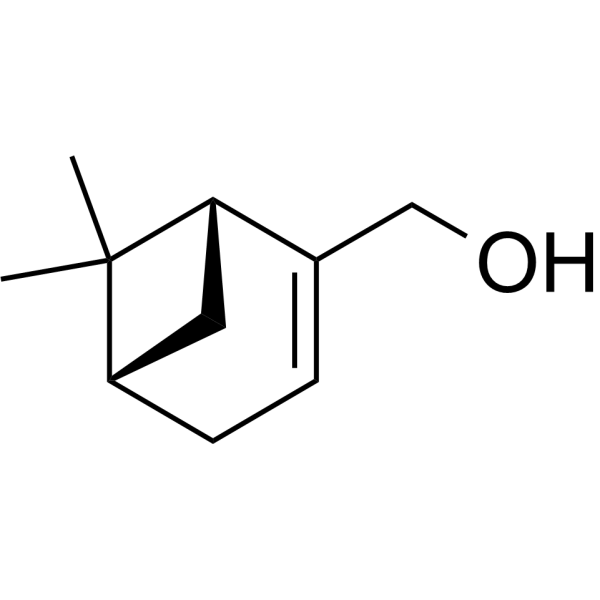
(-)-MyrtenolMyrtenol Enantiomer -

HY-W791537
Linalyl formateDrug Derivative -

HY-126070
N-Butyl cinnamateBiochemical Reagent -

HY-W744618
AmbrettolideMacrolide-type Musk -

HY-N7851
TerpineolNatural Product -

HY-N8829R
(-)-Myrtenol (Standard)Myrtenol Enantiomer -
HY-W012779
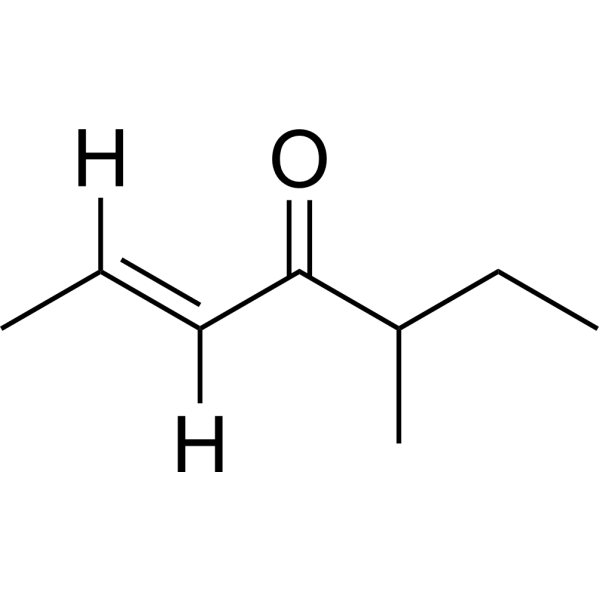
5-Methylhept-2-en-4-oneBiochemical Assay Reagent


Activité biologique
Description
In Vitro
Dihydromyrcenol (0.1-10%) induces growth inhibition related to phototoxicity in Bakers' Yeast at a concentration of 10%, but exerts no such effect at concentrations of 0.1% or 1.0%[1].
MedChemExpress (MCE) has not independently confirmed the accuracy of these methods. They are for reference only.
In Vivo
The acute dermal LD50 of single-dose Dihydromyrcenol in rabbits is greater than 5.0 g/kg, and mortality and skin irritation are observed at the tested dose[1].
Undiluted dihydromyrcenol (0.5 mL; topical application) induces skin irritation in New Zealand white rabbits, with average erythema and edema scores of 2.0 and 1.6 at 24-72 h, respectively, and partial resolution by day 7[1].
MedChemExpress (MCE) has not independently confirmed the accuracy of these methods. They are for reference only.
-
Animal Model:unspecified strain[1]
-
Dosage:2.56 g/kg; 3.2 g/kg; 4.0 g/kg; 5.0 g/kg
-
Administration:p.o.; single dose
-
Result:Recorded mortality of 1/10 rats at 2.56 g/kg, 3/10 rats at 3.2 g/kg, 4/10 rats at 4.0 g/kg, and 8/10 rats at 5.0 g/kg.
Observed toxic signs including lethargy, piloerection, blood on nose, flaccidity, ataxia, and diarrhea.
Determined acute oral LD50 to be 4.1 g/kg.
-
Animal Model:white New Zealand strain[1]
-
Dosage:0.5 mL undiluted
-
Administration:single 4-hour semi-occlusive application
-
Result:Observed very slight erythema in 2 animals and very slight edema in 1 animal at 1 hour post-application.
Noted decreased irritation responses between 24 and 48 hours.
Recorded well-defined erythema in 2 animals (1 with very slight edema) and very slight erythema with slight desquamation in 1 animal at 72 hours.
Observed very slight erythema with marked desquamation in 2 animals, very slight edema in 1 animal, and desquamation in 1 animal at 160 hours.\nObserved well-defined erythema and moderate edema in 1 animal, well-defined erythema and slight edema in 2 animals, and very slight reactions in 1 animal at 1 hour post-application.
Noted increased severity at 24 hours, decreased edematous reactions by 48 hours, and only very slight responses remaining in 1 animal after 7 days.
Recorded well-defined erythema in 3 animals and desquamation in 1 animal after 7 days.
Reported average irritation scores of 2.0 for erythema and 1.6 for edema at 24-72 hours.


Chemical Information
-
CAS No. 18479-58-8
-
Appearance Liquid (Density: 0.784 g/cm3)
-
Masse moléculaire 156.27
-
Formule C10H20O
-
Color Colorless to light yellow
-
SMILES
OC(C)(C)CCCC(C=C)C
-
Livraison
Room temperature in continental US; may vary elsewhere.
-
Stockage
Store at room temperature 3 years
In solvent -80°C 2 years -20°C 1 year


Solvant et solubilité
In Vitro:
DMSO : 200 mg/mL (1279.84 mM; Need ultrasonic; Hygroscopic DMSO has a significant impact on the solubility of product, please use newly opened DMSO)
Please refer to the solubility information to select the appropriate solvent. Once prepared, please aliquot and store the solution to prevent product inactivation from repeated freeze-thaw cycles.
Storage method and period of stock solution: -80°C, 2 years; -20°C, 1 year. When stored at -80°C, please use it within 2 years. When stored at -20°C, please use it within 1 year.
Please refer to the solubility information to select the appropriate solvent. Once prepared, please aliquot and store the solution to prevent product inactivation from repeated freeze-thaw cycles.
Storage method and period of stock solution: -80°C, 2 years; -20°C, 1 year. When stored at -80°C, please use it within 2 years. When stored at -20°C, please use it within 1 year.
Concentration (start) × Volume (start) = Concentration (final) × Volume (final)
In Vivo:
Select the appropriate dissolution method based on your experimental animal and administration route.
- For the following dissolution methods, please ensure to first prepare a clear stock solution using an In Vitro approach and then sequentially add co-solvents:
- To ensure reliable experimental results, the clarified stock solution can be appropriately stored based on storage conditions. As for the working solution for In Vivo experiments, it is recommended to prepare freshly and use it on the same day.
- The percentages shown for the solvents indicate their volumetric ratio in the final prepared solution. If precipitation or phase separation occurs during preparation, heat and/or sonication can be used to aid dissolution.
Add each solvent one by one: 10% DMSO 40% PEG300 5% Tween-80 45% Saline
Solubility: ≥ 5 mg/mL (32.00 mM); Clear solution
This protocol yields a clear solution of ≥ 5 mg/mL (saturation unknown).
Taking 1 mL working solution as an example, add 100 μL DMSO stock solution (50.0 mg/mL) to 400 μL PEG300, and mix evenly; then add 50 μL Tween-80 and mix evenly; then add 450 μL Saline to adjust the volume to 1 mL.
Preparation of Saline: Dissolve 0.9 g sodium chloride in ddH₂O and dilute to 100 mL to obtain a clear Saline solution.
Add each solvent one by one: 10% DMSO 90% (20% SBE-β-CD in Saline)
Solubility: ≥ 5 mg/mL (32.00 mM); Clear solution
This protocol yields a clear solution of ≥ 5 mg/mL (saturation unknown).
Taking 1 mL working solution as an example, add 100 μL DMSO stock solution (50.0 mg/mL) to 900 μL 20% SBE-β-CD in Saline, and mix evenly.
Preparation of 20% SBE-β-CD in Saline (4°C, storage for one week): 2 g SBE-β-CD powder is dissolved in 10 mL Saline, completely dissolve until clear.
In Vivo Dissolution Calculator
Please enter the basic information of animal experiments:
-
-
-
-
Recommended: Prepare an additional quantity of animals to account for potential losses during experiments.
Please enter your animal formula composition:
-
%DMSO +
Recommended: Keep the proportion of DMSO in working solution below 2% if your animal is weak.
-
%+
-
+%Tween-80 + +
-
%Saline +
The co-solvents required include: DMSO, . All of co-solvents are available by MedChemExpress (MCE). , Tween 80. All of co-solvents are available by MedChemExpress (MCE).
Working solution concentration: 0.22 mg/mL
Method for preparing stock solution: mg drug dissolved in μL DMSO. Stock solution concentration: mg/mL.
1. Take μL DMSO stock solution;
2. Add μL .
μL , mix evenly;
3. Then add μL Tween 80, mix evenly;
4. Then add μL
Please ensure that the stock solution in the first step is dissolved to a clear state, and add co-solvents in sequence. You can use ultrasonic heating (ultrasonic cleaner, recommended frequency 20-40 kHz), vortexing, etc. to assist dissolution.


Pureté et documentation
-
Fiche technique (272 KB)
-
SDS (393 KB)
- English - EN (393 KB)
- Français - FR (393 KB)
- Deutsch - DE (393 KB)
- Norwegian - NO (393 KB)
- Español - ES (393 KB)
- Swedish - SV (393 KB)
- Italian - IT (393 KB)
- Korean - KR (393 KB)
- Portuguese - PT (393 KB)
-
Instruction de manipulation (2659 KB)
Références


Complete Stock Solution Preparation Table
Please refer to the solubility information to select the appropriate solvent. Once prepared, please aliquot and store the solution to prevent product inactivation from repeated freeze-thaw cycles.
Storage method and period of stock solution: -80°C, 2 years; -20°C, 1 year. When stored at -80°C, please use it within 2 years. When stored at -20°C, please use it within 1 year.
| Optional Solvent | Concentration Solvent Mass | 1 mg | 5 mg | 10 mg | 25 mg |
|---|---|---|---|---|---|
| DMSO | 1 mM | 6.3992 mL | 31.9959 mL | 63.9918 mL | 159.9795 mL |
| 5 mM | 1.2798 mL | 6.3992 mL | 12.7984 mL | 31.9959 mL | |
| 10 mM | 0.6399 mL | 3.1996 mL | 6.3992 mL | 15.9980 mL | |
| 15 mM | 0.4266 mL | 2.1331 mL | 4.2661 mL | 10.6653 mL | |
| 20 mM | 0.3200 mL | 1.5998 mL | 3.1996 mL | 7.9990 mL | |
| 25 mM | 0.2560 mL | 1.2798 mL | 2.5597 mL | 6.3992 mL | |
| 30 mM | 0.2133 mL | 1.0665 mL | 2.1331 mL | 5.3327 mL | |
| 40 mM | 0.1600 mL | 0.7999 mL | 1.5998 mL | 3.9995 mL | |
| 50 mM | 0.1280 mL | 0.6399 mL | 1.2798 mL | 3.1996 mL | |
| 60 mM | 0.1067 mL | 0.5333 mL | 1.0665 mL | 2.6663 mL | |
| 80 mM | 0.0800 mL | 0.3999 mL | 0.7999 mL | 1.9997 mL | |
| 100 mM | 0.0640 mL | 0.3200 mL | 0.6399 mL | 1.5998 mL |


Dihydromyrcenol Related Classifications
HY-W142457 Related Classifications
 Powered by Bioz