



Prostatic Hyperplasia
-
Prostatic Hyperplasia (9)


- Formula: C6H5K3O8
- Molecular Weight: 322.39
Tripotassium hydroxycitrate is an orally active, multi-target, multi-bioactive organic acid. Tripotassium hydroxycitrate activates Nrf2 and its downstream molecule GPX4, increases glutathione levels, and thereby inhibits ferroptosis. Tripotassium hydroxycitrate activates the Nrf2/Keap1 and ACLY/NF-κB signaling pathways, upregulates the activities of antioxidant enzymes such as superoxide dismutase, reduces MDA content, thereby alleviating oxidative stress and renal tubular epithelial cell apoptosis, and improves pulmonary vascular and right ventricular remodeling. Tripotassium hydroxycitrate activates both the AMPK and mTORC1/S6K pathways, triggers the unfolded protein response, arrests the cancer cell cycle, and induces DNA fragmentation.

- Formula: C21H20O12
- Molecular Weight: 464.38
Quercetin 5-O-β-D-glucopyranoside is a glycosylated flavonoid metabolite and flavonoid compound. Quercetin 5-O-β-D-glucopyranoside can be produced by microbial transformation of Quercetin (HY-18085) via Mucor hiemalis. Quercetin 5-O-β-D-glucopyranoside can be used in studies related to benign prostatic hyperplasia.

- Formula: C15H19ClN2
- Molecular Weight: 262.78
N1-Benzyl-N2-phenylethane-1,2-diamine hydrochloride is a pharmaceutical intermediate that can be used for the synthesis of α1a-adrenergic receptor antagonists.

- Formula: C23H19N3O6
- Molecular Weight: 433.41
PDE4/5-IN-1 is a selective phosphodiesterase 4/5 (PDE4/5) dual inhibitor. PDE4/5-IN-1 functionally inhibits PDE5, PDE4B2, and PDE4D2 activity. PDE4/5-IN-1 relaxes isolated rat prostate tissue, enhances nitric oxide-induced relaxation in isolated rat prostate tissue, and reduces alpha-1 adrenoceptor-mediated contractile responses in isolated rat prostate tissue. PDE4/5-IN-1 inhibits proliferation of human hyperplastic prostate cells. PDE4/5-IN-1 can be used for the research of benign prostatic hyperplasia.

- Formula: C22H27N3O4
- Molecular Weight: 397.47
α1A/1D-Adrenoceptor antagonist-1 (Compound 15) is a selective α1A/1D-adrenoceptor dual antagonist with IC50 values of 20.26 and 164.9 nM. α1A/1D-Adrenoceptor antagonist-1 shows an IC50 of 1912 nM for α1B-adrenoceptor.α1A/1D-Adrenoceptor antagonist-1 can be used for research of benign prostatic hyperplasia.

- Formula: C30H35F2N5O5
- Molecular Weight: 583.63
SNAP-6201 is a selective α1a adrenoceptor antagonist with a Ki of 0.2 nM. SNAP-6201 exhibits >1400-fold selectivity over α1b and α1d adrenoceptors. SNAP-6201 exhibits excellent selectively to inhibit intraurethral pressure (IUP) in the anesthetized dog model. SNAP-6201 can be used for benign prostatic hyperplasia (BPH) research.
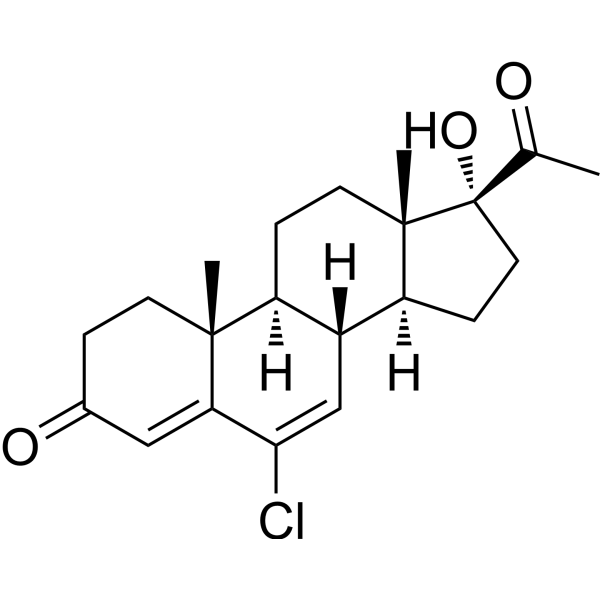
- Formula: C21H27ClO3
- Molecular Weight: 362.89
Chlormadinone is an orally active anti-androgen agent. Chlormadinone improves intermittency, terminal dribbling, and urinary stream size and force. Chlormadinone can be used for the research of benign prostatic hyperplasia.

- Formula: C20H30O2
- Molecular Weight: 302.46
Oxendolone (TSAA-291) is a steroidal antiandrogen with partial agonist properties, exhibiting a Ki value of 1.4 nM for the androgen receptor. Oxendolone exerts tissue-specific androgen receptor activity, induces unique androgen receptor conformational changes, and drives differential cofactor recruitment. Oxendolone is recruited to the androgen receptor in a PIAS1-dependent manner. Oxendolone increases levator ani muscle weight in castrated mice. Oxendolone can be used for research on benign prostatic hyperplasia.

- Formula: C34H34ClF3N4O4
- Molecular Weight: 655.11
α1A Adrenoceptor antagonist-1 is a selective α1A adrenoceptor antagonist with a human Ki <20 nM. α1A Adrenoceptor antagonist-1 exhibits activity against benign prostatic hyperplasia (BPH) to enable less hindered urine flow. α1A Adrenoceptor antagonist-1 relaxes α1a receptor-enriched urethral smooth muscle tissue without inducing hypotension. α1A Adrenoceptor antagonist-1 can be used for the research of benign prostatic hyperplasia (BPH).



