



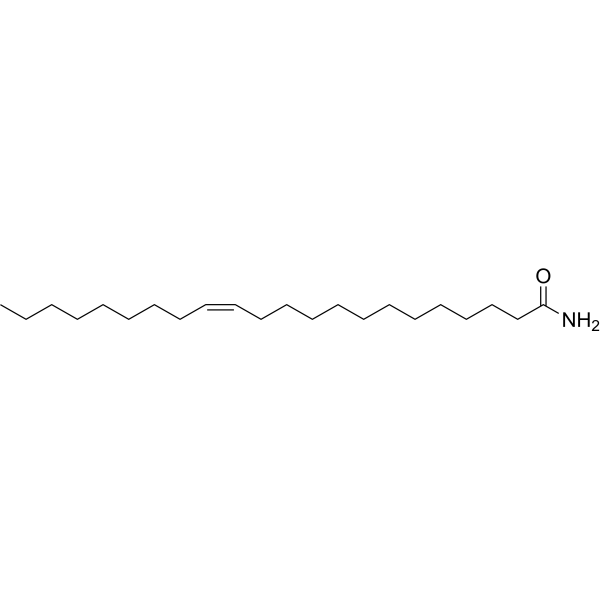
Erucamide

Based on 1 Customer Validation
Erucamide is an orally active, blood-brain barrier-permeable TMEM19 ligand and T3SS inhibitor. Erucamide exerts retinal neuroprotective effects in mouse models of retinal degeneration. Erucamide attenuates depression- and anxiety-like behaviors in mice.\n\nErucamide binds to the conserved hydrophobic pocket in HrcC, disrupts its outer membrane localization, and blocks T3SS-mediated effector protein secretion in Gram-negative pathogenic bacteria. Erucamide enhances the antimicrobial immunity of plants against pathogenic bacteria. Erucamide can be used in research related to retinitis pigmentosa, anxiety and depression, bacterial wilt, and bacterial blight.
For research use only. We do not sell to patients.
- Purity : 99.32%
- CAS No.: 112-84-5
- Formula: C22H43NO
- Molecular Weight:337.58
-
Storage:Powder -20°C, 3 years ; In solvent -80°C, 6 months , -20°C, 1 month

To place orders, for customer services and technical support, please contact: MedChemExpress USA
Tel: 609-228-6898 E-mail: [email protected] [email protected]


-
 Biological Activity
-
Chemical Information
-
Solvent & Solubility
- Protocols
- Purity & Documentation
- References
-
 Help & FAQs


-

HY-121389
HexadecanamideAnti-inflammatory Agent -
HY-N2327
OleamideEndogenous Metabolite -
HY-W127445
BehenamideBiochemical Assay Reagent -

HY-W009123R
Erucamide (Standard)Bioactive Fluid Regulator -

HY-120963
N-Oleoyl Taurine -
HY-116538
(10E,12Z)-Octadeca-10,12-dienoic acidPPARα Activator -
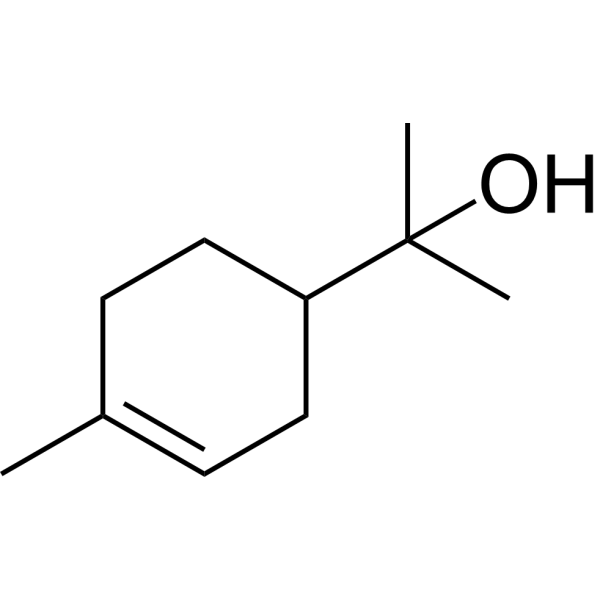
HY-N5142
α-TerpineolAntibiotic -
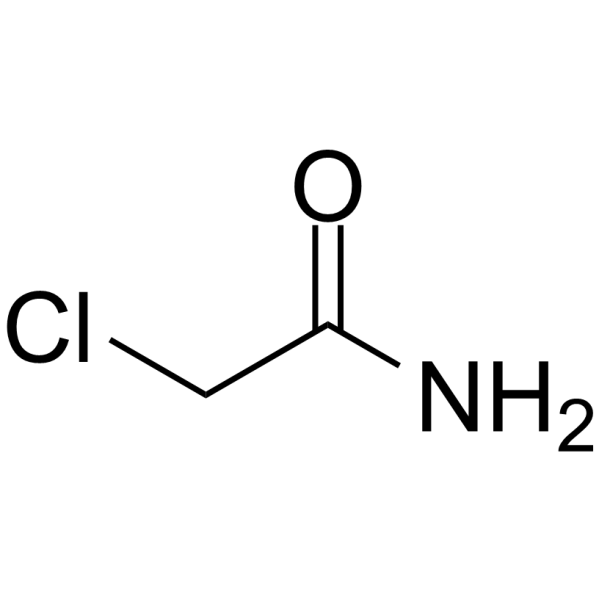
HY-W010629
2-ChloroacetamideHerbicide Agent -
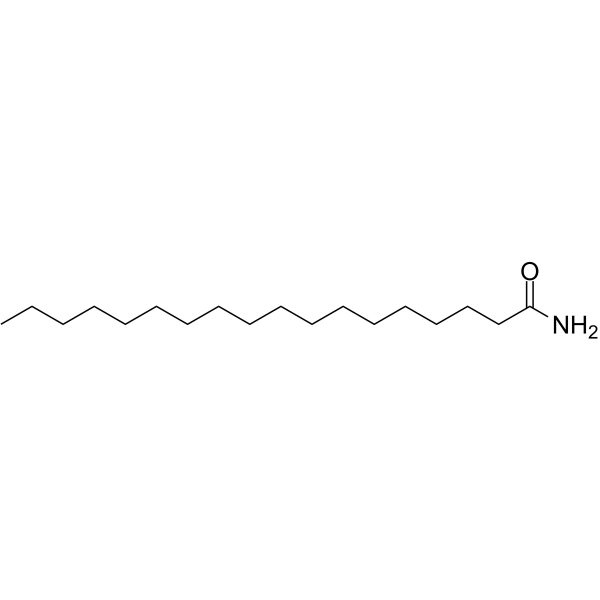
HY-W130610
StearamideCorrosion Inhibitor -
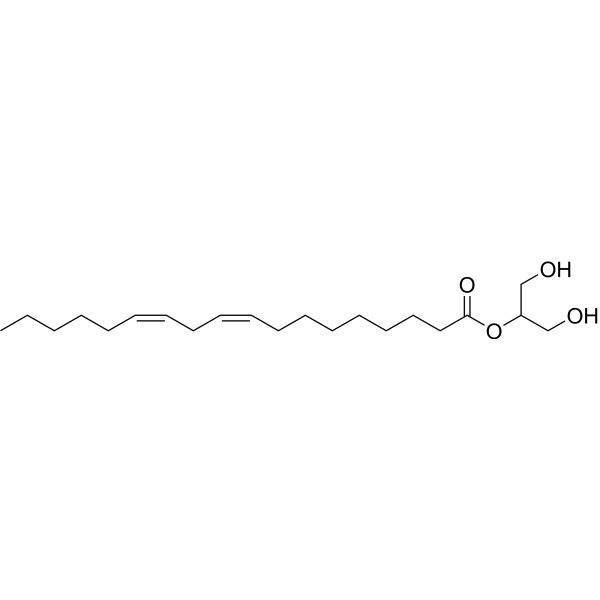
HY-130311
2-Linoleoyl glycerolCB1 Receptor Agonist -

HY-120969
Docosanoyl ethanolamideEster Product -
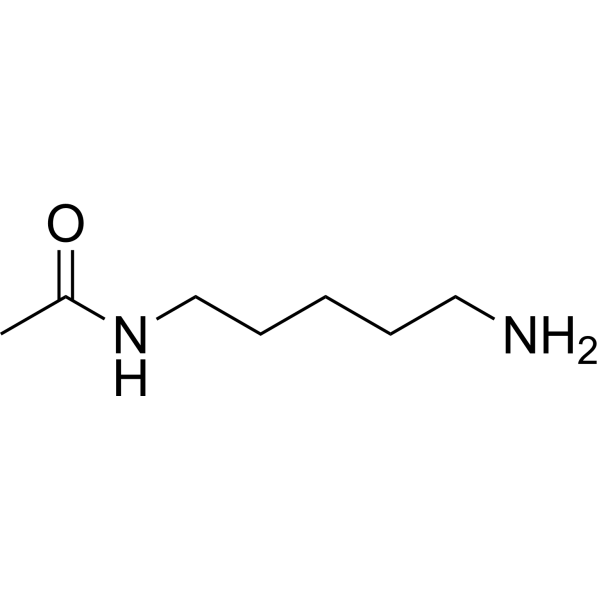
HY-101403
N-(5-Aminopentyl)acetamideEndogenous Metabolite
All Endogenous Metabolite Isoforms
More

Biological Activity
Description
In Vitro
Erucamide (0.64 μM) significantly upregulates the expressions of PDGFα, CTGF, PDGFβ, CX3CL1, Ang1 and BDNF in CD11b+ MPCs, and this effect depends on the transmembrane protein TMEM19[1].
Erucamide specifically binds to the transmembrane protein TMEM19 in HMC3 microglial cells and TMEM19-overexpressing HEK293T cells[1].
Erucamide (6-150 μM, 20 h) inhibits T3SS-mediated secretion of AvrPto in P. syringae pv. tomato DC3000[2].
Erucamide (150 μM, 20 h) inhibits the secretion and assembly of the P. syringae T3SS, as well as Hrp pilus assembly, by binding to HrcC and preventing the outer membrane localization of HrcC and HrpA[2].
Erucamide (6-150 μM) dose-dependently inhibits the growth of P. syringae in Arabidopsis thaliana, while it restores antimicrobial immune activity in erucamide-accumulation-deficient plant lines[2].
Erucamide reduces the severity of bacterial diseases and the proliferation level of pathogens in rice and *Nicotiana benthamiana*, as well as the bacterial wilt severity and mortality rate of tomato plants[2].
MedChemExpress (MCE) has not independently confirmed the accuracy of these methods. They are for reference only. Further protocols information, click here.
-
Cell Line:P. syringae pv. tomato DC3000
-
Concentration:6, 30, 150 μM
-
Incubation Time:20 h
-
Result:Inhibited AvrPto secretion, with 150 μM erucamide reducing secretion by 83%.
-
Cell Line:P. syringae
-
Concentration:150 μM
-
Incubation Time:20 h
-
Result:Altered the thermal stability of HrcC, causing a shift in the unfolding transition (Tm).
In Vivo
Erucamide (214 ng; intravitreal injection; single administration) activates CD116+ myeloid cells in the retina of wild-type mice, thereby increasing the expression levels of proangiogenic factors and neurotrophic factors[1].
Erucamide (5-20 mg/kg, p.o., 7 days) attenuates depression- and anxiety-like behaviors in mice, and its antidepressant and anxiolytic effects may be associated with the regulation of the hypothalamic-pituitary-adrenal (HPA) axis[4].
MedChemExpress (MCE) has not independently confirmed the accuracy of these methods. They are for reference only.
-
Animal Model:RD10 (B6.CXB1-Pde6brd10/J) mice (postnatal day 12, 22, and 32)[1]
-
Dosage:214 ng
-
Administration:subretinal; at postnatal day 12 and 22
-
Result:Increased surviving photoreceptor rows to 6.4 at P32.
Significantly increased outer nuclear layer thickness. Significantly increased inner nuclear layer thickness. Significantly protected intraretinal deep plexus vasculature from vaso-obliteration.
Significantly increased scotopic B-wave amplitude at 50 cd*s/m2 intensity.
-
Animal Model:Wild-type mice[1]
-
Dosage:214 ng
-
Administration:intravitreal; single injection
-
Result:Induced widespread infiltration of GS-Lectin-positive CD116⁺ myeloid cells throughout the retina.
Upregulated expression of pro-angiogenic and neurotrophic genes including PDGF, CTGF, CX3CL1, Ang1, and BDNF in flow cytometry-sorted CD116⁺ cells from treated retinas.
-
Animal Model:Male adult Kunming mice (18-22 g)[4]
-
Dosage:5, 10, 20 mg/kg
-
Administration:p.o., 7 days
-
Result:Reduced the resting time in mice during TST and FST tests.
Increased the open-arm and open-arm injection times in the elevation plus maze test.
Decreased serum ACTH, CORT, and T-AOC levels.


Chemical Information
-
CAS No. 112-84-5
-
Appearance Solid
-
Molecular Weight 337.58
-
Formula C22H43NO
-
Color White to off-white
-
SMILES
CCCCCCCC/C=C\CCCCCCCCCCCC(N)=O
-
Synonyms
cis-13-Docosenamide
-
Shipping
Room temperature in continental US; may vary elsewhere.
-
Storage
Powder -20°C 3 years In solvent -80°C 6 months -20°C 1 month


Solvent & Solubility
In Vitro:
Ethanol : 12.5 mg/mL (37.03 mM; Need ultrasonic)
DMSO : 1.56 mg/mL (4.62 mM; ultrasonic and warming and heat to 60°C; Hygroscopic DMSO has a significant impact on the solubility of product, please use newly opened DMSO)
Please refer to the solubility information to select the appropriate solvent. Once prepared, please aliquot and store the solution to prevent product inactivation from repeated freeze-thaw cycles.
Storage method and period of stock solution: -80°C, 6 months; -20°C, 1 month. When stored at -80°C, please use it within 6 months. When stored at -20°C, please use it within 1 month.
Please refer to the solubility information to select the appropriate solvent. Once prepared, please aliquot and store the solution to prevent product inactivation from repeated freeze-thaw cycles.
Storage method and period of stock solution: -80°C, 6 months; -20°C, 1 month. When stored at -80°C, please use it within 6 months. When stored at -20°C, please use it within 1 month.
Concentration (start) × Volume (start) = Concentration (final) × Volume (final)
In Vivo:
Select the appropriate dissolution method based on your experimental animal and administration route.
- For the following dissolution methods, please ensure to first prepare a clear stock solution using an In Vitro approach and then sequentially add co-solvents:
- To ensure reliable experimental results, the clarified stock solution can be appropriately stored based on storage conditions. As for the working solution for In Vivo experiments, it is recommended to prepare freshly and use it on the same day.
- The percentages shown for the solvents indicate their volumetric ratio in the final prepared solution. If precipitation or phase separation occurs during preparation, heat and/or sonication can be used to aid dissolution.
Add each solvent one by one: 10% EtOH 90% Corn Oil
Solubility: ≥ 1.25 mg/mL (3.70 mM); Clear solution
This protocol yields a clear solution of ≥ 1.25 mg/mL (saturation unknown). If the continuous dosing period exceeds half a month, please choose this protocol carefully.
Taking 1 mL working solution as an example, add 100 μL EtOH stock solution (12.5 mg/mL) to 900 μL Corn oil, and mix evenly.
In Vivo Dissolution Calculator
Please enter the basic information of animal experiments:
-
-
-
-
Recommended: Prepare an additional quantity of animals to account for potential losses during experiments.
Please enter your animal formula composition:
-
%DMSO +
Recommended: Keep the proportion of DMSO in working solution below 2% if your animal is weak.
-
%+
-
+%Tween-80 + +
-
%Saline +
The co-solvents required include: DMSO, . All of co-solvents are available by MedChemExpress (MCE). , Tween 80. All of co-solvents are available by MedChemExpress (MCE).
Working solution concentration: 0.22 mg/mL
Method for preparing stock solution: mg drug dissolved in μL DMSO. Stock solution concentration: mg/mL.
1. Take μL DMSO stock solution;
2. Add μL .
μL , mix evenly;
3. Then add μL Tween 80, mix evenly;
4. Then add μL
Please ensure that the stock solution in the first step is dissolved to a clear state, and add co-solvents in sequence. You can use ultrasonic heating (ultrasonic cleaner, recommended frequency 20-40 kHz), vortexing, etc. to assist dissolution.

Protocols
-
Research Protocol for Infectious Diseases
Infectious-disease experiments test how pathogens interact with host barriers, innate immune receptors, inflammatory signaling, pathogen replication, and tissue injury; pattern-recognition receptors such as TLRs, RIG-I-like receptors, NOD-like receptors, and inflammasomes detect microbial molecules and activate NF-κB, interferon, and cytokine responses. The central hypothesis is that infection severity reflects the balance between pathogen burden and host response: protective inflammation restricts pathogen growth, whereas excessive or mislocalized inflammation contributes to tissue damage and disease phenotype. Unresolved questions include which host pathways are protective versus pathogenic, why some infection models fail to translate to human disease, and which combined readouts best predict clinically relevant infection outcomes.
-
Gram Staining of Tissue Sections
Gram staining of tissue sections is a histochemical technique used to differentiate Gram-positive and Gram-negative bacteria within histological specimens based on differences in bacterial cell wall structure and dye retention, adapted from classical bacteriological Gram staining into tissue-compatible “histological Gram stain” variants. In tissue applications, modifications of the Brown-Hopps and Brown-Brenn methods are commonly used to improve differentiation of microorganisms embedded within host connective tissue and to reduce overstaining or loss of Gram-negative signal, which are known limitations of earlier approaches. The principle relies on crystal violet-iodine complex retention in Gram-positive organisms and subsequent decolorization and counterstaining steps that allow contrast visualization of Gram-negative organisms against tissue background.


Purity & Documentation
-
Data Sheet (273 KB)
-
SDS (396 KB)
- English - EN (396 KB)
- Français - FR (396 KB)
- Deutsch - DE (396 KB)
- Norwegian - NO (396 KB)
- Español - ES (396 KB)
- Swedish - SV (396 KB)
- Italian - IT (396 KB)
- Korean - KR (396 KB)
- Portuguese - PT (396 KB)
-
Handling Instructions (2659 KB)
References
[1]. Hamberger A, et al. Erucamide as a modulator of water balance: new function of a fatty acid amide. Neurochem Res.2003 Feb;28(2):177-85. [Content Brief]
[2]. Li MM, et al. Antidepressant and anxiolytic-like behavioral effects of erucamide, a bioactive fatty acid amide, involving the hypothalamus-pituitary-adrenal axis in mice. Neurosci Lett. 2017 Feb 15;640:6-12. [Content Brief]
[3]. Wei G, et al. Erucamide regulates retinal neurovascular crosstalk. bioRxiv [Preprint]. 2025 Sep 7:2025.09.02.673793. [Content Brief]
[4]. Miao P, et al. A widespread plant defense compound disarms bacterial type III injectisome assembly. Science. 2025;387(6737):eads0377. [Content Brief]


Complete Stock Solution Preparation Table
Please refer to the solubility information to select the appropriate solvent. Once prepared, please aliquot and store the solution to prevent product inactivation from repeated freeze-thaw cycles.
Storage method and period of stock solution: -80°C, 6 months; -20°C, 1 month. When stored at -80°C, please use it within 6 months. When stored at -20°C, please use it within 1 month.
| Optional Solvent | Concentration Solvent Mass | 1 mg | 5 mg | 10 mg | 25 mg |
|---|---|---|---|---|---|
| DMSO / Ethanol | 1 mM | 2.9623 mL | 14.8113 mL | 29.6226 mL | 74.0565 mL |
| Ethanol | 5 mM | 0.5925 mL | 2.9623 mL | 5.9245 mL | 14.8113 mL |
| 10 mM | 0.2962 mL | 1.4811 mL | 2.9623 mL | 7.4057 mL | |
| 15 mM | 0.1975 mL | 0.9874 mL | 1.9748 mL | 4.9371 mL | |
| 20 mM | 0.1481 mL | 0.7406 mL | 1.4811 mL | 3.7028 mL | |
| 25 mM | 0.1185 mL | 0.5925 mL | 1.1849 mL | 2.9623 mL | |
| 30 mM | 0.0987 mL | 0.4937 mL | 0.9874 mL | 2.4686 mL |


Erucamide Related Classifications
HY-W009123 Related Classifications
 Powered by Bioz