



Ezatiostat hydrochloride
Based on 7 publication(s) in Google Scholar
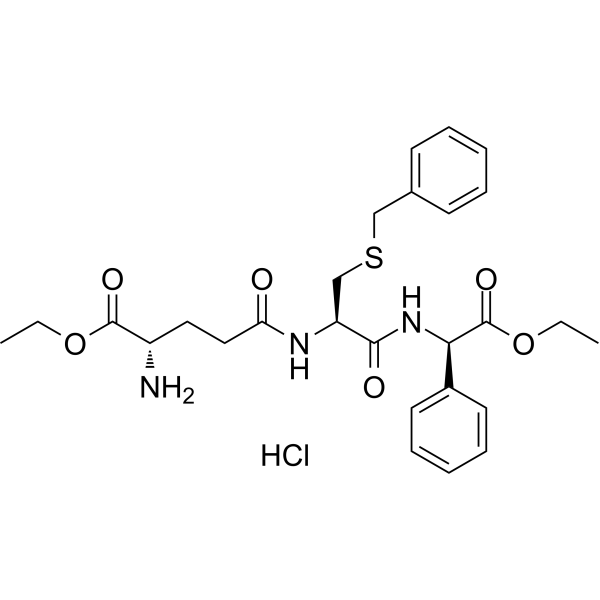
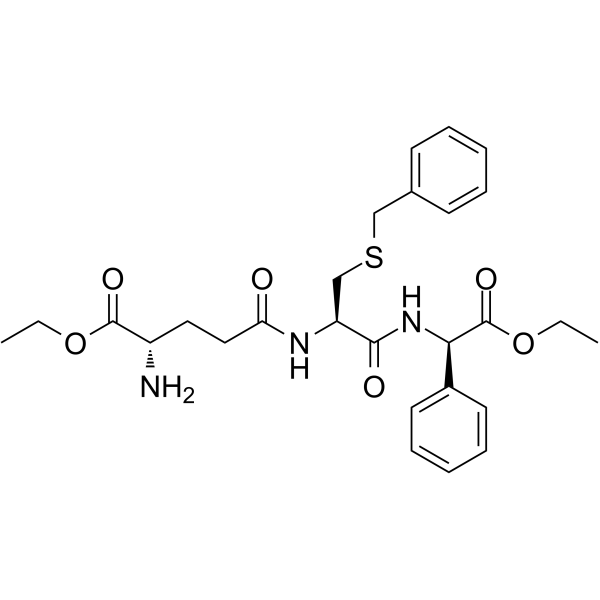
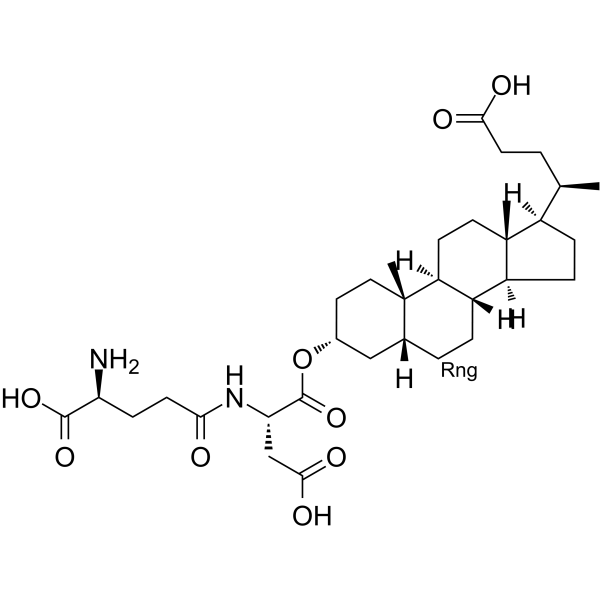
Ezatiostat hydrochloride (TER199; TLK199 hydrochloride) is a tripeptide analog of glutathione and is a selective and orally active glutathione S-transferase P1-1 (GSTP1) inhibitor. Ezatiostat hydrochloride leads to JNK activation by inhibiting GSTP1. Ezatiostat hydrochloride stimulates both lymphocyte production and bone marrow progenitor proliferation. Ezatiostat hydrochloride has the potential for myelodysplastic syndrome (MDS) treatment.
For research use only. We do not sell to patients.
- CAS No.: 286942-97-0
- Formula: C27H36ClN3O6S
- Molecular Weight:566.11
-
Storage:
Please store the product under the recommended conditions in the Certificate of Analysis.

To place orders, for customer services and technical support, please contact: MedChemExpress USA
Tel: 609-228-6898 E-mail: [email protected] [email protected]


-
 Biological Activity
-
Chemical Information
- Purity & Documentation
- References
-
 Help & FAQs



Publications Citing Use of MedChemExpress (MCE) Ezatiostat hydrochloride
More- Cell Res. 2018 Dec;28(12):1171-1185. [Abstract]
- Redox Biol. 2024 Oct:76:103323. [Abstract]
- Redox Biol. 2023 May:61:102635. [Abstract]
- Adv Sci (Weinh). 2023 Mar;10(7):e2205262. [Abstract]
- Phytomedicine. 2024 Nov:134:155989. [Abstract]
- Free Radic Biol Med. 2024 Sep:222:229-243. [Abstract]
- Arch Biochem Biophys. 2024 Jul:757:110043. [Abstract]
 Customer Validation & Images

-
Bio/Physico-chemical Assay
-
WB
-
Cell Proliferation/Viability Assay
-
In Vivo Efficacy Study
-
Cell Proliferation/Viability Assay


Biological Activity
Description
IC50 & Target
Glutathione S-transferase P1-1 (GSTP1)[1]
In Vitro
Ezatiostat causes dissociation of the enzyme from the jun-N-terminal kinase/c-Jun (JNK/JUN) complex, leading to JNK activation by phosphorylation. The therapeutic action of ezatiostat appears to include both proliferation of normal myeloid progenitors as well as apoptosis of the malignant clone[1].
Selection of a resistant clone of an HL60 tumor cell line through chronic exposure to Ezatiostat (TLK199) results in cells with elevated activities of c-Jun NH2 terminal kinase (JNK1) and ERK1/ERK2, and allowes the cells to proliferate under stress conditions that induced high levels of apoptosis in the wild type cells[2].
MedChemExpress (MCE) has not independently confirmed the accuracy of these methods. They are for reference only.
In Vivo
MedChemExpress (MCE) has not independently confirmed the accuracy of these methods. They are for reference only.
Clinical Trial
| NCT Number | Sponsor | Condition | Start Date |
Phase

|
|---|---|---|---|---|
| NCT01329991 | Plexxikon| | 2011-05 | PHASE1 |


Chemical Information
-
CAS No. 286942-97-0
-
Molecular Weight 566.11
-
Formula C27H36ClN3O6S
-
Synonyms
TER199; TLK199 hydrochloride
-
Shipping
Room temperature in continental US; may vary elsewhere.
-
Storage
Please store the product under the recommended conditions in the Certificate of Analysis.


Publications (7)
-
Journal Impact Factor
-
Most Recent
-
Cell Res
2018 Dec;28(12):1171-1185. PMID: 30287942 -
Redox Biol
Tryptanthrin targets GSTP1 to induce senescence and increases the susceptibility to apoptosis by senolytics in liver cancer cells. [Abstract]2024 Oct:76:103323. PMID: 39180983
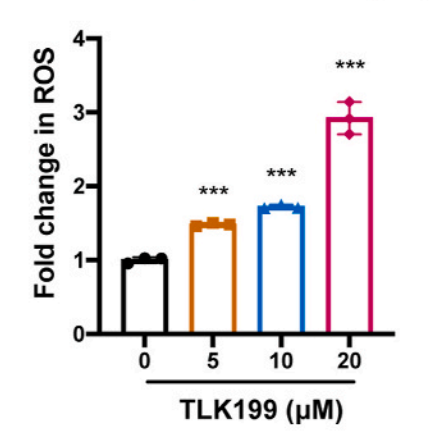
Ezatiostat hydrochloride purchased from MedChemExpress. Usage Cited in: Redox Biol. 2024 Oct:76:103323. [Abstract]
Huh7 cells were treated with 0, 5, 10, and 20 μM Ezatiostat (TLK199) for 72 h, followed by FACS analysis to assess ROS production.
Ezatiostat hydrochloride purchased from MedChemExpress. Usage Cited in: Redox Biol. 2024 Oct:76:103323. [Abstract]
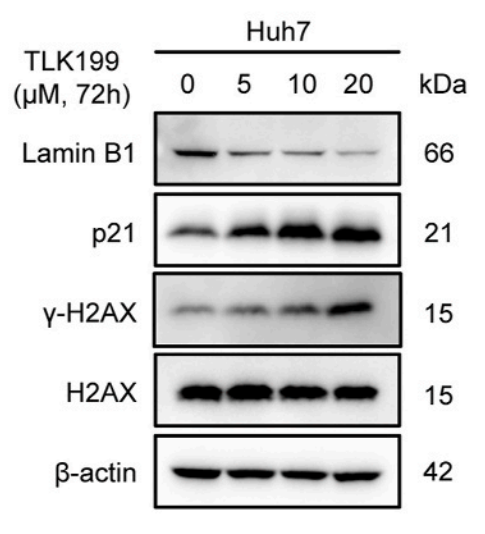
Protein expression levels of Lamin B1, p21, γ-H2AX and H2AX were detected by western blot upon treatment of Ezatiostat (TLK199, 0-20 μM, 72 h), with β-actin as a loading control.
-
Redox Biol
GSTP1-mediated S-glutathionylation of Pik3r1 is a redox hub that inhibits osteoclastogenesis through regulating autophagic flux. [Abstract]2023 May:61:102635. PMID: 36870110 -
Adv Sci (Weinh)
Targeting GSTP1 as Therapeutic Strategy against Lung Adenocarcinoma Stemness and Resistance to Tyrosine Kinase Inhibitors. [Abstract]2023 Mar;10(7):e2205262. PMID: 36709476
Ezatiostat hydrochloride purchased from MedChemExpress. Usage Cited in: Adv Sci (Weinh). 2023 Mar;10(7):e2205262. [Abstract]
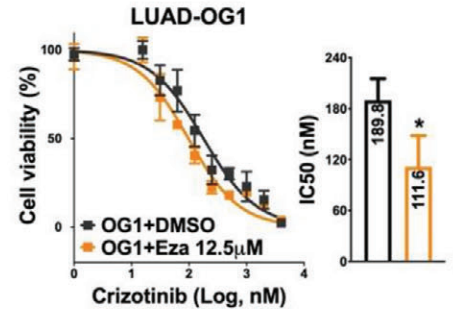
In vitro effects of treatment with the GSTP1 inhibitor Ezatiostat (12.5 μM) on crizotinib sensitivity in LUAD-OG1 evaluated by Cell titer-Glo cell viability assay.
Ezatiostat hydrochloride purchased from MedChemExpress. Usage Cited in: Adv Sci (Weinh). 2023 Mar;10(7):e2205262. [Abstract]
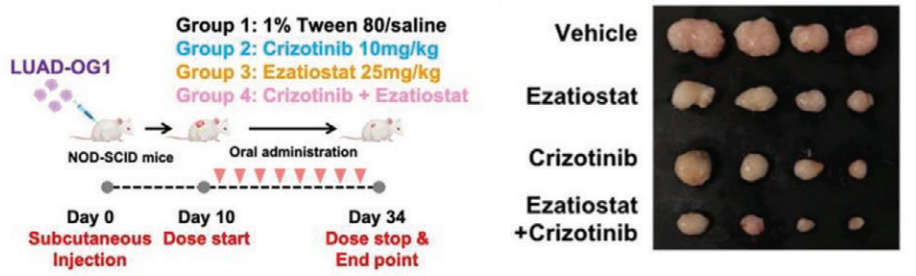
Schematic diagram of the treatment regimen with 1% Tween 80/saline (Group 1), crizotinib (10 mg/kg; Group2), ezatiostat (25 mg/kg; Group 3), or the combination of ezatiostat with crizotinib (Group 4) in NOD-SCID mice. n = 4 mice per group. Representative image of LUAD-OG1 xenografts from the four groups at the endpoint are shown.
Ezatiostat hydrochloride purchased from MedChemExpress. Usage Cited in: Adv Sci (Weinh). 2023 Mar;10(7):e2205262. [Abstract]
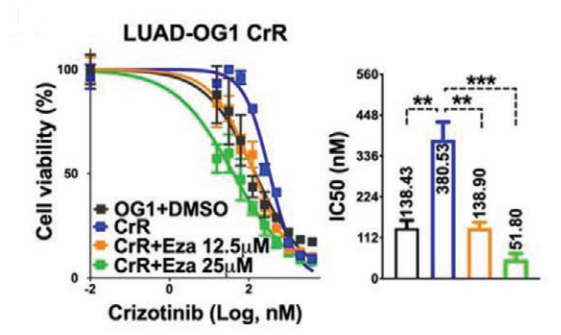
Ex vivo effects of GSTP1 inhibitor Ezatiostat (12.5 and 25 μM) treatment on crizotinib sensitivity in crizotinib-resistant LUAD-OG1 evaluated by Cell titer-Glo cell viability assay.
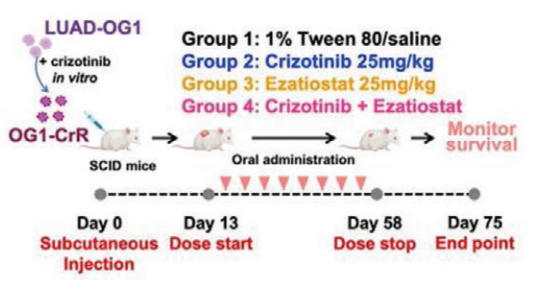
Ezatiostat hydrochloride purchased from MedChemExpress. Usage Cited in: Adv Sci (Weinh). 2023 Mar;10(7):e2205262. [Abstract]
Schematic diagram of oral gavage of the treatment regimen with 1% Tween 80/saline (Group 1), crizotinib (25 mg kg−1; Group2), ezatiostat (25 mg/kg; Group 3), or the combination of ezatiostat with crizotinib (Group 4) in SCID mice.
-
Phytomedicine
Galangin alleviated Doxorubicin-induced cardiotoxicity by inhibiting ferroptosis through GSTP1/JNK pathway. [Abstract]2024 Nov:134:155989. PMID: 39217656 -
Free Radic Biol Med
Mifepristone protects acetaminophen induced liver injury through NRF2/GSH/GST mediated ferroptosis suppression. [Abstract]2024 Sep:222:229-243. PMID: 38906233 -
Arch Biochem Biophys
Subcellular distribution and Nrf2/Keap1-interacting properties of Glutathione S-transferase P in hepatocellular carcinoma. [Abstract]2024 Jul:757:110043. PMID: 38789086


Purity & Documentation
References
[1]. Galili N, et al. Prediction of response to therapy with ezatiostat in lower risk myelodysplastic syndrome. J Hematol Oncol. 2012 May 6;5:20 [Content Brief]
[2]. Ruscoe JE, et al. Pharmacologic or genetic manipulation of glutathione S-transferase P1-1 (GSTpi) influences cell proliferation pathways. J Pharmacol Exp Ther. 2001 Jul;298(1):339-45. [Content Brief]

Calculators
Concentration (start) × Volume (start) = Concentration (final) × Volume (final)


Ezatiostat hydrochloride Related Classifications
HY-13634 Related Classifications
 Powered by Bioz