



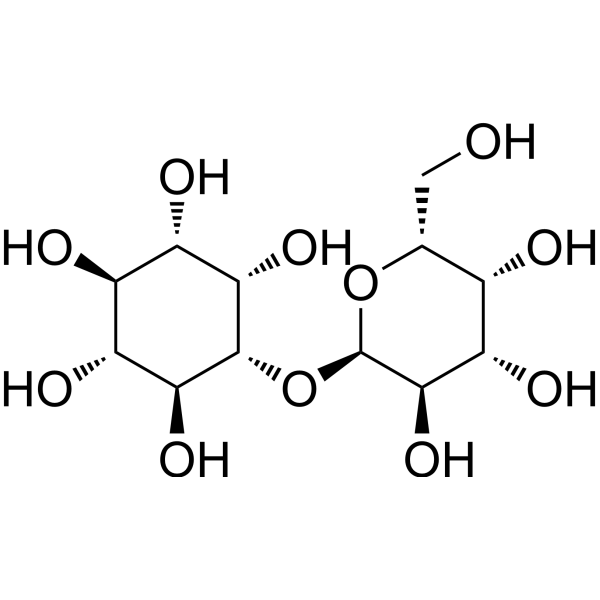
Galactinol

Based on 1 Customer Validation
Galactinol is a disaccharide carbohydrate serving as a galactosyl donor, which belongs to the raffinose family oligosaccharide pathway and acts as an important osmoprotectant. Galactinol not only induces disease resistance in plants against fungal and bacterial pathogens, but also significantly enhances plant tolerance to abiotic stresses such as drought, high salinity, low temperature and oxidative damage. In addition, Galactinol has the ability to scavenge hydroxyl radicals, can act as a signaling component for root colonization-induced systemic resistance, and is positively correlated with seed longevity in various crops, making it a potential biomarker for evaluating seed vigor. Therefore, Galactinol can be used in the research of various plant diseases including fungal leaf spot, bacterial angular leaf spot, gray mold and soft rot.
For research use only. We do not sell to patients.
- Purity : 99.92%
- CAS No.: 3687-64-7
- Formula: C12H22O11
- Molecular Weight:342.30
-
Storage:Powder -20°C, 3 years , 4°C, 2 years ; In solvent -80°C, 6 months , -20°C, 1 month

To place orders, for customer services and technical support, please contact: MedChemExpress USA
Tel: 609-228-6898 E-mail: [email protected] [email protected]


-
 Biological Activity
-
Chemical Information
-
Solvent & Solubility
- Protocols
- Purity & Documentation
- References
-
 Help & FAQs



All Galectin Isoforms
More

Biological Activity
Description
In Vitro
Galactinol (0.5-10 mM) potently scavenges hydroxyl radicals in vitro with an ID50 of 3.1 mM and a second-order rate constant of 7.8 × 10⁹ M-1s-1[1].
Galactinol (40.4 ± 18.8-1,727 ± 366 nmol/g fresh weight; endogenous production via transgene overexpression) in Arabidopsis thaliana ecotype Columbia plants confers protection against methylviologen-induced oxidative stress under control light intensity, as evidenced by preserved PSII activity, reduced lipid peroxidation, and maintained antioxidant pool levels[1].
Galactinol (40.4 ± 18.8-1,727 ± 366 nmol/g fresh weight; endogenous production via transgene overexpression) in Arabidopsis thaliana ecotype Columbia plants confers protection against methylviologen-induced oxidative stress under high light intensity, as evidenced by reduced visible leaf injury, preserved PSII activity, and reduced lipid peroxidation[1].
Galactinol (40.4 ± 18.8-1,727 ± 366 nmol/g fresh weight; endogenous production via transgene overexpression) in Arabidopsis thaliana ecotype Columbia plants confers protection against salinity stress, as evidenced by reduced visible leaf bleaching, preserved PSII activity, and reduced lipid peroxidation[1].
Galactinol (0.5-5 mM; root application) confers enhanced resistance to fungal and bacterial pathogens, tolerance to drought and high-salinity stress at 0.5 mM, while 5 mM induces expression of specific defense-related genes in wild-type tobacco[2].
MedChemExpress (MCE) has not independently confirmed the accuracy of these methods. They are for reference only. Further protocols information, click here.


Chemical Information
-
CAS No. 3687-64-7
-
Appearance Solid
-
Molecular Weight 342.30
-
Formula C12H22O11
-
Color White to off-white
-
SMILES
O[C@@H]([C@@H]([C@H]([C@@H]([C@@H]1O)O)O)O)[C@H]1O[C@H]2O[C@@H]([C@@H]([C@@H]([C@H]2O)O)O)CO
-
Shipping
Room temperature in continental US; may vary elsewhere.
-
Storage
Powder -20°C 3 years 4°C 2 years In solvent -80°C 6 months -20°C 1 month


Solvent & Solubility
In Vitro:
H2O : 250 mg/mL (730.35 mM; Need ultrasonic)
Please refer to the solubility information to select the appropriate solvent. Once prepared, please aliquot and store the solution to prevent product inactivation from repeated freeze-thaw cycles.
Storage method and period of stock solution: -80°C, 6 months; -20°C, 1 month. When stored at -80°C, please use it within 6 months. When stored at -20°C, please use it within 1 month.
* Note: If you choose water as the stock solution, please dilute it to the working solution, then filter and sterilize it with a 0.22 μm filter before use.
Please refer to the solubility information to select the appropriate solvent. Once prepared, please aliquot and store the solution to prevent product inactivation from repeated freeze-thaw cycles.
Storage method and period of stock solution: -80°C, 6 months; -20°C, 1 month. When stored at -80°C, please use it within 6 months. When stored at -20°C, please use it within 1 month.
* Note: If you choose water as the stock solution, please dilute it to the working solution, then filter and sterilize it with a 0.22 μm filter before use.
Concentration (start) × Volume (start) = Concentration (final) × Volume (final)

Protocols
-
ROS/oxidative-stress fluorescent staining
ROS/oxidative-stress fluorescent staining uses cell-permeant fluorogenic probes that become fluorescent after oxidation inside cells or tissues; commonly used examples include DCFH-DA/DCFDA for broad cellular oxidant detection, DHE for superoxide-related signal detection, MitoSOX for mitochondrial superoxide-related signal detection, and CellROX probes for oxidative-stress-associated fluorescence readouts. The assay detects probe oxidation rather than a single ROS species unless the probe and analysis method have been chemically validated for that species. DCFH-DA enters cells, is deacetylated by intracellular esterases to DCFH, and produces fluorescent DCF after oxidation, so the readout is used as an operational measure of total cellular oxidative stress rather than a species-specific ROS measurement. DHE and MitoSOX can report superoxide-related oxidation, but red fluorescence alone can include non-specific ethidium-like oxidation products; HPLC or optimized spectral approaches are


Purity & Documentation
-
Data Sheet (278 KB)
-
SDS (394 KB)
- English - EN (394 KB)
- Français - FR (394 KB)
- Deutsch - DE (394 KB)
- Norwegian - NO (394 KB)
- Español - ES (394 KB)
- Swedish - SV (394 KB)
- Italian - IT (394 KB)
- Korean - KR (394 KB)
- Portuguese - PT (394 KB)
-
Handling Instructions (2659 KB)
References
[1]. Nishizawa A, et al. Galactinol and raffinose constitute a novel function to protect plants from oxidative damage. Plant Physiol. 2008 Jul;147(3):1251-63. [Content Brief]
[2]. Kim MS, et al. Galactinol is a signaling component of the induced systemic resistance caused by Pseudomonas chlororaphis O6 root colonization. Mol Plant Microbe Interact. 2008;21(12):1643-1653. [Content Brief]
[3]. de Souza Vidigal D, et al. Galactinol as marker for seed longevity. Plant Sci. 2016;246:112-118. [Content Brief]


Complete Stock Solution Preparation Table
Please refer to the solubility information to select the appropriate solvent. Once prepared, please aliquot and store the solution to prevent product inactivation from repeated freeze-thaw cycles.
Storage method and period of stock solution: -80°C, 6 months; -20°C, 1 month. When stored at -80°C, please use it within 6 months. When stored at -20°C, please use it within 1 month.
| Optional Solvent | Concentration Solvent Mass | 1 mg | 5 mg | 10 mg | 25 mg |
|---|---|---|---|---|---|
| H2O | 1 mM | 2.9214 mL | 14.6071 mL | 29.2141 mL | 73.0354 mL |
| 5 mM | 0.5843 mL | 2.9214 mL | 5.8428 mL | 14.6071 mL | |
| 10 mM | 0.2921 mL | 1.4607 mL | 2.9214 mL | 7.3035 mL | |
| 15 mM | 0.1948 mL | 0.9738 mL | 1.9476 mL | 4.8690 mL | |
| 20 mM | 0.1461 mL | 0.7304 mL | 1.4607 mL | 3.6518 mL | |
| 25 mM | 0.1169 mL | 0.5843 mL | 1.1686 mL | 2.9214 mL | |
| 30 mM | 0.0974 mL | 0.4869 mL | 0.9738 mL | 2.4345 mL | |
| 40 mM | 0.0730 mL | 0.3652 mL | 0.7304 mL | 1.8259 mL | |
| 50 mM | 0.0584 mL | 0.2921 mL | 0.5843 mL | 1.4607 mL | |
| 60 mM | 0.0487 mL | 0.2435 mL | 0.4869 mL | 1.2173 mL | |
| 80 mM | 0.0365 mL | 0.1826 mL | 0.3652 mL | 0.9129 mL | |
| 100 mM | 0.0292 mL | 0.1461 mL | 0.2921 mL | 0.7304 mL |
* Note: If you choose water as the stock solution, please dilute it to the working solution, then filter and sterilize it with a 0.22 μm filter before use.


Galactinol Related Classifications
HY-N9497 Related Classifications
 Powered by Bioz