



ELR510444
Based on 1 publication(s) in Google Scholar
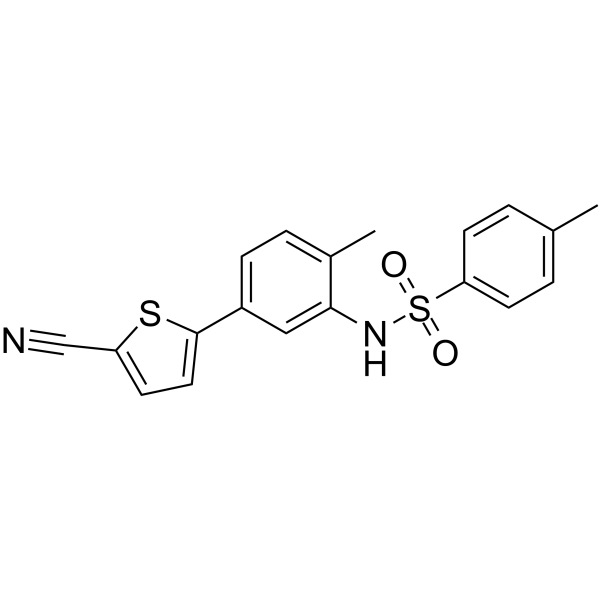
ELR510444 is an orally active tubulin inhibitor with an IC50 of 10 μM. ELR510444 binds to the colchicine-binding site on β-tubulin, inhibits tubulin assembly, depolymerizes microtubules and blocks HIF activity. ELR510444 induces cellular microtubule loss, abnormal mitotic spindle, mitotic arrest, apoptosis, morphological changes in tumor endothelial cells, and inhibits cancer cell proliferation, angiogenesis and tumor growth. ELR510444 can be used in research related to various cancers such as renal cell carcinoma.
Para uso exclusivo en investigación. No vendemos a pacientes.
- Pureza: 98.0%
- No. CAS: 1233948-35-0
- Fòrmula: C19H16N2O2S2
- Peso molecular:368.47
-
Almacenamiento:Powder -20°C, 3 years , 4°C, 2 years ; In solvent -80°C, 2 years , -20°C, 1 year

To place orders, for customer services and technical support, please contact: MedChemExpress USA
Tel: 609-228-6898 E-mail: [email protected] [email protected]


-
 Actividad biológica
-
Chemical Information
-
Solvente y solubilidad
- Pureza y Documentación
- Referencias
-
 Help & FAQs
-

Apoptosis Compound Library
HY-L003
-
Cell Cycle/DNA Damage Compound Library
HY-L004
-
Epigenetics Compound Library
HY-L005
-
Immunology/Inflammation Compound Library
HY-L007
-
Metabolism/Protease Compound Library
HY-L012
-
Anti-Cancer Compound Library
HY-L025
-
Anti-Aging Compound Library
HY-L034
-
Reprogramming Compound Library
HY-L039
-
Oxygen Sensing Compound Library
HY-L045
-
Cytoskeleton Compound Library
HY-L060
-
Glutamine Metabolism Compound Library
HY-L064
-
Anti-Breast Cancer Compound Library
HY-L074
-
Anti-Lung Cancer Compound Library
HY-L075
-
Anti-Cancer Metabolism Compound Library
HY-L083
-
Angiogenesis-Related Compound Library
HY-L088
-
Transcription Factor-Targeted Library
HY-L090
-
Protein-protein Interaction Inhibitor Library
HY-L109
-
Cancer Stem Cells Compound Library
HY-L135
-
Metabolic Enzyme Compound Library
HY-L146
-
Cell Death Library
HY-L162
-
Anti-Ovarian Cancer Compound Library
HY-L173
-
Multi-Target Compound Library
HY-L176
-
Bioactive Compound Library Max
HY-L181
-
MCE Bioactive Compound Library
HY-L001V
-
Bioactive Compound Library
HY-L001
-
Anti-Fibrosis Compound Library
HY-L185
-
Protein Kinase Compound Library
HY-L196
-
Non-Alcoholic Fatty Liver Disease (NAFLD) Compound Library
HY-L199
-
Lactic Acid Metabolic Compound Library
HY-L204
-
High-Throughput Bioactive Compound Library
HY-L205
-
High-Efficiency Gene Editing Compound Library
HY-L244


Publications Citing Use of MedChemExpress (MCE) ELR510444
More

Actividad biológica
ELR510444 (48 h) potently inhibits the proliferation of various cancer cell lines and endothelial cell lines at low nanomolar concentrations, with relatively low relative resistance in βIII-tubulin-overexpressing HeLa cells (Rr = 1.4) and P-glycoprotein-overexpressing SK-OV-3 cells (Rr = 2.3)[1].
ELR510444 (18 h) acts as a microtubule depolymerizing agent in rat embryonic aortic smooth muscle cells A-10, with an EC50 of 21 nM for inducing cellular microtubule loss[1].
ELR510444 (25 nM; 18 h) induces mitotic arrest and formation of compact abnormal multipolar spindles in HeLa cervical cancer cells[1].
ELR510444 induces apoptosis in HCT-116 cells, with an EC50 of 19 nM for activating caspase 3/7, which is consistent with its antiproliferative mechanism[1].
ELR510444 (30 nM; 1 h) induces rapid morphological changes (retraction of intercellular junctions, formation of membrane vesicles) in 2H-11 mouse tumor endothelial cells upon treatment at 30 nM for 1 h, suggesting its potential vascular disrupting activity[1].
ELR510444 (0-100 nM; 16 h) potently inhibits HIF-1α activity in VHL-deficient RCC4 cells, with nearly complete inhibition observed at concentrations ≥ 30 nM[2].
ELR510444 (0-100 nM; 24 h) reduces the protein expression of HIF-1α and HIF-2α in VHL-deficient RCC4 cells in a dose-dependent manner[2].
ELR510444 (10 nM; 24 h) significantly reduces the transcriptional level of HIF-1α in VHL-deficient RCC4 cells, as well as the transcriptional level of HIF-2α in VHL-deficient RCC4, 786-O and A498 cells[2].
ELR510444 (10 nM; 16 h) significantly reduces VEGF secretion in VHL-deficient A498, RCC4 and 786-O renal cell carcinoma cells[2].
ELR510444 (0-1000 nM; 72 h) reduces cell viability in all tested renal cell carcinoma cell lines, and exerts more significant efficacy in VHL-deficient A498, 786-O and RCC4 cells compared with VHL-proficient ACHN, Caki-1 and Caki-2 cells[2].
ELR510444 (3-30 nM; 24 h) reduces the clonogenic survival rate of all tested renal cell carcinoma cell lines, and exerts more significant efficacy on VHL-deficient A498, 786-O and RCC4 cells compared with VHL-proficient ACHN, Caki-1 and Caki-2 cells[2].
ELR510444 (10-30 nM; 24 h) induces apoptosis in all tested renal cell carcinoma cell lines; it exhibits selective activity against VHL-deficient A498, 786-O and RCC4 cells at a concentration of 10 nM, and acts on all cell lines at 30 nM[2].
Studies show that introduction of VHL into VHL-deficient A498 and 786-O renal cell carcinoma cells significantly reduces the sensitivity of these cells to apoptosis induced by 10 nM ELR510444 (10 nM; 24 h)[2].
ELR510444 (10 nM; 24 h) reduces the expression level of HIF-2α protein in vector-only-transfected and VHL-transfected A498 and 786-O renal cell carcinoma cells under both basal and hypoxic (CoCl2-treated) conditions[2].
ELR510444 (10 nM; 16 h) reduces VEGF secretion levels in vector-only-transfected and VHL-transfected A498 and 786-O renal cell carcinoma cells under both basal and hypoxic (CoCl2-treated) conditions[2].
ELR510444 (0-30 nM; 72 h) reduces the viability of vector-only transfected and VHL-transfected A498 and 786-O renal cell carcinoma cells, and its efficacy against VHL-transfected cells is enhanced under hypoxic conditions (treated with CoCl2)[2].
ELR510444 (10-30 nM; 24 h) induces mitotic arrest and apoptosis in all tested renal cell carcinoma cell lines at the concentration of 30 nM, while it preferentially induces apoptosis in VHL-deficient cell lines at 10 nM[2].
ELR510444 (20-35 nM; 24 h) destabilizes microtubules in RCC4 renal cancer cells, with an EC50 of 27 nM, and significant depolymerization is observed at concentrations ≥ 20 nM[2].
MedChemExpress (MCE) has not independently confirmed the accuracy of these methods. They are for reference only.
-
Cell Line:HeLa cervical cancer cells
-
Concentration:25 nM
-
Incubation Time:18 h
-
Result:Caused accumulation of HeLa cells with tetraploid DNA content (mitotic arrest) and induced formation of aberrant, compact, multiple mitotic spindles.
-
Cell Line:VHL-deficient RCC4 renal cell carcinoma cells
-
Concentration:0, 3, 10, 30 and 100 nM
-
Incubation Time:24 h
-
Result:Induced a dose-dependent decrease in both HIF-1α and HIF-2α protein expression, with visible reduction starting at 0.3 nM and near-complete loss at 100 nM.
Maintained consistent β-tubulin levels across all concentrations.
-
Cell Line:VHL-deficient RCC4, 786-O, and A498 renal cell carcinoma cells
-
Concentration:10 nM
-
Incubation Time:24 h
-
Result:Reduced HIF-1α transcript levels in RCC4 cells with a fold change ~-1.2 relative to control.
Reduced HIF-2α transcript levels in 786-O, RCC4, and A498 cell.
-
Cell Line:VHL-deficient A498, RCC4, and 786-O renal cell carcinoma cells
-
Concentration:10 nM
-
Incubation Time:16 h
-
Result:Decreased VEGF secretion in all three cell lines: from ~2100 pg/mL to ~1100 pg/mL in A498, ~1500 pg/mL to ~800 pg/mL in RCC4, and ~1300 pg/mL to ~800 pg/mL in 786-O.
-
Cell Line:VHL-deficient (A498, 786-O, RCC4) and VHL-proficient (ACHN, Caki-1, Caki-2) renal cell carcinoma cells
-
Concentration:10 and 30 nM
-
Incubation Time:24 h
-
Result:Stimulated apoptosis in all tested RCC cell lines.
Induced 20-45% DNA fragmentation in VHL-deficient lines at 10 nM, compared to 10-20% in VHL-proficient lines.
Induced 25-45% DNA fragmentation in all lines at 30 nM.
-
Cell Line:VHL-transfected and vector-only control A498 and 786-O renal cell carcinoma cells
-
Concentration:10 nM
-
Incubation Time:24 h
-
Result:Induced ~20% DNA fragmentation in vector-only A498 cells and ~17% in vector-only 786-O cells, compared to ~8-9% in VHL-transfected A498 and 786-O cells.
-
Cell Line:VHL-transfected and vector-only control A498 and 786-O renal cell carcinoma cells treated with hypoxia mimic (CoCl2)
-
Concentration:10 nM
-
Incubation Time:24 h
-
Result:Reduced HIF-2α levels under both basal and hypoxic (CoCl2-treated) conditions in both vector and VHL-transfected cells, despite CoCl2 stimulating HIF-2α expression in VHL-transfected cells.
-
Cell Line:VHL-transfected and vector-only control A498 and 786-O renal cell carcinoma cells treated with hypoxia mimic (CoCl2)
-
Concentration:10 nM
-
Incubation Time:16 h
-
Result:Reduced VEGF secretion under both basal and hypoxic (CoCl2-treated) conditions in both vector and VHL-transfected cells, with levels corresponding to reduced HIF-2α expression.
-
Cell Line:VHL-deficient (A498, 786-O, RCC4) and VHL-proficient (ACHN, Caki-1, Caki-2) renal cell carcinoma cells
-
Concentration:10 and 30 nM
-
Incubation Time:24 h
-
Result:Induced mitotic (G2/M) arrest and increased sub-G0/G1 apoptotic cells in all tested RCC lines at 30 nM.
Induced apoptosis preferentially in VHL-deficient lines without prominent G2/M arrest at 10 nM.
-
Cell Line:RCC4 renal cell carcinoma cells
-
Concentration:20, 25, 30 and 35 nM
-
Incubation Time:24 h
-
Result:Induced microtubule destabilization in a dose-dependent manner, with detectable depolymerization starting at 15 nM, visible effects in most cells at 20 nM, and an EC50 of 27 nM for microtubule loss.
| Species | Dose | Route | Cmax | T1/2 |
|---|---|---|---|---|
| Mice[1] | 25 mg/kg | p.o. | 1.2 μg/mL | 3.6 h |
ELR510444 (8 mg/kg; p.o.; QDx5; 2 weeks) significantly reduces tumor volume by ~55%, inhibits tumor angiogenesis, increases tumor necrosis, and induces tumor cell and endothelial cell apoptosis in the 786-O RCC xenograft model[2].
ELR510444 (8 mg/kg; p.o.; QDx5; 2 weeks) significantly reduces tumor volume by ~46%, inhibits tumor angiogenesis, increases tumor necrosis, and induces tumor cell and endothelial cell apoptosis in the A498 RCC xenograft model[2].
MedChemExpress (MCE) has not independently confirmed the accuracy of these methods. They are for reference only.
-
Animal Model:BALB/c nude (female, 6 to 7 weeks of age)[1]
-
Dosage:3 mg/kg; 6 mg/kg; 12.5 mg/kg
-
Administration:p.o.; daily; 28 days
-
Result:Caused dose-dependent antitumor effects.
Demonstrated antitumor activity comparable with positive control ABT-751 at 75 mg/kg at 6 mg/kg dose.
Showed no additional antitumor activity at 12.5 mg/kg maximum tolerated dose compared with 6 mg/kg dose.
Maintained animal body weight during first 2 weeks of treatment, with only minor weight loss in last 2 weeks that never dropped below initial body weight.
Achieved at least a 2-fold therapeutic window.
-
Animal Model:BALB/c nude mice (female)[2]
-
Dosage:8 mg/kg
-
Administration:p.o.; QDx5; 2 weeks
-
Result:Decreased mean tumor volume by ~55% compared to vehicle controls.
Reduced PCNA-positive cells to ~35% from ~85% in controls.
Increased cleaved caspase-3 positive cells to ~10% from ~1.5% in controls.
Elevated central tumor necrosis to 60% from 5% in controls.
Reduced mean vessel density to 16 from 39 in controls.
Increased endothelial cell apoptosis to 7% from 1% in controls.
Reduced VEGF relative intensity to ~0.65 from ~1.7 in controls.
Caused no significant animal weight loss.\nDecreased mean tumor volume by ~46% compared to vehicle controls.
Reduced PCNA-positive cells to ~32% from ~90% in controls.
Increased cleaved caspase-3 positive cells to ~12% from ~1% in controls.
Elevated central tumor necrosis to 27% from 4% in controls.
Reduced mean vessel density to 12 from 34 in controls.
Increased endothelial cell apoptosis to 8% from 0.5% in controls.
Reduced VEGF relative intensity to ~0.6 from ~1.55 in controls.
Caused no significant animal weight loss.


Chemical Information
-
No. CAS 1233948-35-0
-
Appearance Solid
-
Peso molecular 368.47
-
Fòrmula C19H16N2O2S2
-
Color Light yellow to yellow
-
SMILES
O=S(C1=CC=C(C)C=C1)(NC2=CC(C3=CC=C(C#N)S3)=CC=C2C)=O
-
Envío
Room temperature in continental US; may vary elsewhere.
-
Almacenamiento
Powder -20°C 3 years 4°C 2 years In solvent -80°C 2 years -20°C 1 year


Publications (1)
-
Journal Impact Factor
-
Most Recent
-
RSC Adv
Structural insights into targeting of the colchicine binding site by ELR510444 and parbendazole to achieve rational drug design. [Abstract]2021 May 25;11(31):18938-18944. PMID: 35478655


Solvente y solubilidad
DMSO : ≥ 37 mg/mL (100.42 mM; Hygroscopic DMSO has a significant impact on the solubility of product, please use newly opened DMSO)
* "≥" means soluble, but saturation unknown.
Please refer to the solubility information to select the appropriate solvent. Once prepared, please aliquot and store the solution to prevent product inactivation from repeated freeze-thaw cycles.
Storage method and period of stock solution: -80°C, 2 years; -20°C, 1 year. When stored at -80°C, please use it within 2 years. When stored at -20°C, please use it within 1 year.
Please refer to the solubility information to select the appropriate solvent. Once prepared, please aliquot and store the solution to prevent product inactivation from repeated freeze-thaw cycles.
Storage method and period of stock solution: -80°C, 2 years; -20°C, 1 year. When stored at -80°C, please use it within 2 years. When stored at -20°C, please use it within 1 year.
Concentration (start) × Volume (start) = Concentration (final) × Volume (final)


Pureza y Documentación
-
Ficha de datos (289 KB)
-
SDS (392 KB)
- English - EN (392 KB)
- Français - FR (392 KB)
- Deutsch - DE (392 KB)
- Norwegian - NO (392 KB)
- Español - ES (392 KB)
- Swedish - SV (392 KB)
- Italian - IT (392 KB)
- Korean - KR (392 KB)
- Portuguese - PT (392 KB)
-
Instrucciones de manejo (2659 KB)
Referencias
[1]. Risinger AL, et al. ELR510444, a novel microtubule disruptor with multiple mechanisms of action. J Pharmacol Exp Ther. 2011;336(3):652-660. [Content Brief]
[2]. Carew JS, et al. ELR510444 inhibits tumor growth and angiogenesis by abrogating HIF activity and disrupting microtubules in renal cell carcinoma. PLoS One. 2012;7(1):e31120. [Content Brief]


Complete Stock Solution Preparation Table
Please refer to the solubility information to select the appropriate solvent. Once prepared, please aliquot and store the solution to prevent product inactivation from repeated freeze-thaw cycles.
Storage method and period of stock solution: -80°C, 2 years; -20°C, 1 year. When stored at -80°C, please use it within 2 years. When stored at -20°C, please use it within 1 year.
| Optional Solvent | Concentration Solvent Mass | 1 mg | 5 mg | 10 mg | 25 mg |
|---|---|---|---|---|---|
| DMSO | 1 mM | 2.7139 mL | 13.5696 mL | 27.1393 mL | 67.8481 mL |
| 5 mM | 0.5428 mL | 2.7139 mL | 5.4279 mL | 13.5696 mL | |
| 10 mM | 0.2714 mL | 1.3570 mL | 2.7139 mL | 6.7848 mL | |
| 15 mM | 0.1809 mL | 0.9046 mL | 1.8093 mL | 4.5232 mL | |
| 20 mM | 0.1357 mL | 0.6785 mL | 1.3570 mL | 3.3924 mL | |
| 25 mM | 0.1086 mL | 0.5428 mL | 1.0856 mL | 2.7139 mL | |
| 30 mM | 0.0905 mL | 0.4523 mL | 0.9046 mL | 2.2616 mL | |
| 40 mM | 0.0678 mL | 0.3392 mL | 0.6785 mL | 1.6962 mL | |
| 50 mM | 0.0543 mL | 0.2714 mL | 0.5428 mL | 1.3570 mL | |
| 60 mM | 0.0452 mL | 0.2262 mL | 0.4523 mL | 1.1308 mL | |
| 80 mM | 0.0339 mL | 0.1696 mL | 0.3392 mL | 0.8481 mL | |
| 100 mM | 0.0271 mL | 0.1357 mL | 0.2714 mL | 0.6785 mL |


ELR510444 Related Classifications
HY-16191 Related Classifications
 Powered by Bioz