



IRAK4-IN-19
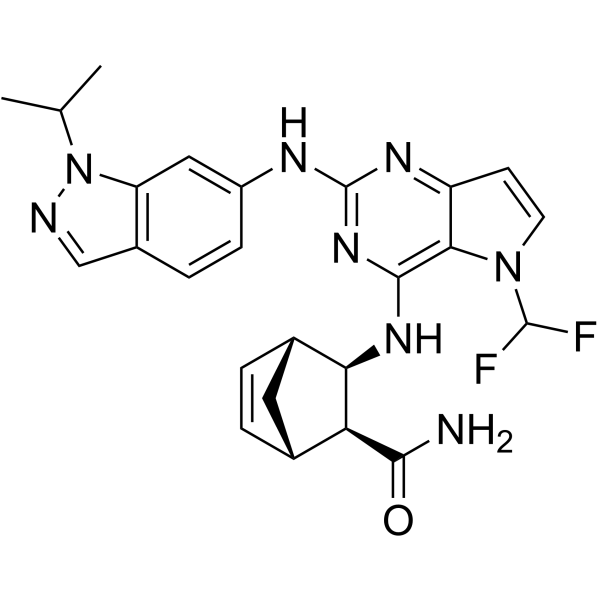
IRAK4-IN-19 is a potent interleukin-1 receptor-associated kinase 4 (IRAK4) inhibitor with an IC50 value of 4.3 nM. IRAK4-IN-19 can inhibit LPS-induced IL23 production in THP and DC cells, and stop arthritis development in arthritis rats. IRAK4-IN-19 can be used for researching arthritis disease.
For research use only. We do not sell to patients.
- CAS No.: 3032075-32-1
- Formula: C25H26F2N8O
- Molecular Weight:492.52
-
Storage:
Please store the product under the recommended conditions in the Certificate of Analysis.

To place orders, for customer services and technical support, please contact: MedChemExpress USA
Tel: 609-228-6898 E-mail: [email protected] [email protected]


-
 Biological Activity
-
Chemical Information
- Protocols
- Purity & Documentation
- References
-
 Help & FAQs




Biological Activity
Description
IC50 & Target
[1]|
IRAK4 4.3 nM (IC50) |
Cellular Effect
|
Cell Line

|
Type | Value | Description | References |
|---|---|---|---|---|
| A549 | IC50 |
0.82 μM
Compound: 39
|
Induction of PAD activity against human A549 cells
Induction of PAD activity against human A549 cells
|
[PMID: 35863718] |
| Dendritic cell | IC50 |
0.22 μM
Compound: 39
|
Antiinflammatory activity against human dendritic cells assessed as inhibition of LPS induced IL-23 production
Antiinflammatory activity against human dendritic cells assessed as inhibition of LPS induced IL-23 production
|
[PMID: 35863718] |
| THP-1 | IC50 |
0.23 μM
Compound: 39
|
Antiinflammatory activity against human THP-1 cells assessed as inhibition of LPS induced IL-23 production
Antiinflammatory activity against human THP-1 cells assessed as inhibition of LPS induced IL-23 production
|
[PMID: 35863718] |
In Vitro
IRAK4-IN-19 (compound 39) has inhibitory activity against LPS-induced IL23 in THP and DC with IC50s of 0.23 and 0.22 μM, respectively[1].
MedChemExpress (MCE) has not independently confirmed the accuracy of these methods. They are for reference only. Further protocols information, click here.
In Vivo
IRAK4-IN-19 (1 mg/kg for IV, 5 mg/kg for PO, single dosage) exhibits a favorable pharmacokinetics profile[1].
IRAK4-IN-19 (5, 15, 45 and 75 mg/kg) exhibits good efficacy in an acute mouse model for the IL-1β induced IL-6 expression, with 64% inhibition at 75 mg/kg dose, 37% inhibition at 45 mg/kg dose, 16% inhibition at 15 mg/kg dose and 9% inhibition at 5 mg/kg[1].
MedChemExpress (MCE) has not independently confirmed the accuracy of these methods. They are for reference only.
-
Animal Model:Rats[1]
-
Dosage:30 mg/kg
-
Administration:twice daily for 21 days
-
Result:Completely stopped arthritis development in arthritis rats at 30 mg/kg.
-
Animal Model:Rats[1]
-
Dosage:1 mg/kg, 5 mg/kg
-
Administration:IV and PO, single dosage
-
Result:Exhibited a favorable pharmacokinetics profile with a clearance of 6 mL/min/kg and oral bioavailability of 43%.


Chemical Information
-
CAS No. 3032075-32-1
-
Molecular Weight 492.52
-
Formula C25H26F2N8O
-
SMILES
CC(N1N=CC2=C1C=C(NC(N=C3C=C4)=NC(N[C@H]5[C@@H](C(N)=O)[C@@H]6C=C[C@H]5C6)=C3N4C(F)F)C=C2)C
-
Shipping
Room temperature in continental US; may vary elsewhere.
-
Storage
Please store the product under the recommended conditions in the Certificate of Analysis.

Protocols
-
Collagen-Induced Arthritis
Collagen-induced arthritis (CIA) is an autoimmune murine model of rheumatoid arthritis in which immunization with type II collagen (CII) emulsified in an adjuvant induces a T cell- and autoantibody-driven inflammatory arthritis characterized by synovial hyperplasia, immune cell infiltration, and joint destruction. The model typically relies on genetically susceptible mouse strains (e. g. , DBA/1) and reproduces key features of human rheumatoid arthritis, including anti-collagen immune responses and progressive joint inflammation. Disease onset generally occurs within ~3-4 weeks after immunization, depending on antigen/adjuvant combinations and protocol variation. The immunopathology is driven by adaptive immune activation against CII, leading to systemic and local joint inflammation mediated by pro-inflammatory cytokines and effector immune cells, making CIA a standard preclinical platform for evaluating immunomodulatory and anti-arthritic interventions.
-
Cell Cytotoxicity Assay
Cytotoxicity assays are usually based on the assessment of cell membrane damage, which can also be indirectly detected by measuring cell viability. Detection methods include MTT assay, CKK-8 assay, LDH assay and ATP assay, etc.


Purity & Documentation
References

Calculators
Concentration (start) × Volume (start) = Concentration (final) × Volume (final)


IRAK4-IN-19 Related Classifications
HY-150733 Related Classifications
 Powered by Bioz