



ジノテフラン
Based on 4 publication(s) in Google Scholar
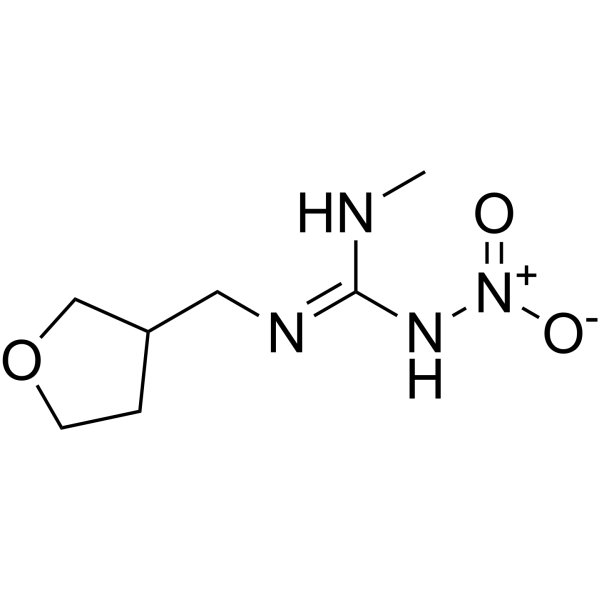
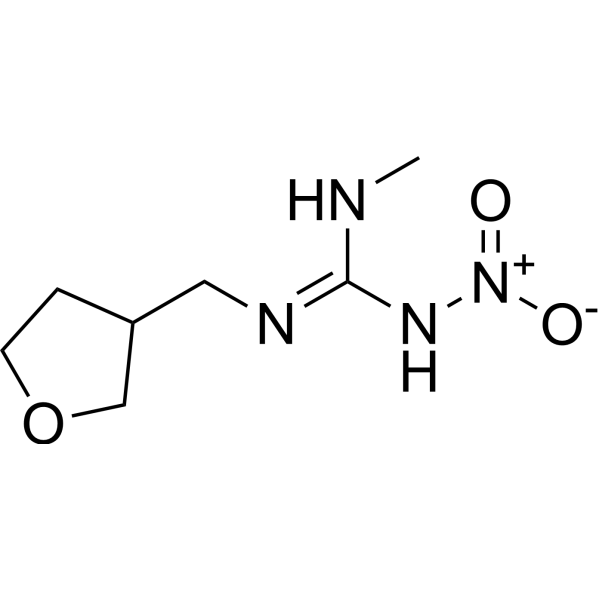
Dinotefuran is an orally active and competitive inhibitor and insecticide targeting insect nicotinic acetylcholine receptors (nAChRs). Dinotefuran blocks neural signaling and induces neural dysfunction in insects. Dinotefuran binds to [3H]epibatidine in the neural cord membrane of American cockroach with an IC50 of 890 nM and to [3H]α-bungarotoxin with an IC50 of 36.1 μM. Dinotefuran exhibits knockdown activity (KD50=0.351 nmol/g) and lethal activity (LD50=0.173 nmol/g) against German cockroach. Dinotefuran is mainly used for agricultural pest control, such as field control of piercing-sucking and chewing insects (e.g., aphids, planthoppers), while its environmental toxicological effects (e.g., oxidative stress and reproductive neurotoxicity on earthworms) are also a research focus to assess ecological risks.
商品は「研究用試薬」です。人や動物の医療用・臨床診断用・食品用の製品ではありません。
研究用途以外に使用した場合、当社は一切の責任を負いかねます。
- 純度: 99.74%
- CAS 番号: 165252-70-0
- 分子式: C7H14N4O3
- 分子量:202.21
-
保管条件:Powder -20°C, 3 years , 4°C, 2 years ; In solvent -80°C, 2 years , -20°C, 1 year

To place orders, for customer services and technical support, please contact: MedChemExpress USA
Tel: 609-228-6898 E-mail: [email protected] [email protected]


-
 生物活性
生物活性
-
化学情報
-
溶剤 & 溶解度
- 純度とドキュメンテーション
- 参考文献
-
 Help & FAQs


MedChemExpress(MCE)の使用を引用している文献 Dinotefuran
MoreParasite アイソフォーム固有の製品をすべて表示
More

生物活性
製品説明
体外実験
Dinotefuran (1 μM; 120 min) competitively inhibits the binding of [3H]EPI to nicotinic acetylcholine receptors (nAChRs) in the neuronal cord membrane of American cockroaches[1].
MedChemExpress (MCE) has not independently confirmed the accuracy of these methods. They are for reference only.
-
Cell Line:Periplaneta americana nerve cord membrane preparations
-
Concentration:IC50: 890 nM ((±)-Dinotefuran); 856 nM ((+)-Dinotefuran); 1890 nM ((-)-Dinotefuran)
-
Incubation Time:120 minutes
-
Result:Inhibited [3H]EPI binding with an IC50 of 890 nM, with (+)-enantiomer being ~2-fold more potent than (-)-enantiomer.
体内実験
Dinotefuran (0.015%-0.06%; mixed in feed; daily intake) leads to prolonged movement time of F0 males, decreased fertility of females, increases birth weight and imbalanced sex ratio of F1 pups, delayes olfactory orientation of female offspring, decreases movement distance and speed of male offspring, and increased urination frequency[2].
MedChemExpress (MCE) has not independently confirmed the accuracy of these methods. They are for reference only.
-
Animal Model:Toxicity model in CD-1 mouse (4-week-old)[2]
-
Dosage:0% (control), 0.015%, 0.03%, and 0.06%
-
Administration:Oral, given in the basal diets (CE-2); 5 weeks of age of the F0 generation to 11 weeks of age of the F1 generation in mice.
-
Result:In F0 adult males, movement time during exploratory behavior significantly increased with dose-related trends), while rearing time and average rearing time decreased.
In F1 offspring, litter size and weight at birth increased in dose-related trends), but sex ratio (male/female) decreased significantly.
On postnatal day (PND) 21, offspring body weight increased in both sexes for males, for females).
Female offspring showed delayed olfactory orientation time on PND 14, while male offspring exhibited reduced total distance, average speed, and increased defecation frequency and urination.


化学情報
-
CAS 番号 165252-70-0
-
性状 Solid
-
分子量 202.21
-
分子式 C7H14N4O3
-
Color White to off-white
-
SMILES
O=[N+](N/C(NC)=N/CC1COCC1)[O-]
-
別名
Dinotefuran
-
輸送条件
Room temperature in continental US; may vary elsewhere.
-
保管条件
Powder -20°C 3 years 4°C 2 years In solvent -80°C 2 years -20°C 1 year


Publications (4)
-
Journal Impact Factor
-
Most Recent
-
J Hazard Mater
Impact of long-term cadmium exposure on insecticidal cross-resistance and biological traits of Brown planthopper Nilaparvata lugens (Hemiptera: Delphacidae). [Abstract]2025 Jul 15:492:138203. PMID: 40209407 -
Insect Biochem Mol Biol
Development of an efficient insecticide substrate and inhibitor screening system of insect P450s using fission yeast. [Abstract]2023 Jun:157:103958. PMID: 37182814 -
Insects
The Transcriptomic Landscape of Molecular Effects after Sublethal Exposure to Dinotefuran on Apis mellifera. [Abstract]2021 Oct 2;12(10):898. PMID: 34680667 -


溶剤 & 溶解度
体外:
DMSO : 66.67 mg/mL (329.71 mM; Need ultrasonic; Hygroscopic DMSO has a significant impact on the solubility of product, please use newly opened DMSO)
H2O : 50 mg/mL (247.27 mM; Need ultrasonic)
Please refer to the solubility information to select the appropriate solvent. Once prepared, please aliquot and store the solution to prevent product inactivation from repeated freeze-thaw cycles.
Storage method and period of stock solution: -80°C, 2 years; -20°C, 1 year. When stored at -80°C, please use it within 2 years. When stored at -20°C, please use it within 1 year.
* Note: If you choose water as the stock solution, please dilute it to the working solution, then filter and sterilize it with a 0.22 μm filter before use.
Please refer to the solubility information to select the appropriate solvent. Once prepared, please aliquot and store the solution to prevent product inactivation from repeated freeze-thaw cycles.
Storage method and period of stock solution: -80°C, 2 years; -20°C, 1 year. When stored at -80°C, please use it within 2 years. When stored at -20°C, please use it within 1 year.
* Note: If you choose water as the stock solution, please dilute it to the working solution, then filter and sterilize it with a 0.22 μm filter before use.
濃度 (開始) × 体積 (開始) = 濃度 (終了) × 体積 (終了)
体内:
For the following dissolution methods, please prepare the working solution directly:
It is recommended to prepare fresh solutions and use them promptly within a short period of time.
The percentages shown for the solvents indicate their volumetric ratio in the final prepared solution. If precipitation or phase separation occurs during preparation, heat and/or sonication can be used to aid dissolution.
Add each solvent one by one: PBS
Solubility: 25 mg/mL (123.63 mM); Clear solution; Need ultrasonic


純度とドキュメンテーション
-
データシート (278 KB)
-
SDS (761 KB)
- English - EN (761 KB)
- Français - FR (761 KB)
- Deutsch - DE (761 KB)
- Norwegian - NO (761 KB)
- Español - ES (761 KB)
- Swedish - SV (761 KB)
- Italian - IT (761 KB)
- Korean - KR (761 KB)
- Portuguese - PT (761 KB)
-
取扱説明書 (2659 KB)
参考文献
[1]. Mori K, et al. Interaction of dinotefuran and its analogues with nicotinic acetylcholine receptors of cockroach nerve cords. Pest Manag Sci. 2002 Feb;58(2):190-6. [Content Brief]
[2]. Liu T, et al. Biochemical and genetic toxicity of dinotefuran on earthworms (Eisenia fetida). Chemosphere. 2017 Jun;176:156-164. [Content Brief]
[3]. Tanaka T, et al. Reproductive and neurobehavioral effects of dinotefuran in an F1 -generation toxicity study in mice. Birth Defects Res. 2023 Oct 1;115(16):1534-1555. [Content Brief]


Complete Stock Solution Preparation Table
Please refer to the solubility information to select the appropriate solvent. Once prepared, please aliquot and store the solution to prevent product inactivation from repeated freeze-thaw cycles.
Storage method and period of stock solution: -80°C, 2 years; -20°C, 1 year. When stored at -80°C, please use it within 2 years. When stored at -20°C, please use it within 1 year.
| Optional Solvent | Concentration Solvent Mass | 1 mg | 5 mg | 10 mg | 25 mg |
|---|---|---|---|---|---|
| H2O / DMSO | 1 mM | 4.9454 mL | 24.7268 mL | 49.4535 mL | 123.6338 mL |
| 5 mM | 0.9891 mL | 4.9454 mL | 9.8907 mL | 24.7268 mL | |
| 10 mM | 0.4945 mL | 2.4727 mL | 4.9454 mL | 12.3634 mL | |
| 15 mM | 0.3297 mL | 1.6485 mL | 3.2969 mL | 8.2423 mL | |
| 20 mM | 0.2473 mL | 1.2363 mL | 2.4727 mL | 6.1817 mL | |
| 25 mM | 0.1978 mL | 0.9891 mL | 1.9781 mL | 4.9454 mL | |
| 30 mM | 0.1648 mL | 0.8242 mL | 1.6485 mL | 4.1211 mL | |
| 40 mM | 0.1236 mL | 0.6182 mL | 1.2363 mL | 3.0908 mL | |
| 50 mM | 0.0989 mL | 0.4945 mL | 0.9891 mL | 2.4727 mL | |
| 60 mM | 0.0824 mL | 0.4121 mL | 0.8242 mL | 2.0606 mL | |
| 80 mM | 0.0618 mL | 0.3091 mL | 0.6182 mL | 1.5454 mL | |
| 100 mM | 0.0495 mL | 0.2473 mL | 0.4945 mL | 1.2363 mL |
* Note: If you choose water as the stock solution, please dilute it to the working solution, then filter and sterilize it with a 0.22 μm filter before use.


Dinotefuran 関連分類
HY-B0827 関連分類
 Powered by Bioz