



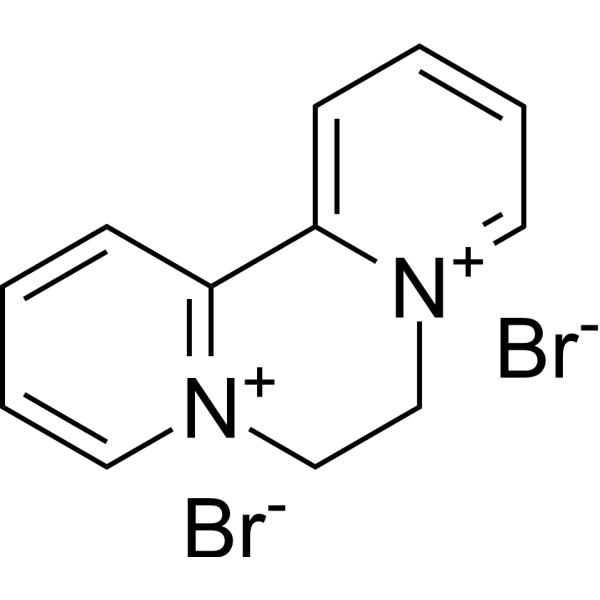
Diquat dibromide
Based on 3 publication(s) in Google Scholar
Diquat dibromide is a comprehensive herbicide. Diquat dibromide increases the production of ROS and triggers mitochondrial Autophagy. Diquat dibromide generates free radicals such as superoxide anions through redox cycles, which induce oxidative stress. Diquat dibromide is cytotoxic, reproductive, and neurotoxic. Diquat dibromide is used in cotton, soybean, and other crops to combat noxious weeds.
商品は「研究用試薬」です。人や動物の医療用・臨床診断用・食品用の製品ではありません。
研究用途以外に使用した場合、当社は一切の責任を負いかねます。
- 純度: 99.94%
- CAS 番号: 85-00-7
- 分子式: C12H12Br2N2
- 分子量:344.05
-
保管条件:
4°C, sealed storage, away from moisture
* In solvent : -80°C, 6 months; -20°C, 1 month (sealed storage, away from moisture)

To place orders, for customer services and technical support, please contact: MedChemExpress USA
Tel: 609-228-6898 E-mail: [email protected] [email protected]


-
 生物活性
生物活性
-
化学情報
-
溶剤 & 溶解度
- 純度とドキュメンテーション
- 参考文献
-
 Help & FAQs
-

Immunology/Inflammation Compound Library
HY-L007
-
Metabolism/Protease Compound Library
HY-L012
-
NF-κB Signaling Compound Library
HY-L014
-
Stem Cell Signaling Compound Library
HY-L017
-
Autophagy Compound Library
HY-L029
-
Anti-Aging Compound Library
HY-L034
-
Oxygen Sensing Compound Library
HY-L045
-
Glutamine Metabolism Compound Library
HY-L064
-
Anti-Cancer Metabolism Compound Library
HY-L083
-
Anti-Parkinson's Disease Compound Library
HY-L085
-
Neurodegenerative Disease-related Compound Library
HY-L086
-
Mitochondria-Targeted Compound Library
HY-L089
-
Glucose Metabolism Compound Library
HY-L092
-
Cuproptosis Compound Library
HY-L133
-
Heterocyclic Compound Library
HY-L138
-
Metabolic Enzyme Compound Library
HY-L146
-
Cell Death Library
HY-L162
-
Bioactive Compound Library Max
HY-L181
-
MCE Bioactive Compound Library
HY-L001V
-
Bioactive Compound Library
HY-L001
-
Pesticide Compound Library
HY-L183
-
Non-Alcoholic Fatty Liver Disease (NAFLD) Compound Library
HY-L199
-
High-Throughput Bioactive Compound Library
HY-L205
-
Environmental Pollutant Compound Library
HY-L247
-
Lactylation Compound Library
HY-L249


MedChemExpress(MCE)の使用を引用している文献 Diquat dibromide
More

生物活性
Diquat dibromide (25 mg/L in drinking water; 10-week treatment) reduces beak red chroma and total plasma carotenoids, and increases lipophilic antioxidant capacity in adult male zebra finches[4].
Diquat (8-12 mg/kg; i.p.; twice a week; 4 weeks) dibromide causes reproductive toxicity in female mice[6].
Diquat (10 mg/kg; i.p.; twice a week; for 6 weeks) dibromide shows neurotoxic effects in male C57/BL-6 mice, inducing motor dysfunctions (such as bradykinesia, gait abnormalities, decreased swimming ability, etc.)[7].
MedChemExpress (MCE) has not independently confirmed the accuracy of these methods. They are for reference only.
-
Animal Model:Twelve male Duroc × Landrace × Yorkshire 35-d-old pigs (weaned at 21 d of age), with an average body weight of 9.6 kg, used as a model for studying the effect of Diquat-induced oxidative stress on intestinal barrier, mitochondrial function, and mitophagy[2].
-
Dosage:10 mg/kg BW (dissolved in 0.9% NaCl solution)
-
Administration:Intraperitoneal injection
-
Result:Significantly decreased ADFI and ADG.
Impaired the intestinal barrier function, as indicated by a decrease in TER, an increase in FD4 flux, and a reduction in the protein abundance of claudin-1, occludin, and zonula occludens-1.
Caused mitochondrial dysfunction, with increased ROS production, decreased membrane potential in intestinal mitochondria, and a decrease in the mRNA abundance of genes related to mitochondrial biogenesis and function.
Triggered mitophagy, as shown by the increased expression of mitophagy-related proteins and the increased ratio of LC3-II to LC3-I.
-
Animal Model:Female ICR mice[6]
-
Dosage:8 mg/kg or 12 mg/kg (dissolved in normal saline)
-
Administration:Intraperitoneal injection, twice a week, for 4 weeks
-
Result:Significantly reduced ovary weights compared with control mice.
Decreased the percentage of normal GV oocytes and polar body extrusion.
Significantly increased ROS production in follicular granulosa cells and oocytes.
Decreased the activities of antioxidant enzymes (T-SOD, GPx and CAT) in the serum, and increased the MDA content.
Reduced the average numbers of fetus and litter size on GD 7.5 d.


化学情報
-
CAS 番号 85-00-7
-
性状 Solid
-
分子量 344.05
-
分子式 C12H12Br2N2
-
Color Light yellow to brown
-
SMILES
[N+]12=CC=CC=C1C3=[N+](CC2)C=CC=C3.[Br-].[Br-]
-
輸送条件
Room temperature in continental US; may vary elsewhere.
-
保管条件
4°C, sealed storage, away from moisture
* In solvent : -80°C, 6 months; -20°C, 1 month (sealed storage, away from moisture)


Publications (3)
-
Journal Impact Factor
-
Most Recent
-
Pestic Biochem Physiol
Sesamin exerts protective effects against diquat-induced acute kidney injury by inhibiting oxidative stress, apoptosis and autophagy: A key role for the SIRT5/FOXO3a signaling pathway. [Abstract]2026 Jan;216(Pt 1):106728. PMID: 41326063 -
Biochem Biophys Res Commun
Alleviation effect of taxifolin on diquat-induced damage to porcine intestinal epithelial cells. [Abstract]2025 Feb 8:748:151318. PMID: 39826529 -
Biomed Pharmacother
Crocin-I mitigates diquat-induced pulmonary fibrosis via activation of the SIRT3/FOXO3a pathway. [Abstract]2025 Apr 6:186:118043. PMID: 40194334


溶剤 & 溶解度
H2O : 5.83 mg/mL (16.95 mM; Need ultrasonic)
Please refer to the solubility information to select the appropriate solvent. Once prepared, please aliquot and store the solution to prevent product inactivation from repeated freeze-thaw cycles.
Storage method and period of stock solution: -80°C, 6 months; -20°C, 1 month (sealed storage, away from moisture). When stored at -80°C, please use it within 6 months. When stored at -20°C, please use it within 1 month.
* Note: If you choose water as the stock solution, please dilute it to the working solution, then filter and sterilize it with a 0.22 μm filter before use.
Please refer to the solubility information to select the appropriate solvent. Once prepared, please aliquot and store the solution to prevent product inactivation from repeated freeze-thaw cycles.
Storage method and period of stock solution: -80°C, 6 months; -20°C, 1 month (sealed storage, away from moisture). When stored at -80°C, please use it within 6 months. When stored at -20°C, please use it within 1 month.
* Note: If you choose water as the stock solution, please dilute it to the working solution, then filter and sterilize it with a 0.22 μm filter before use.
濃度 (開始) × 体積 (開始) = 濃度 (終了) × 体積 (終了)


純度とドキュメンテーション
-
データシート (283 KB)
-
SDS (731 KB)
- English - EN (731 KB)
- Français - FR (731 KB)
- Deutsch - DE (731 KB)
- Norwegian - NO (731 KB)
- Español - ES (731 KB)
- Swedish - SV (731 KB)
- Italian - IT (731 KB)
- Korean - KR (731 KB)
- Portuguese - PT (731 KB)
-
取扱説明書 (2659 KB)
参考文献
[1]. Moreland D E. Mechanisms of action of herbicides. 1980.
[2]. Cao S, et al. Diquat-induced oxidative stress increases intestinal permeability, impairs mitochondrial function, and triggers mitophagy in piglets. J Anim Sci. 2018 May 4;96(5):1795-1805. [Content Brief]
[3]. Singh P, et al. Sirtuin-2 Protects Neural Cells from Oxidative Stress and Is Elevated in Neurodegeneration. Parkinsons Dis. 2017;2017:2643587. [Content Brief]
[4]. Tomášek O, et al. Opposing effects of oxidative challenge and carotenoids on antioxidant status and condition-dependent sexual signalling. Sci Rep. 2016 Mar 22;6:23546. [Content Brief]
[5]. Nisar R, et al. Diquat causes caspase-independent cell death in SH-SY5Y cells by production of ROS independently of mitochondria. Arch Toxicol. 2015 Oct;89(10):1811-25. [Content Brief]
[6]. Zhang JQ, et al. Chronic Exposure to Diquat Causes Reproductive Toxicity in Female Mice. PLoS One. 2016 Jan 19;11(1):e0147075. [Content Brief]
[7]. Karuppagounder SS, et al. Investigate the chronic neurotoxic effects of diquat. Neurochem Res. 2012 May;37(5):1102-11. [Content Brief]
[8]. Acar A. In vivo toxicological assessment of diquat dibromide: cytotoxic, genotoxic, and biochemical approach. Environ Sci Pollut Res Int. 2021;28(34):47550-47561. [Content Brief]


Complete Stock Solution Preparation Table
Please refer to the solubility information to select the appropriate solvent. Once prepared, please aliquot and store the solution to prevent product inactivation from repeated freeze-thaw cycles.
Storage method and period of stock solution: -80°C, 6 months; -20°C, 1 month (sealed storage, away from moisture). When stored at -80°C, please use it within 6 months. When stored at -20°C, please use it within 1 month.
| Optional Solvent | Concentration Solvent Mass | 1 mg | 5 mg | 10 mg | 25 mg |
|---|---|---|---|---|---|
| H2O | 1 mM | 2.9066 mL | 14.5328 mL | 29.0655 mL | 72.6639 mL |
| 5 mM | 0.5813 mL | 2.9066 mL | 5.8131 mL | 14.5328 mL | |
| 10 mM | 0.2907 mL | 1.4533 mL | 2.9066 mL | 7.2664 mL | |
| 15 mM | 0.1938 mL | 0.9689 mL | 1.9377 mL | 4.8443 mL |
* Note: If you choose water as the stock solution, please dilute it to the working solution, then filter and sterilize it with a 0.22 μm filter before use.


Diquat dibromide 関連分類
HY-122984 関連分類
 Powered by Bioz