



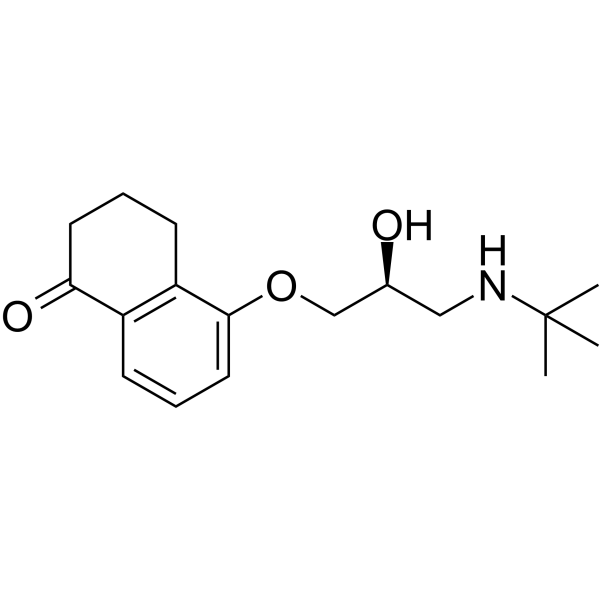
Levobunolol
Based on 1 publication(s) in Google Scholar
Levobunolol (l-Bunolol) is a non-selective β-adrenergic antagonist and vasodilator. By blocking calcium ion influx and reducing the sensitivity of vascular smooth muscle to calcium, Levobunolol effectively dilates the ciliary arteries and increases ocular blood flow, so it is widely used in research on glaucoma and ocular hypertension. Levobunolol inhibits the β-receptor signaling pathway and the expression of related proliferation markers (such as CK3, CK14, CK19, Ki67) in corneal cells. In rabbit models, Levobunolol not only does not inhibit corneal epithelial regeneration, but also accelerates the healing of mechanical injury without adverse effects. Levobunolol also inhibits histamine-induced vasoconstriction and intracellular calcium elevation, exhibiting unique vascular regulatory activity. Levobunolol protects ocular blood flow and promotes corneal repair.
For research use only. We do not sell to patients.
- CAS No.: 47141-42-4
- Formula: C17H25NO3
- Molecular Weight:291.39
-
Storage:
Please store the product under the recommended conditions in the Certificate of Analysis.

To place orders, for customer services and technical support, please contact: MedChemExpress USA
Tel: 609-228-6898 E-mail: [email protected] [email protected]


-
 Biological Activity
-
Chemical Information
- Protocols
- Purity & Documentation
- References
-
 Help & FAQs


Publications Citing Use of MedChemExpress (MCE) Levobunolol
MoreAll Adrenergic Receptor Isoforms
MoreAll Calcium Channel Isoforms
More

Biological Activity
Description
IC50 & Target
|
β adrenergic receptor |
In Vitro
Levobunolol (50 μM; 24 h) significantly inhibits the migration and proliferation of corneal epithelial stem/progenitor cells in TKE2 mice[1].
Levobunolol (50 μM; 7 d) reduces the clone size of corneal epithelial stem/progenitor cells in TKE2 mice without affecting the number of clones[1].
Levobunolol (10 μM-0.3 mM; 10-30 min) induces concentration-dependent relaxation in isolated rabbit ciliary arterial rings precontracted by various stimuli, with the strongest inhibitory potency against histamine-induced contraction (EC50=20.7 μM). This relaxation effect is independent of endothelial nitric oxide synthase activity and vascular endothelium[3].
Levobunolol (10 μM) does not bind to recombinant human histamine H1 receptors, but exhibits partial inhibitory effects on the binding of [3H]tiotidine to histamine H2 receptors[3].
Levobunolol (3 μM) significantly inhibits histamine-induced elevation of [Ca2+]i in human aortic smooth muscle cells cultured in calcium-containing medium, but exerts no effect on this response in calcium-free medium[3].
MedChemExpress (MCE) has not independently confirmed the accuracy of these methods. They are for reference only.
In Vivo
Levobunolol (0.25%; topical; every 12 hours) accelerates rabbit corneal epithelial wound healing, with a mean wound radius of 1.58 mm at 50% closure, a healing rate of 5.00 μm/h, and projected closure before 60 hours[2].
MedChemExpress (MCE) has not independently confirmed the accuracy of these methods. They are for reference only.


Chemical Information
-
CAS No. 47141-42-4
-
Molecular Weight 291.39
-
Formula C17H25NO3
-
SMILES
O=C1CCCC2=C1C=CC=C2OC[C@@H](O)CNC(C)(C)C
-
Synonyms
l-Bunolol
-
Shipping
Room temperature in continental US; may vary elsewhere.
-
Storage
Please store the product under the recommended conditions in the Certificate of Analysis.


Publications (1)
-
Journal Impact Factor
-
Most Recent
-
BMC Ophthalmol
β-blocker eye drops affect ocular surface through β2 adrenoceptor of corneal limbal stem cells. [Abstract]2021 Dec 5;21(1):419. PMID: 34863129


Purity & Documentation
References

Calculators
Concentration (start) × Volume (start) = Concentration (final) × Volume (final)


Levobunolol Related Classifications
HY-B1035A Related Classifications
 Powered by Bioz