



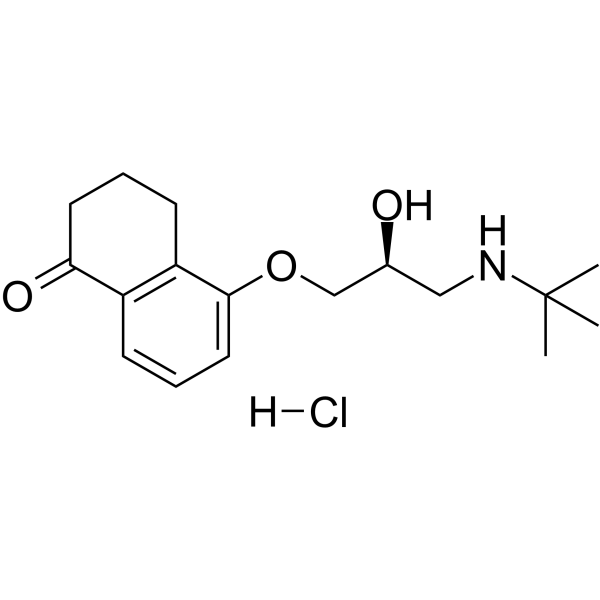
Levobunolol hydrochloride
Based on 1 publication(s) in Google Scholar
Levobunolol (l-Bunolol) hydrochloride is a non-selective β-adrenergic antagonist and vasodilator. By blocking calcium ion influx and reducing the sensitivity of vascular smooth muscle to calcium, Levobunolol hydrochloride effectively dilates the ciliary arteries and increases ocular blood flow, so it is widely used in research on glaucoma and ocular hypertension. Levobunolol hydrochloride inhibits the β-receptor signaling pathway and the expression of related proliferation markers (such as CK3, CK14, CK19, Ki67) in corneal cells. In rabbit models, Levobunolol hydrochloride not only does not inhibit corneal epithelial regeneration, but also accelerates the healing of mechanical injury without adverse effects. Levobunolol hydrochloride also inhibits histamine-induced vasoconstriction and intracellular calcium elevation, exhibiting unique vascular regulatory activity. Levobunolol hydrochloride protects ocular blood flow and promotes corneal repair.
For research use only. We do not sell to patients.
- Purity: 99.95%
- CAS No.: 27912-14-7
- Formula: C17H26ClNO3
- Molecular Weight:327.85
-
Storage:
-20°C, sealed storage, away from moisture
* In solvent : -80°C, 6 months; -20°C, 1 month (sealed storage, away from moisture)

To place orders, for customer services and technical support, please contact: MedChemExpress USA
Tel: 609-228-6898 E-mail: [email protected] [email protected]


-
 Biological Activity
-
Chemical Information
-
Solvent & Solubility
- Purity & Documentation
- References
-
 Help & FAQs


Publications Citing Use of MedChemExpress (MCE) Levobunolol hydrochloride
MoreAll Adrenergic Receptor Isoforms
MoreAll Calcium Channel Isoforms
More

Biological Activity
Description
IC50 & Target
|
β adrenergic receptor |
In Vitro
Levobunolol (50 μM; 24 h) significantly inhibits the migration and proliferation of corneal epithelial stem/progenitor cells in TKE2 mice[1].
Levobunolol (50 μM; 7 d) reduces the clone size of corneal epithelial stem/progenitor cells in TKE2 mice without affecting the number of clones[1].
Levobunolol hydrochloride (10 μM-0.3 mM; 10-30 min) induces concentration-dependent relaxation in isolated rabbit ciliary arterial rings precontracted by various stimuli, with the strongest inhibitory potency against histamine-induced contraction (EC50=20.7 μM). This relaxation effect is independent of endothelial nitric oxide synthase activity and vascular endothelium[3].
Levobunolol hydrochloride (10 μM) does not bind to recombinant human histamine H1 receptors, but exhibits partial inhibitory effects on the binding of [3H]tiotidine to histamine H2 receptors[3].
Levobunolol hydrochloride (3 μM) significantly inhibits histamine-induced elevation of [Ca2+]i in human aortic smooth muscle cells cultured in calcium-containing medium, but exerts no effect on this response in calcium-free medium[3].
MedChemExpress (MCE) has not independently confirmed the accuracy of these methods. They are for reference only.
-
Cell Line:TKE2 (murine corneal epithelial stem/progenitor cells)
-
Concentration:50 μM
-
Incubation Time:24 h
-
Result:Significantly reduced the migration capacity of TKE2 cells, as measured by the percentage of wound area remaining after 24 h.
Significantly reduced the absorbance at 450 nm, indicating decreased cell proliferation compared to control.
In Vivo
Levobunolol (hydrochloride) (0.25%; topical; every 12 hours) accelerates rabbit corneal epithelial wound healing, with a mean wound radius of 1.58 mm at 50% closure, a healing rate of 5.00 μm/h, and projected closure before 60 hours[2].
MedChemExpress (MCE) has not independently confirmed the accuracy of these methods. They are for reference only.
-
Animal Model:C57BL/6 mice (8 weeks old, 20-25 g, central corneal epithelium scraped using a 2.5 mm trephine)[1]
-
Dosage:5 mg/mL
-
Administration:topical; 4 times daily
-
Result:Showed a marginally significant reduction in corneal epithelial healing rate compared to control.
Reduced relative fluorescence intensities of differentiation marker CK3, and stem cell markers CK14 and CK19 by ~20-30% for 2.5 mm wounds.
-
Animal Model:New Zealand white rabbits (2-3 kg)[2]
-
Dosage:0.25%
-
Administration:topical; every 12 hours
-
Result:Exhibited a mean wound radius of 1.58 mm at 50% closure time (32 hours post-wounding, p = 0.0001 vs saline controls).
Achieved a linear phase wound healing slope of 5.00 (SD 0.24) μm/h.
Reached projected wound closure time of less than 60 hours.


Chemical Information
-
CAS No. 27912-14-7
-
Appearance Solid
-
Molecular Weight 327.85
-
Formula C17H26ClNO3
-
Color White to off-white
-
SMILES
O=C1CCCC2=C1C=CC=C2OC[C@@H](O)CNC(C)(C)C.[H]Cl
-
Synonyms
l-Bunolol hydrochloride
-
Shipping
Room temperature in continental US; may vary elsewhere.
-
Storage
-20°C, sealed storage, away from moisture
* In solvent : -80°C, 6 months; -20°C, 1 month (sealed storage, away from moisture)


Publications (1)
-
Journal Impact Factor
-
Most Recent
-
BMC Ophthalmol
β-blocker eye drops affect ocular surface through β2 adrenoceptor of corneal limbal stem cells. [Abstract]2021 Dec 5;21(1):419. PMID: 34863129


Solvent & Solubility
In Vitro:
H2O : 50 mg/mL (152.51 mM; Need ultrasonic)
DMSO : 50 mg/mL (152.51 mM; Need ultrasonic; Hygroscopic DMSO has a significant impact on the solubility of product, please use newly opened DMSO)
Please refer to the solubility information to select the appropriate solvent. Once prepared, please aliquot and store the solution to prevent product inactivation from repeated freeze-thaw cycles.
Storage method and period of stock solution: -80°C, 6 months; -20°C, 1 month (sealed storage, away from moisture). When stored at -80°C, please use it within 6 months. When stored at -20°C, please use it within 1 month.
* Note: If you choose water as the stock solution, please dilute it to the working solution, then filter and sterilize it with a 0.22 μm filter before use.
Please refer to the solubility information to select the appropriate solvent. Once prepared, please aliquot and store the solution to prevent product inactivation from repeated freeze-thaw cycles.
Storage method and period of stock solution: -80°C, 6 months; -20°C, 1 month (sealed storage, away from moisture). When stored at -80°C, please use it within 6 months. When stored at -20°C, please use it within 1 month.
* Note: If you choose water as the stock solution, please dilute it to the working solution, then filter and sterilize it with a 0.22 μm filter before use.
Concentration (start) × Volume (start) = Concentration (final) × Volume (final)
In Vivo:
Select the appropriate dissolution method based on your experimental animal and administration route.
- For the following dissolution methods, please ensure to first prepare a clear stock solution using an In Vitro approach and then sequentially add co-solvents:
- To ensure reliable experimental results, the clarified stock solution can be appropriately stored based on storage conditions. As for the working solution for In Vivo experiments, it is recommended to prepare freshly and use it on the same day.
- The percentages shown for the solvents indicate their volumetric ratio in the final prepared solution. If precipitation or phase separation occurs during preparation, heat and/or sonication can be used to aid dissolution.
Add each solvent one by one: 10% DMSO 40% PEG300 5% Tween-80 45% Saline
Solubility: ≥ 2.08 mg/mL (6.34 mM); Clear solution
This protocol yields a clear solution of ≥ 2.08 mg/mL (saturation unknown).
Taking 1 mL working solution as an example, add 100 μL DMSO stock solution (20.8 mg/mL) to 400 μL PEG300, and mix evenly; then add 50 μL Tween-80 and mix evenly; then add 450 μL Saline to adjust the volume to 1 mL.
Preparation of Saline: Dissolve 0.9 g sodium chloride in ddH₂O and dilute to 100 mL to obtain a clear Saline solution.
Add each solvent one by one: 10% DMSO 90% (20% SBE-β-CD in Saline)
Solubility: ≥ 2.08 mg/mL (6.34 mM); Clear solution
This protocol yields a clear solution of ≥ 2.08 mg/mL (saturation unknown).
Taking 1 mL working solution as an example, add 100 μL DMSO stock solution (20.8 mg/mL) to 900 μL 20% SBE-β-CD in Saline, and mix evenly.
Preparation of 20% SBE-β-CD in Saline (4°C, storage for one week): 2 g SBE-β-CD powder is dissolved in 10 mL Saline, completely dissolve until clear.
For the following dissolution methods, please prepare the working solution directly:
It is recommended to prepare fresh solutions and use them promptly within a short period of time.
The percentages shown for the solvents indicate their volumetric ratio in the final prepared solution. If precipitation or phase separation occurs during preparation, heat and/or sonication can be used to aid dissolution.
Add each solvent one by one: PBS
Solubility: 50 mg/mL (152.51 mM); Clear solution; Need ultrasonic
In Vivo Dissolution Calculator
Please enter the basic information of animal experiments:
-
-
-
-
Recommended: Prepare an additional quantity of animals to account for potential losses during experiments.
Working solution concentration: 0.22 mg/mL
This product has good water solubility, please refer to the measured solubility data in water/PBS/Saline for details.


Purity & Documentation
-
Data Sheet (279 KB)
-
SDS (392 KB)
- English - EN (392 KB)
- Français - FR (392 KB)
- Deutsch - DE (392 KB)
- Norwegian - NO (392 KB)
- Español - ES (392 KB)
- Swedish - SV (392 KB)
- Italian - IT (392 KB)
- Korean - KR (392 KB)
- Portuguese - PT (392 KB)
-
Handling Instructions (2659 KB)
References


Complete Stock Solution Preparation Table
Please refer to the solubility information to select the appropriate solvent. Once prepared, please aliquot and store the solution to prevent product inactivation from repeated freeze-thaw cycles.
Storage method and period of stock solution: -80°C, 6 months; -20°C, 1 month (sealed storage, away from moisture). When stored at -80°C, please use it within 6 months. When stored at -20°C, please use it within 1 month.
| Optional Solvent | Concentration Solvent Mass | 1 mg | 5 mg | 10 mg | 25 mg |
|---|---|---|---|---|---|
| H2O / DMSO | 1 mM | 3.0502 mL | 15.2509 mL | 30.5018 mL | 76.2544 mL |
| 5 mM | 0.6100 mL | 3.0502 mL | 6.1004 mL | 15.2509 mL | |
| 10 mM | 0.3050 mL | 1.5251 mL | 3.0502 mL | 7.6254 mL | |
| 15 mM | 0.2033 mL | 1.0167 mL | 2.0335 mL | 5.0836 mL | |
| 20 mM | 0.1525 mL | 0.7625 mL | 1.5251 mL | 3.8127 mL | |
| 25 mM | 0.1220 mL | 0.6100 mL | 1.2201 mL | 3.0502 mL | |
| 30 mM | 0.1017 mL | 0.5084 mL | 1.0167 mL | 2.5418 mL | |
| 40 mM | 0.0763 mL | 0.3813 mL | 0.7625 mL | 1.9064 mL | |
| 50 mM | 0.0610 mL | 0.3050 mL | 0.6100 mL | 1.5251 mL | |
| 60 mM | 0.0508 mL | 0.2542 mL | 0.5084 mL | 1.2709 mL | |
| 80 mM | 0.0381 mL | 0.1906 mL | 0.3813 mL | 0.9532 mL | |
| 100 mM | 0.0305 mL | 0.1525 mL | 0.3050 mL | 0.7625 mL |
* Note: If you choose water as the stock solution, please dilute it to the working solution, then filter and sterilize it with a 0.22 μm filter before use.


Levobunolol hydrochloride Related Classifications
HY-B1035 Related Classifications
 Powered by Bioz
Keywords
- Levobunolol
- 27912-14-7
- l-Bunolol
- Adrenergic Receptor
- Calcium Channel
- Casein Kinase
- corneal cells
- rabbit ciliary artery rings
- human aortic smooth muscle cells
- β2-adrenoceptor
- β-adrenergic antagonist
- glaucoma
- corneal epithelial stem/progenitor cells
- vascular smooth muscle cells
- rabbits
- β adrenergic receptor
- Inhibitor
- inhibitor
- inhibit