



Low molecular weight protamine

Based on 1 Customer Validation
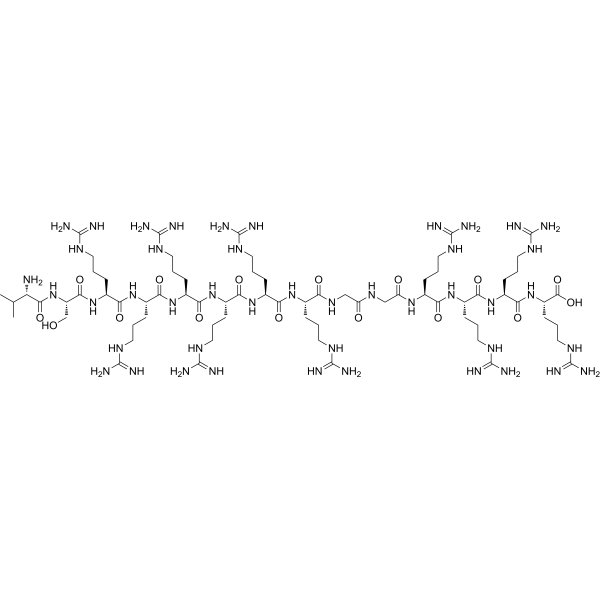
Low molecular weight protamine (LMWP;TDSP5) is a truncated arginine-rich protamine peptide, as well as a heparin/low-molecular-weight heparin antidote and a cell-penetrating delivery carrier. Low molecular weight protamine neutralizes heparin-induced anticoagulant activities, including aPTT, anti-Xa and anti-IIa activities, and also neutralizes anti-Xa activity of commercially available low-molecular-weight heparin preparations. Low molecular weight protamine translocates across mammalian cell membranes, delivers conjugated impermeable molecules across tumor tissues, enhances skin permeability of conjugated epidermal growth factor, and accelerates wound healing when conjugated with epidermal growth factor. Low molecular weight protamine retains the in vitro cell proliferation activity of conjugated EGF, and also enables site-specific conjugation with peptides or proteins via genetic recombination. Low molecular weight protamine can be used in studies related to colon adenocarcinoma, skin wounds and diabetic skin wounds.
For research use only. We do not sell to patients.
- Purity : 98.07%
- CAS No.: 121052-30-0
- Formula: C72H142N44O16
- Molecular Weight:1880.18
-
Storage:
Sealed storage, away from moisture.
Powder -80°C, 2 years , -20°C, 1 year* In solvent : -80°C, 6 months; -20°C, 1 month (sealed storage, away from moisture)

To place orders, for customer services and technical support, please contact: MedChemExpress USA
Tel: 609-228-6898 E-mail: [email protected] [email protected]


-
 Biological Activity
-
Chemical Information
-
Solvent & Solubility
- Protocols
- Purity & Documentation
- References
-
 Help & FAQs


All VEGFR Isoforms
More

Biological Activity
Description
In Vitro
Low molecular weight protamine (18 μg/U; 3 minutes) completely neutralizes the aPTT-clotting activity of 5 U/mL heparin in human plasma at a TDSP5/heparin ratio of 18 μg/U[1].
Low molecular weight protamine (12 μg/U; 2 minutes, 10 minutes) completely neutralizes the anti-IIa activity of 0.5 U/mL heparin in human plasma at a TDSP5/heparin ratio of 12 μg/U[1].
Low molecular weight protamine (4.5 mg/mL, 22 μg/U; 60 minutes) alone (4.5 mg/mL) causes only 30% complement consumption in human serum, and TDSP5-heparin complexes (22 μg/U ratio, with 2.5-10 U/mL heparin) cause ~50% complement consumption, showing significantly reduced complement activation potential compared to protamine[1].
Low molecular weight protamine (63 μM; 2 hours) exhibits significantly reduced cross-reactivity with mouse antiprotamine antibodies, requiring a concentration of 63 μM to achieve 50% inhibition of antibody binding in a competitive ELISA[1].
LMWP-gelonin conjugate inhibits protein synthesis in a cell-free rabbit reticulocyte lysate system with an IC50 of 23 pM[2].
FITC-labeled LMWP (TDSP5) (0.2 μM; 30 min) is taken up by 293T, HeLa, CT-26, MCF-7, NIH3T3, and MG63 cells with high efficiency, equivalent to TAT peptide, and this uptake is unaffected by 10% serum[2].
Low molecular weight protamine (0.2 μM; 30 min) localizes to the cytoplasm of HeLa cells, delivers covalently conjugated gelonin to the cytoplasm of CT-26 cells, and delivers covalently conjugated phalloidin to the cytoplasm of MG63 cells to label cytoskeletons without permeabilization[2].
Low molecular weight protamine (0.01-10.0 mM; 72 h) exhibits minimal cytotoxicity to 293T cells, with less than 10% reduction in cell viability at concentrations up to 10.0 mM after 72 h of incubation[2].
LMWP-gelonin conjugate (48 h) exhibits potent dose-dependent cytotoxicity against CT-26 colon adenocarcinoma cells with an IC50 of 39 pM after 48 h of incubation[2].
MedChemExpress (MCE) has not independently confirmed the accuracy of these methods. They are for reference only.
-
Cell Line:HeLa, CT-26, MG63
-
Concentration:0.2 μM
-
Incubation Time:30 min
-
Result:Localized largely in the cytoplasm of HeLa cells.
Delivered covalently conjugated gelonin to the cytoplasm of CT-26 cells, confirming internalization rather than surface adsorption.
Delivered covalently conjugated phalloidin to the cytoplasm of MG63 cells to label cytoskeletons without a cell permeabilization step.
-
Cell Line:293T
-
Concentration:0.01-10.0 mM
-
Incubation Time:72 h
-
Result:Caused less than 10% reduction in cell viability at all tested concentrations up to 10.0 mM.
-
Cell Line:NIH3T3 mouse fibroblast cell line
-
Concentration:0.1 μM; 1.0 μM
-
Incubation Time:24 h
-
Result:Increased cell viability to 128% relative to the control group at 0.1 μM.
Increased cell viability to 143% relative to the control group at 1.0 μM.
In Vivo
MedChemExpress (MCE) has not independently confirmed the accuracy of these methods. They are for reference only.
- Cell migration
- BrdU Incorporation Assay
- Somatic Cell Culture
- CFSE Dye Dilution Proliferation Assay
- Dye-dilution cell tracking and proliferation staining
- CCK-8/WST-8 Cell Proliferation Assay
- Protocol for Cell Cycle
- Cell Counting-Based Growth Curve Assay
- Colony Formation (Clonogenic) Assay
- Cell Viability Determination by MTT Colorimetric Assay
- EdU Incorporation Assay (Click Chemistry-Based DNA Synthesis Measurement)
- Ki-67 Immunostaining Proliferation Assay
- PCNA Immunodetection Proliferation Assay
- Protocol for Cell Counting and Cell Density Analysis
- Transepithelial/transendothelial electrical resistance assay
- MTT Cell Proliferation Assay
- Cell-Exclusion Zone Migration Assay


Chemical Information
-
CAS No. 121052-30-0
-
Appearance Solid
-
Molecular Weight 1880.18
-
Formula C72H142N44O16
-
Color White to off-white
-
Synonyms
LMWP; TDSP5
-
Sequence
Val-Ser-Arg-Arg-Arg-Arg-Arg-Arg-Gly-Gly-Arg-Arg-Arg-Arg
-
Sequence Shortening
VSRRRRRRGGRRRR
-
Shipping
Room temperature in continental US; may vary elsewhere.
-
Storage
Sealed storage, away from moisture
Powder -80°C 2 years -20°C 1 year * In solvent : -80°C, 6 months; -20°C, 1 month (sealed storage, away from moisture)


Solvent & Solubility
In Vitro:
H2O : ≥ 100 mg/mL (53.19 mM)
* "≥" means soluble, but saturation unknown.
Please refer to the solubility information to select the appropriate solvent. Once prepared, please aliquot and store the solution to prevent product inactivation from repeated freeze-thaw cycles.
Storage method and period of stock solution: -80°C, 6 months; -20°C, 1 month (sealed storage, away from moisture). When stored at -80°C, please use it within 6 months. When stored at -20°C, please use it within 1 month.
* Note: If you choose water as the stock solution, please dilute it to the working solution, then filter and sterilize it with a 0.22 μm filter before use.
Please refer to the solubility information to select the appropriate solvent. Once prepared, please aliquot and store the solution to prevent product inactivation from repeated freeze-thaw cycles.
Storage method and period of stock solution: -80°C, 6 months; -20°C, 1 month (sealed storage, away from moisture). When stored at -80°C, please use it within 6 months. When stored at -20°C, please use it within 1 month.
* Note: If you choose water as the stock solution, please dilute it to the working solution, then filter and sterilize it with a 0.22 μm filter before use.
Concentration (start) × Volume (start) = Concentration (final) × Volume (final)


Purity & Documentation
-
Data Sheet (280 KB)
-
SDS (252 KB)
- English - EN (252 KB)
- Français - FR (252 KB)
- Deutsch - DE (252 KB)
- Norwegian - NO (252 KB)
- Español - ES (252 KB)
- Swedish - SV (252 KB)
- Italian - IT (252 KB)
- Korean - KR (252 KB)
- Portuguese - PT (252 KB)
-
Handling Instructions (2659 KB)
References
[1]. Chang LC, et al. Low molecular weight protamine (LMWP) as nontoxic heparin/low molecular weight heparin antidote (II): in vitro evaluation of efficacy and toxicity. AAPS PharmSci. 2001;3(3):E18. [Content Brief]
[2]. Park YJ, et al. Nontoxic membrane translocation peptide from protamine, low molecular weight protamine (LMWP), for enhanced intracellular protein delivery: in vitro and in vivo study. FASEB J. 2005;19(11):1555-1557. [Content Brief]
[3]. Choi JK, et al. The effect of epidermal growth factor (EGF) conjugated with low-molecular-weight protamine (LMWP) on wound healing of the skin. Biomaterials. 2012;33(33):8579-8590. [Content Brief]


Complete Stock Solution Preparation Table
Please refer to the solubility information to select the appropriate solvent. Once prepared, please aliquot and store the solution to prevent product inactivation from repeated freeze-thaw cycles.
Storage method and period of stock solution: -80°C, 6 months; -20°C, 1 month (sealed storage, away from moisture). When stored at -80°C, please use it within 6 months. When stored at -20°C, please use it within 1 month.
| Optional Solvent | Concentration Solvent Mass | 1 mg | 5 mg | 10 mg | 25 mg |
|---|---|---|---|---|---|
| H2O | 1 mM | 0.5319 mL | 2.6593 mL | 5.3186 mL | 13.2966 mL |
| 5 mM | 0.1064 mL | 0.5319 mL | 1.0637 mL | 2.6593 mL | |
| 10 mM | 0.0532 mL | 0.2659 mL | 0.5319 mL | 1.3297 mL | |
| 15 mM | 0.0355 mL | 0.1773 mL | 0.3546 mL | 0.8864 mL | |
| 20 mM | 0.0266 mL | 0.1330 mL | 0.2659 mL | 0.6648 mL | |
| 25 mM | 0.0213 mL | 0.1064 mL | 0.2127 mL | 0.5319 mL | |
| 30 mM | 0.0177 mL | 0.0886 mL | 0.1773 mL | 0.4432 mL | |
| 40 mM | 0.0133 mL | 0.0665 mL | 0.1330 mL | 0.3324 mL | |
| 50 mM | 0.0106 mL | 0.0532 mL | 0.1064 mL | 0.2659 mL |
* Note: If you choose water as the stock solution, please dilute it to the working solution, then filter and sterilize it with a 0.22 μm filter before use.


Low molecular weight protamine Related Classifications
HY-P5107 Related Classifications
 Powered by Bioz