



MI-773 TFA
Based on 6 publication(s) in Google Scholar
MI-773 TFA is an orally active, selective MDM2-p53 interaction inhibitor with a Ki of 0.88 nM for MDM2. MI-773 TFA blocks the MDM2-TP53 interaction. MI-773 TFA potently activates p53. MI-773 TFA induces Apoptosis. MI-773 TFA causes tumor regression in xenograft models of adenoid cystic carcinoma. MI-773 TFA exhibits anticancer effects in neuroblastoma. MI-773 TFA can be used for the research of adenoid cystic carcinoma.
For research use only. We do not sell to patients.
- Purity : 98.91%
- CAS No.: 1303609-37-1
- Formula: C31H35Cl2F4N3O5
- Molecular Weight:676.53
-
Storage:
4°C, sealed storage, away from moisture
* In solvent : -80°C, 6 months; -20°C, 1 month (sealed storage, away from moisture)


To place orders, for customer services and technical support, please contact: MedChemExpress USA
Tel: 609-228-6898 E-mail: [email protected] [email protected]


-
 Biological Activity
-
Chemical Information
-
Solvent & Solubility
- Protocols
- Purity & Documentation
- References
-
 Help & FAQs


Publications Citing Use of MedChemExpress (MCE) MI-773 TFA
More Customer Validation & Images

-
WB


Biological Activity
Description
In Vivo
MI-773 (100 mg/kg; p.o.; daily) TFA mediates significant tumor regression in the ACCx6 adenoid cystic carcinoma PDX model[1].
MI-773 (100 mg/kg; p.o.; daily) TFA mediates significant tumor regression in the ACCx9 adenoid cystic carcinoma PDX model[1].
MedChemExpress (MCE) has not independently confirmed the accuracy of these methods. They are for reference only.
-
Animal Model:CB.17.SCID (male and female, severe combined immunodeficient)[1]
-
Dosage:10 mg/kg; 50 mg/kg; 100 mg/kg
-
Administration:p.o.; daily
-
Result:Modestly reduced tumor growth rate, resulting in a tumor growth inhibition (TGI) index of 34% and final average tumor volume of 600 mm3 at 20 days of treatment (10 mg/kg).
Caused significant tumor regression, with a TGI index of 127%, 86% tumor shrinkage, and final average tumor volume of 30 mm3 at 20 days of treatment (100 mg/kg).
Increased time to tumor failure (defined as 2x increase in pre-treatment volume; p=0.044) (100 mg/kg).
Increased percentage of TUNEL-positive apoptotic cells (p=0.015) and p53-positive cells (p<0.001) in tumor tissue, with p53 localization shifted from nuclear to cytoplasmic (100 mg/kg).
Increased p53 and phospho-p53 (Ser392) protein levels in tumor lysates (50 or 100 mg/kg).
Showed no observable weight loss in all treatment groups.
- Detection of Apoptosis
- TUNEL staining for apoptotic DNA fragmentation
- Annexin V plus membrane-impermeant dye apoptosis staining
- Patient-Derived Xenograft (PDX)
- Apoptosis Solutions
- Splenic/Portal-Vein Liver Metastasis Xenograft
- Subcutaneous Cell-Line-Derived Xenograft
- Orthotopic Cell-Line Xenograft
- Intraperitoneal/Peritoneal Dissemination Xenograft


Chemical Information
-
CAS No. 1303609-37-1
-
Appearance Solid
-
Molecular Weight 676.53
-
Formula C31H35Cl2F4N3O5
-
Color White to off-white
-
SMILES
O=C([C@H](N[C@@H]1CC(C)(C)C)[C@H](C2=CC=CC(Cl)=C2F)[C@]31C(NC4=C3C=CC(Cl)=C4)=O)N[C@H]5CC[C@H](O)CC5.OC(C(F)(F)F)=O
-
Shipping
Room temperature in continental US; may vary elsewhere.
-
Storage
4°C, sealed storage, away from moisture
* In solvent : -80°C, 6 months; -20°C, 1 month (sealed storage, away from moisture)


Publications (6)
-
Journal Impact Factor
-
Most Recent
-
Nat Chem Biol
Discovery and characterization of highly potent and selective allosteric USP7 inhibitors. [Abstract]2018 Feb;14(2):118-125. PMID: 29200206
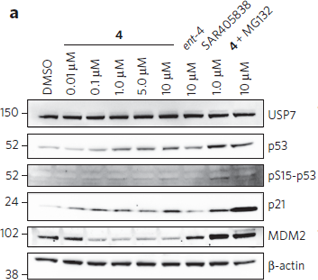
MI-773 TFA purchased from MedChemExpress. Usage Cited in: Nat Chem Biol. 2018 Feb;14(2):118-125. [Abstract]
HCT 116 cells are treated with 4, ent-4 and SAR405838 for 2 h and lysed for western blotting analysis probing for USP7, p53, p-Ser15-p53, p21, MDM2 and β-actin as indicated.
-
Cells
PROTAC-Mediated Targeted Degradation of MDM2 Induces Tumor-Suppressive Signaling in Osteosarcoma Cells. [Abstract]2026 Mar 5;15(5):473. PMID: 41827906 -
Int J Mol Sci
Improving Reporter Gene Assay Methodology for Evaluating the Ability of Compounds to Restore P53 Activity. [Abstract]2022 Nov 10;23(22):13867. PMID: 36430341 -
BMC Biol
A yeast two-hybrid system for the screening and characterization of small-molecule inhibitors of protein-protein interactions identifies a novel putative Mdm2-binding site in p53. [Abstract]2017 Nov 9;15(1):108. PMID: 29121928 -
-
Mater Sci Eng C Mater Biol Appl
A stimuli-responsive combination therapy for recovering p53-inactivation associated drug resistance. [Abstract]2020 Mar:108:110403. PMID: 31923941


Solvent & Solubility
In Vitro:
DMSO : 100 mg/mL (147.81 mM; Need ultrasonic; Hygroscopic DMSO has a significant impact on the solubility of product, please use newly opened DMSO)
Please refer to the solubility information to select the appropriate solvent. Once prepared, please aliquot and store the solution to prevent product inactivation from repeated freeze-thaw cycles.
Storage method and period of stock solution: -80°C, 6 months; -20°C, 1 month (sealed storage, away from moisture). When stored at -80°C, please use it within 6 months. When stored at -20°C, please use it within 1 month.
Please refer to the solubility information to select the appropriate solvent. Once prepared, please aliquot and store the solution to prevent product inactivation from repeated freeze-thaw cycles.
Storage method and period of stock solution: -80°C, 6 months; -20°C, 1 month (sealed storage, away from moisture). When stored at -80°C, please use it within 6 months. When stored at -20°C, please use it within 1 month.
Concentration (start) × Volume (start) = Concentration (final) × Volume (final)
In Vivo:
Select the appropriate dissolution method based on your experimental animal and administration route.
- For the following dissolution methods, please ensure to first prepare a clear stock solution using an In Vitro approach and then sequentially add co-solvents:
- To ensure reliable experimental results, the clarified stock solution can be appropriately stored based on storage conditions. As for the working solution for In Vivo experiments, it is recommended to prepare freshly and use it on the same day.
- The percentages shown for the solvents indicate their volumetric ratio in the final prepared solution. If precipitation or phase separation occurs during preparation, heat and/or sonication can be used to aid dissolution.
Add each solvent one by one: 10% DMSO 90% (20% SBE-β-CD in Saline)
Solubility: ≥ 2.5 mg/mL (3.70 mM); Clear solution
This protocol yields a clear solution of ≥ 2.5 mg/mL (saturation unknown).
Taking 1 mL working solution as an example, add 100 μL DMSO stock solution (25.0 mg/mL) to 900 μL 20% SBE-β-CD in Saline, and mix evenly.
Preparation of 20% SBE-β-CD in Saline (4°C, storage for one week): 2 g SBE-β-CD powder is dissolved in 10 mL Saline, completely dissolve until clear.
In Vivo Dissolution Calculator
Please enter the basic information of animal experiments:
-
-
-
-
Recommended: Prepare an additional quantity of animals to account for potential losses during experiments.
Please enter your animal formula composition:
-
%DMSO +
Recommended: Keep the proportion of DMSO in working solution below 2% if your animal is weak.
-
%+
-
+%Tween-80 + +
-
%Saline +
The co-solvents required include: DMSO, . All of co-solvents are available by MedChemExpress (MCE). , Tween 80. All of co-solvents are available by MedChemExpress (MCE).
Working solution concentration: 0.22 mg/mL
Method for preparing stock solution: mg drug dissolved in μL DMSO. Stock solution concentration: mg/mL. * In solvent : -80°C, 6 months; -20°C, 1 month (sealed storage, away from moisture)
1. Take μL DMSO stock solution;
2. Add μL .
μL , mix evenly;
3. Then add μL Tween 80, mix evenly;
4. Then add μL
Please ensure that the stock solution in the first step is dissolved to a clear state, and add co-solvents in sequence. You can use ultrasonic heating (ultrasonic cleaner, recommended frequency 20-40 kHz), vortexing, etc. to assist dissolution.


Purity & Documentation
-
Data Sheet (283 KB)
-
SDS (252 KB)
- English - EN (252 KB)
- Français - FR (252 KB)
- Deutsch - DE (252 KB)
- Norwegian - NO (252 KB)
- Español - ES (252 KB)
- Swedish - SV (252 KB)
- Italian - IT (252 KB)
- Korean - KR (252 KB)
- Portuguese - PT (252 KB)
-
Handling Instructions (2659 KB)
References
[1]. Warner KA, et al. Targeting MDM2 for Treatment of Adenoid Cystic Carcinoma. Clin Cancer Res. 2016;22(14):3550-3559. [Content Brief]
[2]. Chen YL, et al. MI-773, a breaker of the MDM2/p53 axis, exhibits anticancer effects in neuroblastoma via downregulation of INSM1. Oncol Lett. 2021;22(6):838. [Content Brief]


Complete Stock Solution Preparation Table
Please refer to the solubility information to select the appropriate solvent. Once prepared, please aliquot and store the solution to prevent product inactivation from repeated freeze-thaw cycles.
Storage method and period of stock solution: -80°C, 6 months; -20°C, 1 month (sealed storage, away from moisture). When stored at -80°C, please use it within 6 months. When stored at -20°C, please use it within 1 month.
| Optional Solvent | Concentration Solvent Mass | 1 mg | 5 mg | 10 mg | 25 mg |
|---|---|---|---|---|---|
| DMSO | 1 mM | 1.4781 mL | 7.3907 mL | 14.7813 mL | 36.9533 mL |
| 5 mM | 0.2956 mL | 1.4781 mL | 2.9563 mL | 7.3907 mL | |
| 10 mM | 0.1478 mL | 0.7391 mL | 1.4781 mL | 3.6953 mL | |
| 15 mM | 0.0985 mL | 0.4927 mL | 0.9854 mL | 2.4636 mL | |
| 20 mM | 0.0739 mL | 0.3695 mL | 0.7391 mL | 1.8477 mL | |
| 25 mM | 0.0591 mL | 0.2956 mL | 0.5913 mL | 1.4781 mL | |
| 30 mM | 0.0493 mL | 0.2464 mL | 0.4927 mL | 1.2318 mL | |
| 40 mM | 0.0370 mL | 0.1848 mL | 0.3695 mL | 0.9238 mL | |
| 50 mM | 0.0296 mL | 0.1478 mL | 0.2956 mL | 0.7391 mL | |
| 60 mM | 0.0246 mL | 0.1232 mL | 0.2464 mL | 0.6159 mL | |
| 80 mM | 0.0185 mL | 0.0924 mL | 0.1848 mL | 0.4619 mL | |
| 100 mM | 0.0148 mL | 0.0739 mL | 0.1478 mL | 0.3695 mL |


MI-773 TFA Related Classifications
HY-17493A Related Classifications
 Powered by Bioz