



Aliskiren
Based on 11 publication(s) in Google Scholar
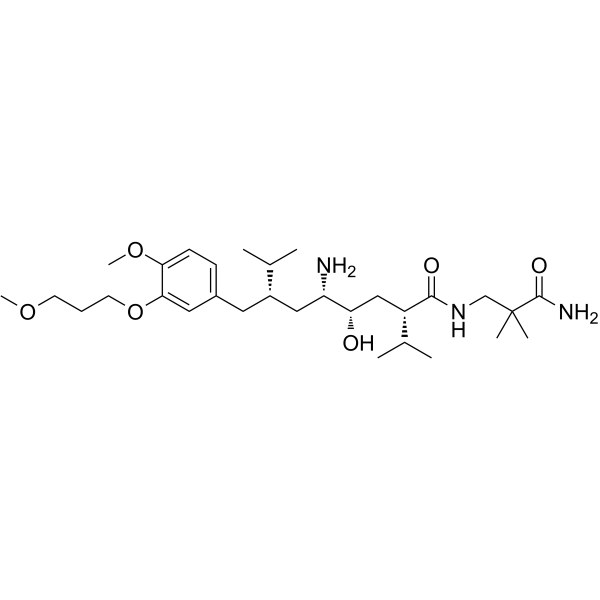
Aliskiren is an orally active, highly potent and selective renin inhibitor, with IC50 of 1.5 nM. Aliskiren can be used for the research of hypertension, cardiovascular diseases and cancer cachexia.
For research use only. We do not sell to patients.
- Purity: 99.70%
- CAS No.: 173334-57-1
- Formula: C30H53N3O6
- Molecular Weight:551.76
-
Storage:Powder -20°C, 3 years , 4°C, 2 years ; In solvent -80°C, 6 months , -20°C, 1 month

To place orders, for customer services and technical support, please contact: MedChemExpress USA
Tel: 609-228-6898 E-mail: [email protected] [email protected]


-
 Biological Activity
-
Chemical Information
-
Solvent & Solubility
- Purity & Documentation
- References
-
 Help & FAQs
-

Anti-Infection Compound Library
HY-L002
-
Metabolism/Protease Compound Library
HY-L012
-
FDA-Approved Drug Library
HY-L022
-
Autophagy Compound Library
HY-L029
-
Drug Repurposing Compound Library
HY-L035
-
Anti-Cardiovascular Disease Compound Library
HY-L046
-
Anti-COVID-19 Compound Library
HY-L052
-
Orally Active Compound Library
HY-L061
-
FDA Approved & Pharmacopeial Drug Library
HY-L066
-
Rare Diseases Drug Library
HY-L102
-
EMA-Approved Drug Library
HY-L116
-
FDA-Approved Anticancer Drug Library
HY-L122
-
Human Metabolite Library
HY-L123
-
Off-patent Drug Library
HY-L141
-
Antihypertensive Compound Library
HY-L145
-
Metabolic Enzyme Compound Library
HY-L146
-
Highly Selective Inhibitors Library
HY-L158
-
Highly Selective Activators Library
HY-L159
-
Cell Death Library
HY-L162
-
Bioactive Compound Library Max
HY-L181
-
MCE Bioactive Compound Library
HY-L001V
-
Drug Repurposing Compound Library Plus
HY-L035P
-
FDA-Approved Drug Library Plus
HY-L022P
-
FDA-Approved Drug Library Mini
HY-L022M
-
Bioactive Compound Library
HY-L001
-
High-Throughput Bioactive Compound Library
HY-L205
-
Mass Spectrometry Human Metabolite Library
HY-L215
-
Nephrotoxicity Compound Library
HY-L229


Publications Citing Use of MedChemExpress (MCE) Aliskiren
More- Clin Sci. 2025 Jan 15;139(1):43-53. [Abstract]
- Biochem Pharmacol. 2025 Dec 13:245:117635. [Abstract]
- Neurobiol Dis. 2014 Nov;71:292-304. [Abstract]
- Lipids Health Dis. 2018 Jul 31;17(1):183. [Abstract]
- Front Biosci (Landmark Ed). 2023 Oct 17;28(10):238. [Abstract]
- Drug Metab Pharmacokinet. 2024 Jun:56:101008. [Abstract]
- Stanford University. 2025.
- Toxicol Res Appl. 2018, 2:239784731880115.
- Toxicol Res Appl. September 25, 2018.
- National Sun Yat-Sen University. 2015 Sep.
- East Tennessee State University. 2015 May.
 Customer Validation & Images

-
WB
-
WB


Biological Activity
IC50: 1.5 nM (renin)[1]
Aliskiren (10 mg/kg, Intragastrically, once) significantly alleviates multiple cachexia-associated symptoms in BALB/c mice bearing C26 mouse colon carcinoma cells, including BW loss, tumor burden, muscle wasting, muscular dysfunction, and shortened survival[3].
MedChemExpress (MCE) has not independently confirmed the accuracy of these methods. They are for reference only.


Chemical Information
-
CAS No. 173334-57-1
-
Appearance Solid
-
Molecular Weight 551.76
-
Formula C30H53N3O6
-
Color White to light yellow
-
SMILES
COCCCOC1=CC(C[C@@H](C[C@@H]([C@H](C[C@H](C(NCC(C)(C(N)=O)C)=O)C(C)C)O)N)C(C)C)=CC=C1OC
-
Synonyms
CGP 60536; CGP60536B; SPP 100
-
Shipping
Room temperature in continental US; may vary elsewhere.
-
Storage
Powder -20°C 3 years 4°C 2 years In solvent -80°C 6 months -20°C 1 month


Publications (11)
-
Journal Impact Factor
-
Most Recent
-
Clin Sci
Higher circulating ACE2 and DPP3 but reduced ACE and angiotensinogen in hyperreninemic sepsis patients. [Abstract]2025 Jan 15;139(1):43-53. PMID: 39699964 -
Biochem Pharmacol
Renin inhibition improved muscular function by alleviating insulin resistance and AGEs/RAGE signaling in skeletal muscle associated with high glucose: Exploration of renin inhibitor tanshinone IIA. [Abstract]2025 Dec 13:245:117635. PMID: 41391695 -
Neurobiol Dis
Interplay between brain stem angiotensins and monocyte chemoattractant protein-1 as a novel mechanism for pressor response after ischemic stroke. [Abstract]2014 Nov;71:292-304. PMID: 25131447 -
Lipids Health Dis
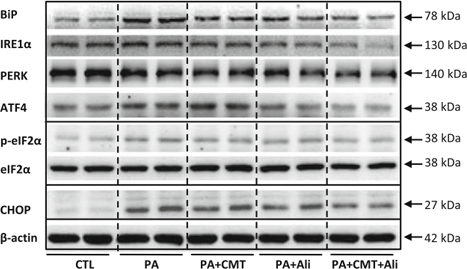
Combination of Chymostatin and Aliskiren attenuates ER stress induced by lipid overload in kidney tubular cells. [Abstract]2018 Jul 31;17(1):183. PMID: 30064425
Aliskiren purchased from MedChemExpress. Usage Cited in: Lipids Health Dis. 2018 Jul 31;17(1):183. [Abstract]
Protein abundance of ER stress markers (BiP, IRE1α, PERK, ATF4, pS51-eIF2α, eIF2α, and CHOP) are upregulated after palmitic acid (PA) treatment, which is prevented by cotreatment with chymostatin (50μM) and Aliskiren (10 nM).
-
Front Biosci (Landmark Ed)
C3aR Antagonist Alleviates C3a Induced Tubular Profibrotic Phenotype Transition via Restoring PPARα/CPT-1α Mediated Mitochondrial Fatty Acid Oxidation in Renin-Dependent Hypertension. [Abstract]2023 Oct 17;28(10):238. PMID: 37919077 -
Drug Metab Pharmacokinet
2024 Jun:56:101008. PMID: 38663183 -
-
-
-
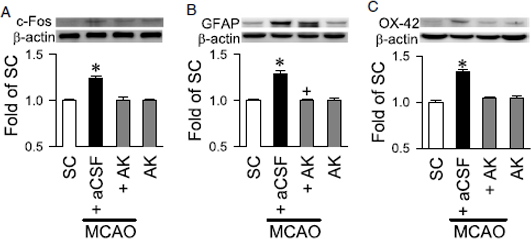
Aliskiren purchased from MedChemExpress. Usage Cited in: National Sun Yat-Sen University. 2015 Sep.
Effects of Aliskiren (AK) produce efficacious antagonism of the protein expression of c-Fos (A), GFAP (B) and OX-42 (C) in SC, aCSF+MCAO, AK+MCAO or AK alone group one day after stroke.
-


Solvent & Solubility
Ethanol : 100 mg/mL (181.24 mM; Need ultrasonic)
DMSO : 100 mg/mL (181.24 mM; Need ultrasonic; Hygroscopic DMSO has a significant impact on the solubility of product, please use newly opened DMSO)
Please refer to the solubility information to select the appropriate solvent. Once prepared, please aliquot and store the solution to prevent product inactivation from repeated freeze-thaw cycles.
Storage method and period of stock solution: -80°C, 6 months; -20°C, 1 month. When stored at -80°C, please use it within 6 months. When stored at -20°C, please use it within 1 month.
Please refer to the solubility information to select the appropriate solvent. Once prepared, please aliquot and store the solution to prevent product inactivation from repeated freeze-thaw cycles.
Storage method and period of stock solution: -80°C, 6 months; -20°C, 1 month. When stored at -80°C, please use it within 6 months. When stored at -20°C, please use it within 1 month.
Concentration (start) × Volume (start) = Concentration (final) × Volume (final)
Select the appropriate dissolution method based on your experimental animal and administration route.
- For the following dissolution methods, please ensure to first prepare a clear stock solution using an In Vitro approach and then sequentially add co-solvents:
- To ensure reliable experimental results, the clarified stock solution can be appropriately stored based on storage conditions. As for the working solution for In Vivo experiments, it is recommended to prepare freshly and use it on the same day.
- The percentages shown for the solvents indicate their volumetric ratio in the final prepared solution. If precipitation or phase separation occurs during preparation, heat and/or sonication can be used to aid dissolution.
Add each solvent one by one: 10% DMSO 40% PEG300 5% Tween-80 45% Saline
Solubility: ≥ 2.5 mg/mL (4.53 mM); Clear solution
This protocol yields a clear solution of ≥ 2.5 mg/mL (saturation unknown).
Taking 1 mL working solution as an example, add 100 μL DMSO stock solution (25.0 mg/mL) to 400 μL PEG300, and mix evenly; then add 50 μL Tween-80 and mix evenly; then add 450 μL Saline to adjust the volume to 1 mL.
Preparation of Saline: Dissolve 0.9 g sodium chloride in ddH₂O and dilute to 100 mL to obtain a clear Saline solution.
Add each solvent one by one: 10% DMSO 90% (20% SBE-β-CD in Saline)
Solubility: ≥ 2.5 mg/mL (4.53 mM); Clear solution
This protocol yields a clear solution of ≥ 2.5 mg/mL (saturation unknown).
Taking 1 mL working solution as an example, add 100 μL DMSO stock solution (25.0 mg/mL) to 900 μL 20% SBE-β-CD in Saline, and mix evenly.
Preparation of 20% SBE-β-CD in Saline (4°C, storage for one week): 2 g SBE-β-CD powder is dissolved in 10 mL Saline, completely dissolve until clear.
Please enter the basic information of animal experiments:
-
-
-
-
Recommended: Prepare an additional quantity of animals to account for potential losses during experiments.
Please enter your animal formula composition:
-
%DMSO +
Recommended: Keep the proportion of DMSO in working solution below 2% if your animal is weak.
-
%+
-
+%Tween-80 + +
-
%Saline +
The co-solvents required include: DMSO, . All of co-solvents are available by MedChemExpress (MCE). , Tween 80. All of co-solvents are available by MedChemExpress (MCE).
Working solution concentration: 0.22 mg/mL
Method for preparing stock solution: mg drug dissolved in μL DMSO. Stock solution concentration: mg/mL.
1. Take μL DMSO stock solution;
2. Add μL .
μL , mix evenly;
3. Then add μL Tween 80, mix evenly;
4. Then add μL
Please ensure that the stock solution in the first step is dissolved to a clear state, and add co-solvents in sequence. You can use ultrasonic heating (ultrasonic cleaner, recommended frequency 20-40 kHz), vortexing, etc. to assist dissolution.


Purity & Documentation
-
Data Sheet (272 KB)
-
SDS (393 KB)
- English - EN (393 KB)
- Français - FR (393 KB)
- Deutsch - DE (393 KB)
- Norwegian - NO (393 KB)
- Español - ES (393 KB)
- Swedish - SV (393 KB)
- Italian - IT (393 KB)
- Korean - KR (393 KB)
- Portuguese - PT (393 KB)
-
Handling Instructions (2659 KB)
References
[1]. Yuji Nakamura, et al. Discovery of DS-8108b, a Novel Orally Bioavailable Renin Inhibitor. ACS Med. Chem. Lett., 2012, 3 (9), pp 754–758 [Content Brief]
[2]. Wood JM, et al. Structure-based design of aliskiren, a novel orally effective renin inhibitor.Biochem Biophys Res Commun, 2003, 308(4), 698-705. [Content Brief]
[3]. Wang C, et al. Aliskiren targets multiple systems to alleviate cancer cachexia. Oncol Rep. 2016 Nov;36(5):3014-3022. [Content Brief]
[4]. Chang AY, et al. Interplay between brain stem angiotensins and monocyte chemoattractant protein-1 as a novel mechanism for pressor response after ischemic stroke. Neurobiol Dis. 2014 Nov;71:292-304. [Content Brief]
[5]. Buczko W, et al. Pharmacokinetics and pharmacodynamics of aliskiren, an oral direct renin inhibitor. Pharmacol Rep. 2008 Sep-Oct;60(5):623-31. [Content Brief]
[6]. Gradman AH, et al.Aliskiren, a novel orally effective renin inhibitor, provides dose-dependent antihypertensive efficacy and placebo-like tolerability in hypertensive patients. Circulation, 2005, 111(8), 1012-1018. [Content Brief]


Complete Stock Solution Preparation Table
Please refer to the solubility information to select the appropriate solvent. Once prepared, please aliquot and store the solution to prevent product inactivation from repeated freeze-thaw cycles.
Storage method and period of stock solution: -80°C, 6 months; -20°C, 1 month. When stored at -80°C, please use it within 6 months. When stored at -20°C, please use it within 1 month.
| Optional Solvent | Concentration Solvent Mass | 1 mg | 5 mg | 10 mg | 25 mg |
|---|---|---|---|---|---|
| Ethanol / DMSO | 1 mM | 1.8124 mL | 9.0619 mL | 18.1238 mL | 45.3096 mL |
| 5 mM | 0.3625 mL | 1.8124 mL | 3.6248 mL | 9.0619 mL | |
| 10 mM | 0.1812 mL | 0.9062 mL | 1.8124 mL | 4.5310 mL | |
| 15 mM | 0.1208 mL | 0.6041 mL | 1.2083 mL | 3.0206 mL | |
| 20 mM | 0.0906 mL | 0.4531 mL | 0.9062 mL | 2.2655 mL | |
| 25 mM | 0.0725 mL | 0.3625 mL | 0.7250 mL | 1.8124 mL | |
| 30 mM | 0.0604 mL | 0.3021 mL | 0.6041 mL | 1.5103 mL | |
| 40 mM | 0.0453 mL | 0.2265 mL | 0.4531 mL | 1.1327 mL | |
| 50 mM | 0.0362 mL | 0.1812 mL | 0.3625 mL | 0.9062 mL | |
| 60 mM | 0.0302 mL | 0.1510 mL | 0.3021 mL | 0.7552 mL | |
| 80 mM | 0.0227 mL | 0.1133 mL | 0.2265 mL | 0.5664 mL | |
| 100 mM | 0.0181 mL | 0.0906 mL | 0.1812 mL | 0.4531 mL |


Aliskiren Related Classifications
HY-12176 Related Classifications
 Powered by Bioz