



Proglumide hemicalcium
Based on 1 publication(s) in Google Scholar
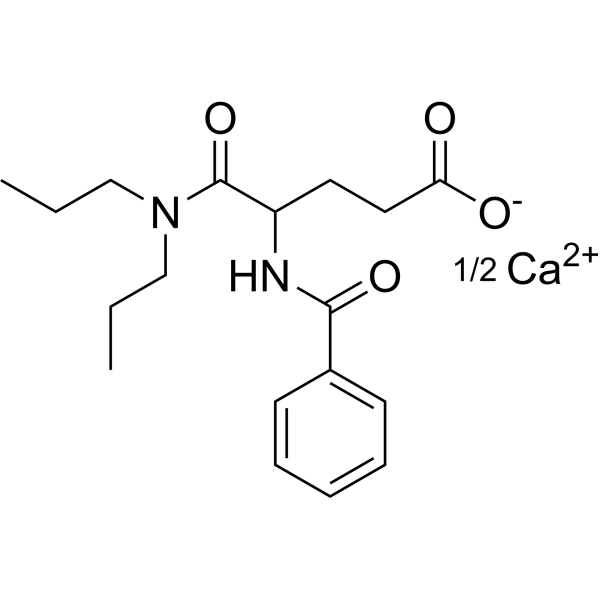
Proglumide hemicalcium is a nonpeptide and orally active cholecystokinin (CCK)-A/B receptors antagonist. Proglumide hemicalcium selective blocks CCK’s effects in the central nervous system (CNS). Proglumide hemicalcium has ability to inhibit gastric secretion and to protect the gastroduodenal mucosa. Proglumide hemicalcium also has antiepileptic and antioxidant activities.
For research use only. We do not sell to patients.
- CAS No.: 85068-56-0
- Formula: C18H26N2O4.1/2Ca
- Molecular Weight:353.44
-
Storage:
Please store the product under the recommended conditions in the Certificate of Analysis.

To place orders, for customer services and technical support, please contact: MedChemExpress USA
Tel: 609-228-6898 E-mail: [email protected] [email protected]


-
 Biological Activity
-
Chemical Information
- Purity & Documentation
- References
-
 Help & FAQs


Publications Citing Use of MedChemExpress (MCE) Proglumide hemicalcium
More

Biological Activity
Description
IC50 & Target
In Vitro
In an in vitro study, Proglumide at concentrations between 0.3-10 mM inhibits CCK-stimulated amylase release dose-dependently, while Proglumide does not influence the basal amylase release at concentrations between 0-3 mM. Dose-response curves to CCK for amylase release shifted to the right with increase in Proglumide concentration. This inhibition by Proglumide is reversible. In addition, the effect of Proglumide is selective for CCK and its related peptide[2].
The incubation of HT29 cells with Proglumide significantly reduces the [3H]-thymidine incorporation to HT29 cells in a dose-dependent manner, with an IC50 of 6.5 mM. Proglumide reduces in a dose-dependent manner the percentage of necrosis with a parallel increase of apoptosis up to 70%[3].
MedChemExpress (MCE) has not independently confirmed the accuracy of these methods. They are for reference only.
In Vivo
MedChemExpress (MCE) has not independently confirmed the accuracy of these methods. They are for reference only.
-
Animal Model:Adult male Sprague Dawley rats (200-250 g; 2 months old) are induced status epilepticus (SE)[1]
-
Dosage:250 mg/kg, 500 mg/kg, and 750 mg/kg
-
Administration:Intraperitoneal injection
-
Result:Dose-dependently and significantly increased the latencies to seizure and SE. Significantly and dose-dependently attenuated Li-PC (SE) induced increase in thiobarbituric acid (TBARS) and catalase (CAT), attenuated Li-Pc induced decrease in SOD, and attenuated depletion of GSH and glutathione-S transferase (GST) in the hippocampus and striatum.
Clinical Trial
| NCT Number | Sponsor | Condition | Start Date |
Phase

|
|---|---|---|---|---|
| NCT01329991 | 2011-05 | PHASE1 |


Chemical Information
-
CAS No. 85068-56-0
-
Molecular Weight 353.44
-
Formula C18H26N2O4.1/2Ca
-
SMILES
O=C([O-])CCC(NC(C1=CC=CC=C1)=O)C(N(CCC)CCC)=O.[Ca+2].[1/2]
-
Shipping
Room temperature in continental US; may vary elsewhere.
-
Storage
Please store the product under the recommended conditions in the Certificate of Analysis.


Publications (1)
-
Journal Impact Factor
-
Most Recent
-
Nat Commun
Paraventricular hypothalamic input to anterior cingulate cortex controls food preferences in chronic visceral pain mice. [Abstract]2025 Jul 1;16(1):5943. PMID: 40593837


Purity & Documentation
References
[1]. Ahmad M, et al. The effects of quinacrine, proglumide, and pentoxifylline on seizure activity, cognitive deficit, and oxidative stress in rat lithium-pilocarpine model of status epilepticus. Oxid Med Cell Longev. 2014;2014:630509. [Content Brief]
[2]. Iwamoto Y, et al. In vitro and in vivo effect of proglumide on cholecystokinin-stimulated amylase release in mouse pancreatic acini. Gastroenterol Jpn. 1984 Feb;19(1):53-8. [Content Brief]
[3]. González-Puga C, et al. Selective CCK-A but not CCK-B receptor antagonists inhibit HT-29 cell proliferation: synergism with pharmacological levels of melatonin. J Pineal Res. 2005 Oct;39(3):243-50. [Content Brief]
[4]. Bunney BS, et al. Further studies on the specificity of proglumide as a selective cholecystokinin antagonist in the central nervous system. Ann N Y Acad Sci. 1985;448:345-51. [Content Brief]
[5]. Tariq M, et al. Gastric and duodenal antiulcer and cytoprotective effects of proglumide in rats. J Pharmacol Exp Ther. 1987 May;241(2):602-7. [Content Brief]

Calculators
Concentration (start) × Volume (start) = Concentration (final) × Volume (final)


Proglumide hemicalcium Related Classifications
HY-103354A Related Classifications
 Powered by Bioz