



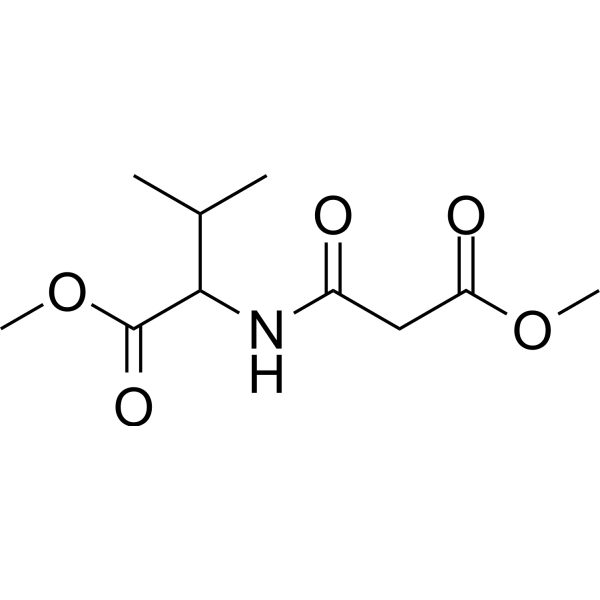
(Rac)-ZLc-002

Based on 1 Customer Validation
(Rac)-ZLc-002, an inhibitor of nNOS interaction with nitric oxide synthase 1 adaptor protein (NOS1AP), suppresses inflammatory nociception and chemotherapy-induced neuropathic pain and synergizes with Paclitaxel (HY-B0015) to reduce tumor cell viability.
For research use only. We do not sell to patients.
- Purity : 98.11%
- Formula: C10H17NO5
- Molecular Weight:231.25
-
Storage:Powder -20°C, 3 years , 4°C, 2 years ; In solvent -80°C, 6 months , -20°C, 1 month

To place orders, for customer services and technical support, please contact: MedChemExpress USA
Tel: 609-228-6898 E-mail: [email protected] [email protected]


-
 Biological Activity
-
Chemical Information
-
Solvent & Solubility
- Protocols
- Purity & Documentation
- References
-
 Help & FAQs




Biological Activity
Description
IC50 & Target
nNOS/NOS1AP interaction[1]
In Vitro
(Rac)-ZLc-002 (10 μM) reduces co-immunoprecipitation of NOS1AP with nNOS immunoprecipitated from primary cultured cortical neurons. (Rac)-ZLc-002 fails to disrupt nNOS–NOS1AP protein–protein interactions in the AlphaScreen in vitro binding assay. It shows no activity in a cell-free assay[1].
(Rac)-ZLc-002 (10 μM) reduces co-immunoprecipitation of full-length NOS1AP but not of PSD95-PDZ2 from HEK293T cells co-expressing full-length nNOS[1].
(Rac)-ZLc-002 (0-50 μM; 72 h) synergizes with Paclitaxel (HY-B0015) to reduce tumor cell viability[1].
MedChemExpress (MCE) has not independently confirmed the accuracy of these methods. They are for reference only. Further protocols information, click here.
-
Cell Line:4T1 cells
-
Concentration:0-50 µM
-
Incubation Time:72 h
-
Result:Treatment alone had no effect on the viability. Showed synergistic effect with Paclitaxel (HY-B0015).
In Vivo
(Rac)-ZLc-002 (4 and 10 mg/kg; i.p.; once) reduces formalin-evoked nociceptive behavior and Fos-like immunoreactivity in the spinal dorsal horn in rats[1].
(Rac)-ZLc-002 (40 mg/kg/day; i.v.; 7 days) attenuates chronic mild stress (CMS)‐induced anxiogenic behavior in ICR mice[2].
(Rac)-ZLc-002 (10 μM; 1 μl; 30 min after Corticosterone, HY-B1618) delivering into the hippocampus for 7 days reverses the behavioural effects of glucocorticoids in mice[2].
MedChemExpress (MCE) has not independently confirmed the accuracy of these methods. They are for reference only.
-
Animal Model:Adult C57BL/6J male mice, paclitaxel model of neuropathic pain[1]
-
Dosage:10 mg/kg
-
Administration:IP, once or daily for 8 days
-
Result:Increased postinjection mechanical paw withdrawal thresholds, mechanical paw withdrawal thresholds differed across postinjection times, and the interaction between drug treatment and injection time was significant. Elevated mechanical paw withdrawal thresholds relative to vehicle treatment from 30 min. Decreased postinjection cold responsiveness, cold responsiveness did not differ reliably across postinjection times, and the interaction between drug treatment and injection time was not significant. Once daily dosing increased mechanical paw withdrawal thresholds relative to the vehicle-treated group across the observation interval.


Chemical Information
-
Appearance Solid
-
Molecular Weight 231.25
-
Formula C10H17NO5
-
Color Off-white to light yellow
-
SMILES
O=C(OC)CC(NC(C(OC)=O)C(C)C)=O
-
Shipping
Room temperature in continental US; may vary elsewhere.
-
Storage
Powder -20°C 3 years 4°C 2 years In solvent -80°C 6 months -20°C 1 month


Solvent & Solubility
In Vitro:
DMSO : 100 mg/mL (432.43 mM; Need ultrasonic; Hygroscopic DMSO has a significant impact on the solubility of product, please use newly opened DMSO)
Please refer to the solubility information to select the appropriate solvent. Once prepared, please aliquot and store the solution to prevent product inactivation from repeated freeze-thaw cycles.
Storage method and period of stock solution: -80°C, 6 months; -20°C, 1 month. When stored at -80°C, please use it within 6 months. When stored at -20°C, please use it within 1 month.
Please refer to the solubility information to select the appropriate solvent. Once prepared, please aliquot and store the solution to prevent product inactivation from repeated freeze-thaw cycles.
Storage method and period of stock solution: -80°C, 6 months; -20°C, 1 month. When stored at -80°C, please use it within 6 months. When stored at -20°C, please use it within 1 month.
Concentration (start) × Volume (start) = Concentration (final) × Volume (final)

Protocols
-
Cell Cytotoxicity Assay
Cytotoxicity assays are usually based on the assessment of cell membrane damage, which can also be indirectly detected by measuring cell viability. Detection methods include MTT assay, CKK-8 assay, LDH assay and ATP assay, etc.
-
Mammalian live/dead viability and cytotoxicity staining
Live/dead viability and cytotoxicity staining assays are based on the simultaneous detection of intracellular esterase activity in metabolically active (viable) cells and membrane integrity loss in non-viable cells. In commonly used dual-staining approaches, membrane-permeant fluorogenic substrates are converted by intracellular esterases into fluorescent products in live cells, while impermeant DNA-binding dyes selectively enter cells with compromised plasma membranes and label nucleic acids in dead or dying cells, enabling discrimination between viable and non-viable populations by fluorescence microscopy or flow cytometry.
-
CCK-8/WST-8 Cell Proliferation Assay
The CCK-8/WST-8 assay is based on the reduction of the water-soluble tetrazolium salt WST-8 to a water-soluble formazan product by cellular dehydrogenases in metabolically active cells, where the generated formazan amount is proportional to the number of living cells and is quantified by measuring absorbance in the visible range, providing a colorimetric readout for cell viability and proliferation assessment. This class of tetrazolium-based assays improves upon earlier MTT-based systems by producing a water-soluble formazan, eliminating the need for organic solubilization steps and enabling direct spectrophotometric measurement in culture medium.
-
MTT Cell Proliferation Assay
The MTT assay is a colorimetric endpoint assay for estimating viable cell number, cell growth, cytotoxicity, or cell activation in cultured mammalian cells. Living cells reduce the yellow tetrazolium salt MTT into purple/blue formazan, while dead cells do not generate the same signal; the resulting color can be quantified with a multiwell spectrophotometer. MTT reduction is commonly interpreted as a readout of metabolic activity that often correlates with viable cell number, but it should not be treated as a direct cell-counting method unless the assay is optimized for the cell type and experimental condition. Studies show that MTT reduction can involve mitochondrial and non-mitochondrial reducing systems, and formazan may accumulate in intracellular lipid droplets rather than simply marking mitochondria.
-
Cell Viability Determination by MTT Colorimetric Assay
The following protocol uses the MTT colorimetric assay as a classic literature-established method for assessing cell viability/metabolic activity in cultured mammalian cells. MTT[3-(4,5-dimethylthiazol-2-yl)-2,5-diphenyltetrazolium bromide] is reduced by metabolically active cells to a colored formazan product; the amount of formazan is quantified spectrophotometrically and provides an indirect measure of metabolically active viable cells. Importantly, MTT reduction reflects cellular oxidoreductase/metabolic activity rather than an absolute direct count of living cells, so changes in cellular metabolism can alter the signal independently of cell number.


Purity & Documentation
-
Data Sheet (273 KB)
-
SDS (251 KB)
- English - EN (251 KB)
- Français - FR (251 KB)
- Deutsch - DE (251 KB)
- Norwegian - NO (251 KB)
- Español - ES (251 KB)
- Swedish - SV (251 KB)
- Italian - IT (251 KB)
- Korean - KR (251 KB)
- Portuguese - PT (251 KB)
-
Handling Instructions (2659 KB)
References
[1]. Lee WH, Carey LM, Li LL, et al. ZLc002, a putative small-molecule inhibitor of nNOS interaction with NOS1AP, suppresses inflammatory nociception and chemotherapy-induced neuropathic pain and synergizes with paclitaxel to reduce tumor cell viability. Mol Pain. 2018;14:1744806918801224. [Content Brief]
[2]. Zhu LJ, Shi HJ, Chang L, et al. nNOS-CAPON blockers produce anxiolytic effects by promoting synaptogenesis in chronic stress-induced animal models of anxiety. Br J Pharmacol. 2020;177(16):3674-3690. [Content Brief]


Complete Stock Solution Preparation Table
Please refer to the solubility information to select the appropriate solvent. Once prepared, please aliquot and store the solution to prevent product inactivation from repeated freeze-thaw cycles.
Storage method and period of stock solution: -80°C, 6 months; -20°C, 1 month. When stored at -80°C, please use it within 6 months. When stored at -20°C, please use it within 1 month.
| Optional Solvent | Concentration Solvent Mass | 1 mg | 5 mg | 10 mg | 25 mg |
|---|---|---|---|---|---|
| DMSO | 1 mM | 4.3243 mL | 21.6216 mL | 43.2432 mL | 108.1081 mL |
| 5 mM | 0.8649 mL | 4.3243 mL | 8.6486 mL | 21.6216 mL | |
| 10 mM | 0.4324 mL | 2.1622 mL | 4.3243 mL | 10.8108 mL | |
| 15 mM | 0.2883 mL | 1.4414 mL | 2.8829 mL | 7.2072 mL | |
| 20 mM | 0.2162 mL | 1.0811 mL | 2.1622 mL | 5.4054 mL | |
| 25 mM | 0.1730 mL | 0.8649 mL | 1.7297 mL | 4.3243 mL | |
| 30 mM | 0.1441 mL | 0.7207 mL | 1.4414 mL | 3.6036 mL | |
| 40 mM | 0.1081 mL | 0.5405 mL | 1.0811 mL | 2.7027 mL | |
| 50 mM | 0.0865 mL | 0.4324 mL | 0.8649 mL | 2.1622 mL | |
| 60 mM | 0.0721 mL | 0.3604 mL | 0.7207 mL | 1.8018 mL | |
| 80 mM | 0.0541 mL | 0.2703 mL | 0.5405 mL | 1.3514 mL | |
| 100 mM | 0.0432 mL | 0.2162 mL | 0.4324 mL | 1.0811 mL |


(Rac)-ZLc-002 Related Classifications
HY-124996 Related Classifications
 Powered by Bioz