



Samidorphan

Based on 1 Customer Validation
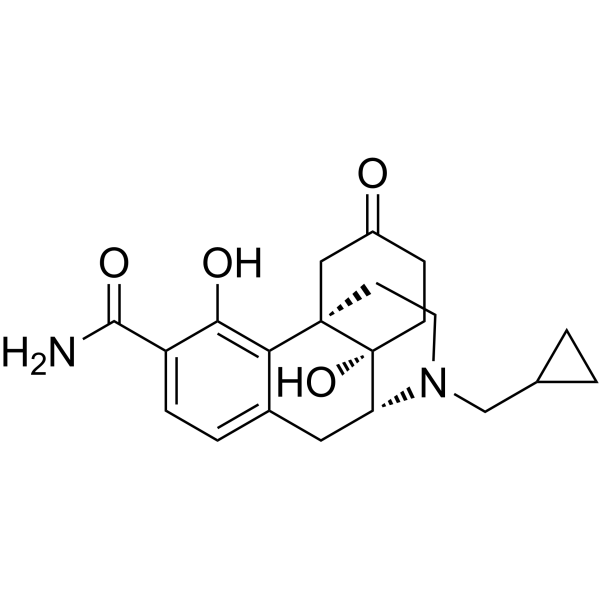
Samidorphan (ALKS-33) is an orally active opioid receptor modulator that targets μ-opioid, κ-opioid, and δ-opioid receptors. Samidorphan acts as a μ-opioid receptor antagonist and a partial agonist at κ-opioid and δ-opioid receptors. In vivo, Samidorphan functions primarily as an opioid receptor antagonist and ameliorates depressive behaviors in animals.
Nos produits utilisent uniquement pour la recherche. Nous ne vendons pas aux patients.
- Pureté : 99.83%
- CAS No.: 852626-89-2
- Formule: C21H26N2O4
- Masse moléculaire:370.44
-
Stockage:Powder -20°C, 3 years ; In solvent -80°C, 6 months , -20°C, 1 month

To place orders, for customer services and technical support, please contact: MedChemExpress USA
Tel: 609-228-6898 E-mail: [email protected] [email protected]


-
 Activité biologique
-
Chemical Information
-
Solvant et solubilité
- Pureté et documentation
- Références
-
 Help & FAQs




Voir tous les produits spécifiques à Isoform Opioid Receptor
More

Activité biologique
Description
In Vivo
Samidorphan (0-10 mg/kg, s.c., 3 h-1 week) can alter the behavior and extracellular neurotransmitter concentration of rats[5].
MedChemExpress (MCE) has not independently confirmed the accuracy of these methods. They are for reference only.
-
Animal Model:WKY rat[5]
-
Dosage:0, 0.3, 1, 3, 10 mg/kg
-
Administration:Subcutaneous injection (s.c.) for 3 h, 24 h, and 1 week
-
Result:Had no significant effect at any of the doses or time points tested.
Concurrant administration of BUP (HY-177072) (0.1 mg/kg) significantly reduced immobility at 3h (p<0.01) and this effect persisted up to 1 week.
Abolished this BUPinduced hyperlocomotion.
Significantly reduced the number of marbles buried compared with vehicle-treated rats.
Attenuated BUP-induced changes of extracellular levels of serotonin and dopamine in the medial prefrontal cortex and nucleus accumbens shell.
-
Animal Model:Swiss mice (180-250 g)[4]
-
Dosage:10 mg/kg
-
Administration:Oral gavage (p.o.) for 2 weeks
-
Result:Significantly higher (P<0.05) line crossing frequency compared to stressed group in the open field maze.
Significant decrease (P<0.01) in the rearing frequency compared to control group.
Essai clinique
| NCT Number | Sponsor | Condition | Start Date |
Phase

|
|---|---|---|---|---|
| NCT01329991 | Plexxikon| | 2011-05 | PHASE1 |


Chemical Information
-
CAS No. 852626-89-2
-
Appearance Solid
-
Masse moléculaire 370.44
-
Formule C21H26N2O4
-
Color White to yellow
-
SMILES
O=C(N)C1=CC=C(C[C@H]([C@@]2(CC3)O)N(CC4)CC5CC5)C([C@]42CC3=O)=C1O
-
Synonyms
ALKS-33; RDC-0313
-
Livraison
Room temperature in continental US; may vary elsewhere.
-
Stockage
Powder -20°C 3 years In solvent -80°C 6 months -20°C 1 month


Solvant et solubilité
In Vitro:
DMSO : 200 mg/mL (539.90 mM; Need ultrasonic; Hygroscopic DMSO has a significant impact on the solubility of product, please use newly opened DMSO)
Please refer to the solubility information to select the appropriate solvent. Once prepared, please aliquot and store the solution to prevent product inactivation from repeated freeze-thaw cycles.
Storage method and period of stock solution: -80°C, 6 months; -20°C, 1 month. When stored at -80°C, please use it within 6 months. When stored at -20°C, please use it within 1 month.
Please refer to the solubility information to select the appropriate solvent. Once prepared, please aliquot and store the solution to prevent product inactivation from repeated freeze-thaw cycles.
Storage method and period of stock solution: -80°C, 6 months; -20°C, 1 month. When stored at -80°C, please use it within 6 months. When stored at -20°C, please use it within 1 month.
Concentration (start) × Volume (start) = Concentration (final) × Volume (final)
In Vivo:
Select the appropriate dissolution method based on your experimental animal and administration route.
- For the following dissolution methods, please ensure to first prepare a clear stock solution using an In Vitro approach and then sequentially add co-solvents:
- To ensure reliable experimental results, the clarified stock solution can be appropriately stored based on storage conditions. As for the working solution for In Vivo experiments, it is recommended to prepare freshly and use it on the same day.
- The percentages shown for the solvents indicate their volumetric ratio in the final prepared solution. If precipitation or phase separation occurs during preparation, heat and/or sonication can be used to aid dissolution.
Add each solvent one by one: 10% DMSO 40% PEG300 5% Tween-80 45% Saline
Solubility: ≥ 5 mg/mL (13.50 mM); Clear solution
This protocol yields a clear solution of ≥ 5 mg/mL (saturation unknown).
Taking 1 mL working solution as an example, add 100 μL DMSO stock solution (50.0 mg/mL) to 400 μL PEG300, and mix evenly; then add 50 μL Tween-80 and mix evenly; then add 450 μL Saline to adjust the volume to 1 mL.
Preparation of Saline: Dissolve 0.9 g sodium chloride in ddH₂O and dilute to 100 mL to obtain a clear Saline solution.
Add each solvent one by one: 10% DMSO 90% (20% SBE-β-CD in Saline)
Solubility: ≥ 5 mg/mL (13.50 mM); Clear solution
This protocol yields a clear solution of ≥ 5 mg/mL (saturation unknown).
Taking 1 mL working solution as an example, add 100 μL DMSO stock solution (50.0 mg/mL) to 900 μL 20% SBE-β-CD in Saline, and mix evenly.
Preparation of 20% SBE-β-CD in Saline (4°C, storage for one week): 2 g SBE-β-CD powder is dissolved in 10 mL Saline, completely dissolve until clear.
In Vivo Dissolution Calculator
Please enter the basic information of animal experiments:
-
-
-
-
Recommended: Prepare an additional quantity of animals to account for potential losses during experiments.
Please enter your animal formula composition:
-
%DMSO +
Recommended: Keep the proportion of DMSO in working solution below 2% if your animal is weak.
-
%+
-
+%Tween-80 + +
-
%Saline +
The co-solvents required include: DMSO, . All of co-solvents are available by MedChemExpress (MCE). , Tween 80. All of co-solvents are available by MedChemExpress (MCE).
Working solution concentration: 0.22 mg/mL
Method for preparing stock solution: mg drug dissolved in μL DMSO. Stock solution concentration: mg/mL.
1. Take μL DMSO stock solution;
2. Add μL .
μL , mix evenly;
3. Then add μL Tween 80, mix evenly;
4. Then add μL
Please ensure that the stock solution in the first step is dissolved to a clear state, and add co-solvents in sequence. You can use ultrasonic heating (ultrasonic cleaner, recommended frequency 20-40 kHz), vortexing, etc. to assist dissolution.


Pureté et documentation
-
Fiche technique (286 KB)
-
SDS (251 KB)
- English - EN (251 KB)
- Français - FR (251 KB)
- Deutsch - DE (251 KB)
- Norwegian - NO (251 KB)
- Español - ES (251 KB)
- Swedish - SV (251 KB)
- Italian - IT (251 KB)
- Korean - KR (251 KB)
- Portuguese - PT (251 KB)
-
Instruction de manipulation (2659 KB)
Références
[1]. McElroy SL, et al. A placebo-controlled pilot study of the novel opioid receptor antagonist ALKS-33 in binge eating disorder. Int J Eat Disord. 2013 Apr;46(3):239-45. [Content Brief]
[2]. Rehan ST, et al. Samidorphan/olanzapine combination therapy for schizophrenia: Efficacy, tolerance and adverse outcomes of regimen, evidence-based review of clinical trials. Ann Med Surg (Lond). 2022 Jun 30;79:104115. [Content Brief]
[5]. Smith KL, et al. Opioid system modulators buprenorphine and samidorphan alter behavior and extracellular neurotransmitter concentrations in the Wistar Kyoto rat. Neuropharmacology. 2019 Mar 1;146:316-326. [Content Brief]


Complete Stock Solution Preparation Table
Please refer to the solubility information to select the appropriate solvent. Once prepared, please aliquot and store the solution to prevent product inactivation from repeated freeze-thaw cycles.
Storage method and period of stock solution: -80°C, 6 months; -20°C, 1 month. When stored at -80°C, please use it within 6 months. When stored at -20°C, please use it within 1 month.
| Optional Solvent | Concentration Solvent Mass | 1 mg | 5 mg | 10 mg | 25 mg |
|---|---|---|---|---|---|
| DMSO | 1 mM | 2.6995 mL | 13.4975 mL | 26.9949 mL | 67.4873 mL |
| 5 mM | 0.5399 mL | 2.6995 mL | 5.3990 mL | 13.4975 mL | |
| 10 mM | 0.2699 mL | 1.3497 mL | 2.6995 mL | 6.7487 mL | |
| 15 mM | 0.1800 mL | 0.8998 mL | 1.7997 mL | 4.4992 mL | |
| 20 mM | 0.1350 mL | 0.6749 mL | 1.3497 mL | 3.3744 mL | |
| 25 mM | 0.1080 mL | 0.5399 mL | 1.0798 mL | 2.6995 mL | |
| 30 mM | 0.0900 mL | 0.4499 mL | 0.8998 mL | 2.2496 mL | |
| 40 mM | 0.0675 mL | 0.3374 mL | 0.6749 mL | 1.6872 mL | |
| 50 mM | 0.0540 mL | 0.2699 mL | 0.5399 mL | 1.3497 mL | |
| 60 mM | 0.0450 mL | 0.2250 mL | 0.4499 mL | 1.1248 mL | |
| 80 mM | 0.0337 mL | 0.1687 mL | 0.3374 mL | 0.8436 mL | |
| 100 mM | 0.0270 mL | 0.1350 mL | 0.2699 mL | 0.6749 mL |


Samidorphan Related Classifications
HY-123689 Related Classifications
 Powered by Bioz