8 Results for "

ATP detection

" in MedChemExpress (MCE) Product Catalog:
Products (8)

8 Results for "ATP detection" in MCE Product Catalog:

36
36 Cited Publications
Cat. No.: HY-K0314

MCE ATP Assay Kit provides a rapid method to measure intracellular ATP. The kit is suitable for ATP determination in cells, tissue, and other biological samples.

loading...
    loading...
12
12 Cited Publications
Cat. No.: HY-K0302

MCE Cell-ATP Viability Detection Kit is used for detecting the number and viability of living cells in culture based on high-sensitivity bioluminescence detection technology of the ATP present.Product specifications: Large sizes are based on 100 mL increments.

loading...
    loading...
Cat. No.: HY-12679
CAS No.: 1621002-24-1
Target:  

Btk

Research Areas:  

Cancer

PF-06658607 is an alkynylated irreversible Brutons tyrosine kinase (BTK) inhibitor that covalently reacts with active site cysteines in the ATP-binding pocket. PF-06658607 can be used to detect "off "-targets for covalent kinase inhibitors in cancer cells. The alkyne moiety allows for azide-based detection probe via copper-catalyzed click chemistry .
loading...
    loading...
Cat. No.: HY-131576
CAS No.: 491-97-4
Synonyms: dTDP
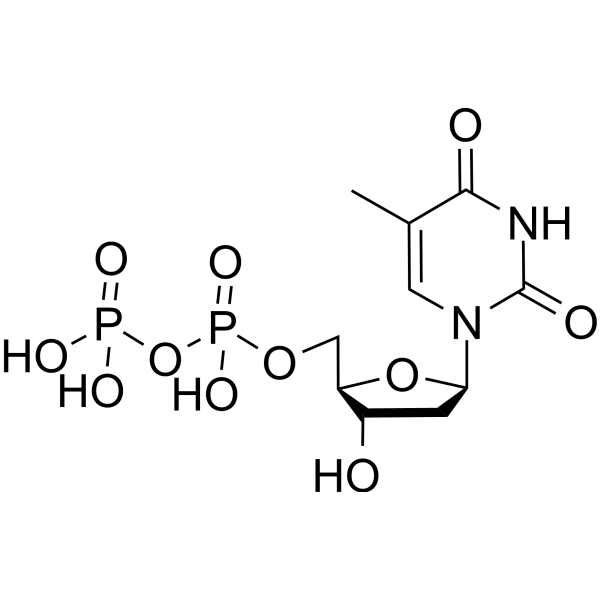
Thymidine 5′-diphosphate (dTDP) is a key product for pyrimidine synthesis in organisms. Thymidine 5′-diphosphate is generated via the phosphorylation of thymidine 5'-monophosphate (dTMP) catalyzed by thymidylate kinase (TMPK), a process requiring ATP and Mg 2+. Thymidine 5′-diphosphate is further catalyzed by TMPK into thymidine 5'-triphosphate (dTTP). Detection of Thymidine 5′-diphosphate levels enables the assessment of TMPK activity .
loading...
    loading...
Cat. No.: HY-D2999
CAS No.: 2996066-33-0
NIR-RED ATP Probe is a NIR-II fluorescent probe. NIR-RED ATP Probe exhibits high affinity and selectivity for ATP and can non-invasively and with high contrast detect changes in ATP concentration at the cellular level, with minimal interference to the abundant biomolecules within the cells. NIR-RED ATP Probe can be used as a biomarker detection tool for drug-induced liver injury (DILI) .
loading...
    loading...
Cat. No.: HY-K6017

MCE 3D Cell-ATP Viability Detection kit is based on high-sensitivity bioluminescence detection technology (luciferase system) that quantitatively measures ATP to detect the number and viability of 3D cells in culture.

loading...
    loading...
Cat. No.: HY-131576B
CAS No.: 28120-41-4
Synonyms: dTDP disodium
Target:  

Endogenous Metabolite

Research Areas:  

Metabolic Disease

Thymidine 5′-diphosphate (dTDP) disodium is a key product for pyrimidine synthesis in organisms. Thymidine 5′-diphosphate is generated via the phosphorylation of thymidine 5'-monophosphate (dTMP) catalyzed by thymidylate kinase (TMPK), a process requiring ATP and Mg 2+. Thymidine 5′-diphosphate disodium is further catalyzed by TMPK into thymidine 5'-triphosphate (dTTP). Detection of Thymidine 5′-diphosphate levels enables the assessment of TMPK activity .
loading...
    loading...
Cat. No.: HY-W783351
CAS No.: 1416808-87-1
Synonyms: Coppersensor 790 acetoxymethyl ester
Target:  

Fluorescent Dye

Research Areas:  

Metabolic Disease

CS790AM (Coppersensor 790 acetoxymethyl ester) is a cell-permeable, Cu +-targeted near-infrared fluorescent probe (λabs=760 nm, λem=790 nm) applicable to live cells. CS790AM can cross lipophilic cell membranes, and is converted into negatively charged CS790 under the action of intracellular esterases to be retained, thus enabling highly sensitive, reversible "turn-on" detection of labile Cu + pools in live cells and mice. CS790AM possesses excellent biocompatibility and selectivity, avoids interference from other metal ions, shows no obvious toxicity, and can be rapidly cleared. CS790AM allows long-term longitudinal monitoring of individual mice, visualizes copper levels in internal organs and isolated livers, and effectively evaluates abnormal copper accumulation in Wilson's disease models (Atp7b -/-) as well as dynamic changes after chelator treatment. CS790AM can be used for research on Wilson's disease and related copper metabolic disorders .
loading...
    loading...

