12 Results for "

CCNE1 amplification

" in MedChemExpress (MCE) Product Catalog:
Products (12)

12 Results for "CCNE1 amplification" in MCE Product Catalog:

2
2 Cited Publications
Cat. No.: HY-160701
CAS No.: 2888704-84-3
Synonyms: BLU-222
Target:  

CDK Apoptosis

Research Areas:  

Cancer

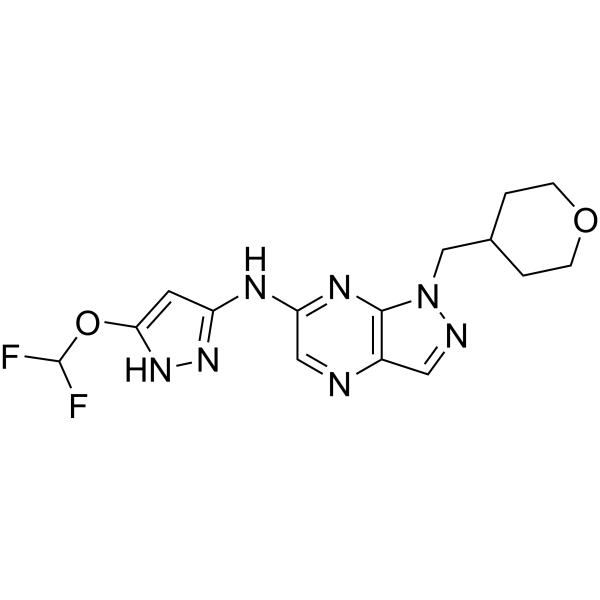
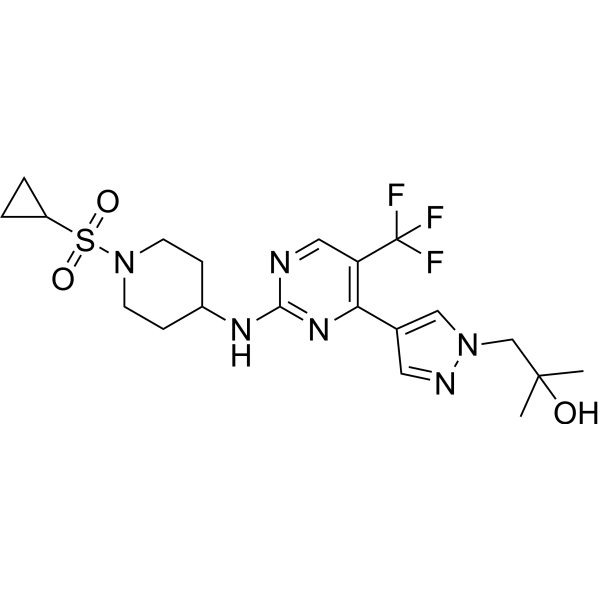
Cirtociclib (BLU-222) is an orally active and highly selective CDK2 inhibitor. Cirtociclib disrupts Rb signaling and causes G1 arrest and apoptosis in CCNE1-amplified endometrial cancer cells .
loading...
    loading...
1
1 Cited Publications
Cat. No.: HY-162255
CAS No.: 2488073-20-5
Target:  

CDK

Research Areas:  

Cancer

CDK2-IN-23 (Compound 17) is a kinase selective and highly potent CDK2 inhibitor (IC50 = 0.29 nM). CDK2-IN-23 shows the pharmacodynamic inhibition of CDK2 in CCNE1-amplified mouse models. CDK2-IN-23 can be used for the research of cancer .
loading...
    loading...
Cat. No.: HY-175842
CAS No.: 3030279-55-8
Target:  

CDK

Research Areas:  

Cancer

CDK2 degrader 7 is an orally active CDK2 degrader, with DC50 values of 13 nM (MKN1cells) and 17 nM (TOV21G cells). CDK2 degrader 7 induces G1 phase arrest in MKN1 cells. CDK2 degrader 7 achieves tumor stasis in HCC1569 (CCNE1-amplified) xenograft models. CDK2 degrader 7 can be used for the study of CCNE1-amplified cancers .
loading...
    loading...
Cat. No.: HY-164827
CAS No.: 2862772-71-0
Target:  

Molecular Glues CDK

Research Areas:  

Cancer

CDK2 degrader 3 is a selective CDK2 molecular glue-like degrader. CDK2 degrader 3 induces G1 cell cycle arrest in CCNE1-amplified cancer cells. CDK2 degrader 3 is applicable to breast cancer-related research .
loading...
    loading...
Cat. No.: HY-175819
CAS No.: 717094-37-6
Target:  

Wee1 Apoptosis

Research Areas:  

Cancer

PD-166285 is a PKMYT1 inhibitor, with an IC50 value of 17 nM. PD166285 shows strong antiproliferative effects against CCNE1-amplified OVCAR3 cells (IC50 = 0.14 μM) and HCC1569 cells (IC50 = 0.21 μM). PD166285 induces apoptosis and arrests CCNE1-amplified HCC1569 cells at the G1/S phase of the cell cycle. PD166285 can be used for the research of PKMYT1-targeted therapies for CCNE1-amplified cancers .
loading...
    loading...
Cat. No.: HY-170442
CAS No.: 3054692-62-2
Synonyms: CDK2-IN-37
Target:  

CDK

Research Areas:  

Cancer

ECI830 (CDK2-IN-37) is an orally active, ATP-competitive and highly selective CDK2 inhibitor. ECI830 shows high selectivity over other CDK family members. ECI830 can be used for the study of HR+/HER2- breast cancer and CCNE1-amplified tumors (such as ovarian cancer and lung cancer) .
loading...
    loading...
Cat. No.: HY-180485
Target:  

PROTACs Wee1 CDK

Research Areas:  

Cancer

PROTAC D16-M1P2 is an orally active CRBN-mediated selective PKMYT1 PROTAC degrader, with a DC50 of 0.7 nM in CCNE1-amplified HCC1569 breast cancer cells. PROTAC D16-M1P2 induces PKMYT1 degradation via the ubiquitin-proteasome system, directly inhibits PKMYT1 kinase activity, suppresses Thr14 phosphorylation of CDK1, and depends on functional CRBN and ubiquitination-like modification processes. PROTAC D16-M1P2 can be used for the research of CCNE1-amplified breast cancer, FBXW7-mutated cholangiocarcinoma, and PPP2R1A-deficient cancers .
loading...
    loading...
Cat. No.: HY-184649
CAS No.: 2922859-30-9
Target:  

CDK

Research Areas:  

Cancer

CDK2-IN-60 is an orally active, ATP-competitive selective CDK2 inhibitor with a Ki of 77 pM. CDK2-IN-60 has high selectivity for both CDK4 and CDK1. CDK2-IN-60 blocks G1/S cell cycle progression to suppress proliferation of CCNE1-amplified tumor cells. CDK2-IN-60 serves as a lead chemical probe for investigating CCNE1-amplified cancers and CDK4/6 inhibitor-resistant HR-positive breast cancer .
loading...
    loading...
Cat. No.: HY-181004
Target:  

CDK

Research Areas:  

Cancer

PKMYT1-IN-13 is a potent, orally active and selective PKMYT1 inhibitor that inhibits PKMYT1 with IC50 values < 10.0 nM in ADP-Glo assay and 19.9 nM in NanoBRET cellular assay. PKMYT1-IN-13 exhibits high selectivity over WEE1. PKMYT1-IN-13 shows selective antiproliferative activity in CCNE1-amplified cells, while showing minimal wild-type effects. PKMYT1-IN-13 shows antitumor efficacy in HCC1569 mouse xenografts. PKMYT1-IN-13 can be used for the research of CCNE1-amplified cancers, such as gastric, ovarian, and breast cancer .
loading...
    loading...
Cat. No.: HY-161463
CAS No.: 3025006-64-5
Target:  

CDK

Research Areas:  

Cancer

CDK2-IN-28 (compound 22) is a CDK2 inhibitor with good selectivity and cellular effects against other CDKs. CDK2-IN-28 has anti-proliferative effects on MKN1 cells (EC50: 0.31 μM) .
loading...
    loading...
Cat. No.: HY-186132
CAS No.: 3030276-48-0
Target:  

PROTACs CDK

Research Areas:  

Cancer

PROTAC CDK2-pRb degrader-1 is an orally active PROTAC-class degrader of CDK2. PROTAC CDK2-pRb degrader-1 effectively inhibits the phosphorylation of retinoblastoma protein (Rb) at serine residues 807/811 by inducing ubiquitination and proteasomal degradation of CDK2. PROTAC CDK2-pRb degrader-1 exhibits significant activity against human cells (with EC50 values of 12 nM and 125 nM, respectively). In xenograft models, PROTAC CDK2-pRb degrader-1 effectively inhibits tumor growth and induces tumor stasis, making it suitable for research related to CCNE1-amplified cancers (such as ovarian cancer, gastric cancer, and breast cancer) .
loading...
    loading...
Cat. No.: HY-180484
CAS No.: 2974454-59-4
Research Areas:  

Cancer

PKMYT1-IN-12 (Compound 4) is a selective inhibitor of PKMYT1, with an IC₅₀ of 2.6 nM. PKMYT1-IN-12 can effectively inhibit the phosphorylation of CDK1, with an IC₅₀ of 44 nM. PKMYT1-IN-12 is a target protein ligand that can be used for the synthesis of PROTAC D16-M1P2 (HY-180485) .
loading...
    loading...
  • 1

