
1. Search Result
Search Result
Pathways Recommended: Stem Cell/Wnt Cell Cycle/DNA Damage
Results for "

CEM T cells

" in MedChemExpress (MCE) Product Catalog:

9

Inhibitors & Agonists

1

Peptides

1

Natural
Products

2

Oligonucleotides

Cat. No. Product Name Target Research Areas Chemical Structure
  • HY-N7634

    Farnesyl Transferase Parasite Infection Cancer
    Tectol, isolated from Lippia sidoides, exhibits significant activity against human leukemia cell lines HL60 and CEM . Tectol is a farnesyltransferase (FTase) inhibitor with IC50s of 2.09 and 1.73 μM for human and T. brucei FTase, respectively. Tectol inhibits drug-resistant strain of P. falciparum (FcB1) with an IC50 of 3.44 μM .
    Tectol
  • HY-157343

    Apoptosis Mitochondrial Metabolism Caspase Neurological Disease Cancer
    GD3 Ganglioside is an Apoptosis inducer and a biomarker for mouse neural stem cells. GD3 Ganglioside expresses in neural stem cells and the subventricular zone of the adult mouse brain. GD3 Ganglioside targets the mitochondrial permeability transition pore complex, induces pore opening, dissipates mitochondrial transmembrane potential, triggers Mitochondrial swelling, releases pro-apoptotic factors, and activates Caspase-9. GD3 Ganglioside is applicable to research related to glioblastoma .
    GD3 Ganglioside
  • HY-W105741

    HIV Infection
    12-Bromododecanoic acid is a bromo fatty acid. 12-Bromododecanoic acid can be used in the synthesis of clickable forms of myristic acid. 12-Bromododecanoic acid inhibits HIV replication in CEM-SS T cells (EC50 = 38 µM) .
    12-Bromododecanoic acid
  • HY-106611

    SR 33287

    Phospholipase Cancer
    Brinazarone (SR 33287) is an inhibitor for acid lysosomal sphingomyelinase, and leads to cellular lipidosis. Brinazarone potentiates the cytotoxic effects of anti-Thy 1.2 AT15E RTA-IT on T2 cells and anti-CD5 T101 on CEM cells .
    Brinazarone
  • HY-160057

    DNA Alkylator/Crosslinker Cancer
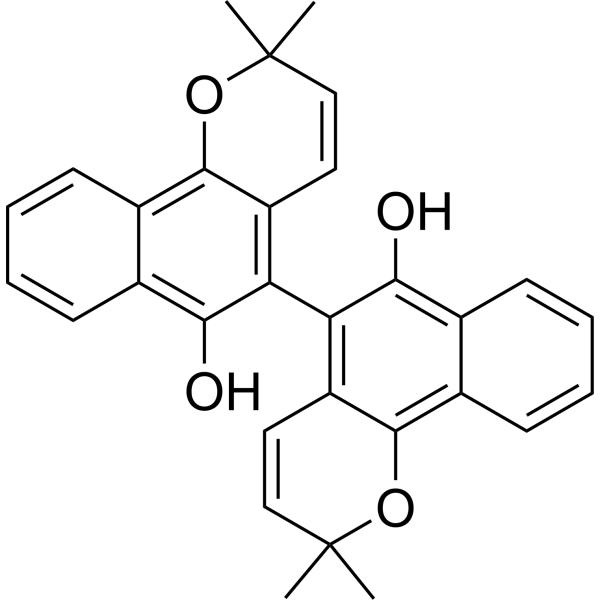
    GMT 8 aptamer sodium is a nucleic acid aptamer targeting different glioblastoma cell lines and exhibits high affinity. GMT 4 aptamer sodium also shows high binding affinity to the T lymphocyte cell line CCRF-CEM .
    GMT 8 aptamer sodium
  • HY-P10596

    Bacterial Fungal Infection Cancer
    Lasioglossin-III is an antimicrobial peptide that can be isolated from the venom of wild bees. Lasioglossin-III has high antibacterial activity against Gram-positive and Gram-negative bacteria, antifungal activity and antitumor activity. Lasioglossin-III has certain cytotoxicity against three cancer cell lines (HeLa S3, CRC SW 480 and CCRF-CEM T) with IC50 values ​​of 4, 18 and 5 μM, respectively .
    Lasioglossin-III
  • HY-182081

    Microtubule/Tubulin Interleukin Related Cancer
    Tubulin polymerization-IN-90 is a tubulin polymerization inhibitor. Tubulin polymerization-IN-90 disrupts tubulin polymerization by binding to the nocodazole-binding site on β-tubulin. Tubulin polymerization-IN-90 induces the release of extracellular vesicles marked by the tetraspanin CD63. Tubulin polymerization-IN-90 induces the release of IL-8 from cells. Tubulin polymerization-IN-90 reduces the viability of cancer cells. Tubulin polymerization-IN-90 can be used in the research of cancers such as acute T-lymphoblastic leukemia .
    Tubulin polymerization-IN-90
  • HY-126773

    Biochemical Assay Reagents Infection
    Dp2mT is a non-cytotoxic control compound, with an IC50 of >3 μM for HIV-1 transcription inhibition and an IC50 of >10 μM for cytotoxicity. Dp2mT does not bind to intracellular iron pools. Dp2mT does not inhibit CDK9 activity .
    Dp2mT
  • HY-183925

    HIV Dihydroorotate Dehydrogenase Infection
    Redoxal is a dihydroorotate dehydrogenase (DHODH) inhibitor and anti-HIV-1 agent. Redoxal induces intracellular pyrimidine depletion by inhibiting the de novo pyrimidine biosynthesis pathway, enhances the protein stability of APOBEC3G (A3G), upregulates the abundance of A3G protein in cells and progeny viral particles, thereby strengthening the host endogenous antiviral restriction mediated by A3G . Redoxal selectively targets DHOdehase at the mitochondrial level, with an IC50 of 430 nM for inhibiting DHO oxidation in human mitochondria and an IC50 of 910 nM in rat mitochondria . Redoxal can be used in studies related to HIV-1 infection .
    Redoxal

Inquiry Online

Your information is safe with us. * Required Fields.

Salutation


Country or Region *

Applicant Name *


Organization Name *

Department *


Email Address *


Product Name *

Cat. No.


Requested quantity *

Phone Number *


Remarks

Inquiry Online

Inquiry Information

Product Name:
Cat. No.:
Quantity:
MCE Japan Authorized Agent:

