12 Results for "

Copper death

" in MedChemExpress (MCE) Product Catalog:
Products (12)

12 Results for "Copper death" in MCE Product Catalog:

130
130 Cited Publications
Cat. No.: HY-12040
CAS No.: 488832-69-5
Purity:  99.80%
Synonyms: STA-4783
Research Areas:  

Cancer

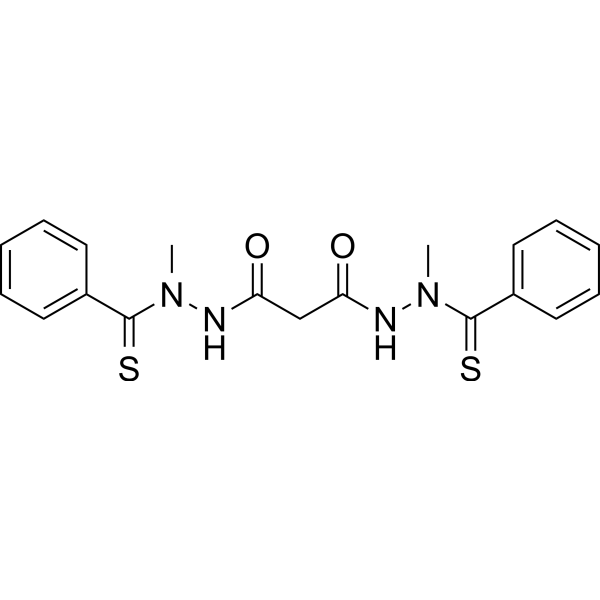
Elesclomol (STA-4783) is a potent copper ionophore and promotes copper-dependent cell death (cuproptosis). Elesclomol specifically binds ferredoxin 1 (FDX1) α2/α3 helices and β5 strand. Elesclomol inhibits FDX1-mediated Fe-S cluster biosynthesis. Elesclomol is an oxidative stress inducer that induces cancer cell apoptosis. Elesclomol is a reactive oxygen species (ROS) inducer. Elesclomol can be used for Menkes and associated disorders of hereditary copper deficiency research .
loading...
    loading...
1
1 Cited Publications
Cat. No.: HY-N7137
CAS No.: 6533-00-2
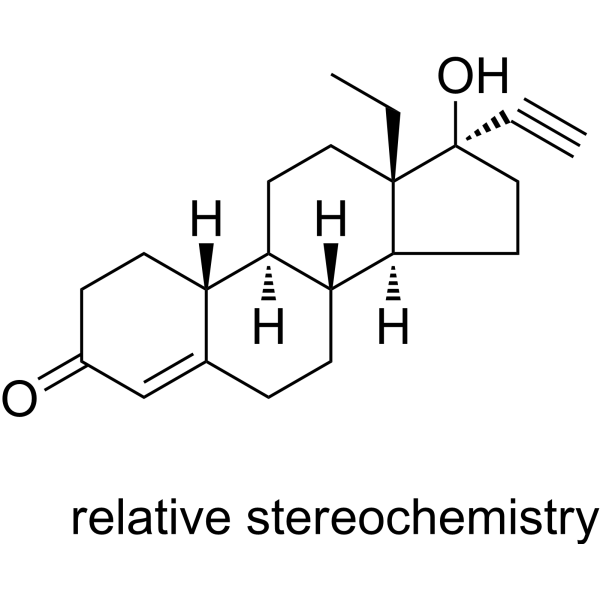
Norgestrel is a synthetic analog of progesterone, a compound commonly found in oral contraceptive pill, and a powerful neuroprotective antioxidant, preventing light-induced ROS in photoreceptor cells, and cell death . Norgestrel is a click chemistry reagent, it contains an Alkyne group and can undergo copper-catalyzed azide-alkyne cycloaddition (CuAAc) with molecules containing Azide groups.
loading...
    loading...
Cat. No.: HY-151829
CAS No.: 2616562-74-2
Target:  

ADC Linkers

Research Areas:  

Others

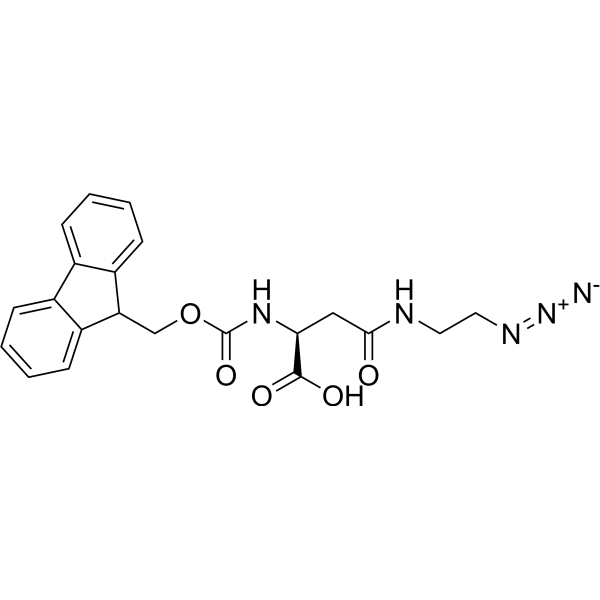
Fmoc-L-Asn(EDA-N3)-OH is a click chemistry reagent containing an azide group. This building block is reported in literature for the modification of Amanitin via Click Chemistry. Alpha-Amanitin is the deadliest member of the amatoxin peptide family produced by the death-cap mushroom A. phalloides. It is an orally available, rigid, bicyclic octapeptide and one of the most lethal known natural products (LD50 = 50-100 μg/kg) acting as highly selective allosteric inhibitor of the RNA polymerase II . It contains an azide group and can undergo copper-catalyzed azide-alkyne cycloaddition (CuAAc) with molecules containing alkyne groups. It can also undergo ring strain-promoted alkyne-azide cycloaddition (SPAAC) with molecules containing DBCO or BCN groups.
loading...
    loading...
Cat. No.: HY-12040S
Synonyms: STA-4783-d2
Elesclomol-d2 (STA-4783-d2) is a deuterium labeled Elesclomol (HY-12040). Elesclomol (STA-4783) is a potent copper ionophore and promotes copper-dependent cell death (cuproptosis). Elesclomol specifically binds ferredoxin 1 (FDX1) α2/α3 helices and β5 strand. Elesclomol inhibits FDX1-mediated Fe-S cluster biosynthesis. Elesclomol is an oxidative stress inducer that induces cancer cell apoptosis. Elesclomol is a reactive oxygen species (ROS) inducer. Elesclomol can be used for Menkes and associated disorders of hereditary copper deficiency research .
loading...
    loading...
Cat. No.: HY-B2028
CAS No.: 2312-35-8
Target:  

Parasite

Research Areas:  

Infection

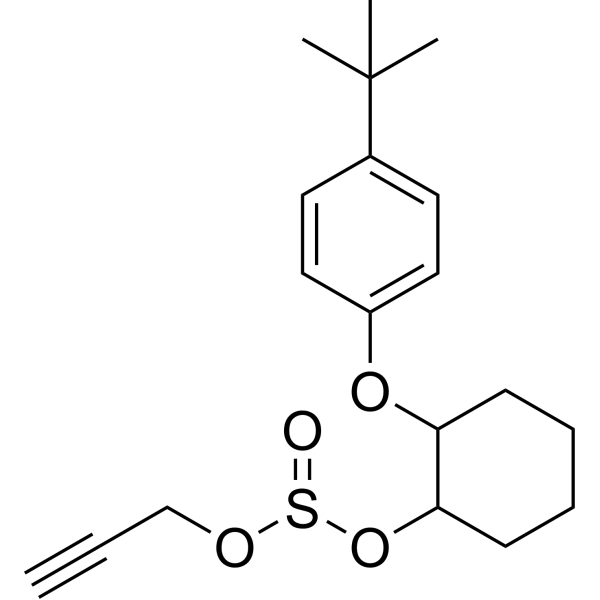
Propargite is a pesticide used to kill mites. Propargite induces β-cell necrosis preceded by DNA damage. Propargite induces MIN6 cell death with an IC50?of?1?μM . Propargite is a click chemistry reagent, it contains an Alkyne group and can undergo copper-catalyzed azide-alkyne cycloaddition (CuAAc) with molecules containing Azide groups.
loading...
    loading...
Cat. No.: HY-B2028R
CAS No.: 2312-35-8
Research Areas:  

Infection

Propargite (Standard) is the analytical standard of Propargite. This product is intended for research and analytical applications. Propargite is a pesticide used to kill mites. Propargite induces β-cell necrosis preceded by DNA damage. Propargite induces MIN6 cell death with an IC50 of 1 μM . Propargite is a click chemistry reagent, it contains an Alkyne group and can undergo copper-catalyzed azide-alkyne cycloaddition (CuAAc) with molecules containing Azide groups.
loading...
    loading...
Cat. No.: HY-126250
CAS No.: 2376326-31-5
Purity:  98.10%
NPD1335 is a Trypanosoma brucei phosphodiesterase B1 (TbrPDEB1) inhibitor with submicromolar activities against T. brucei parasites. NPD1335 displays a greatly improved cytotoxicity profile. NPD1335 increases intracellular cAMP levels and results in the distortion of the cell cycle and cell death . NPD-1335 is a click chemistry reagent, it contains an Alkyne group and can undergo copper-catalyzed azide-alkyne cycloaddition (CuAAc) with molecules containing Azide groups.
loading...
    loading...
Cat. No.: HY-173477
CAS No.: 2446965-04-2
Target:  

Apoptosis

Research Areas:  

Cancer

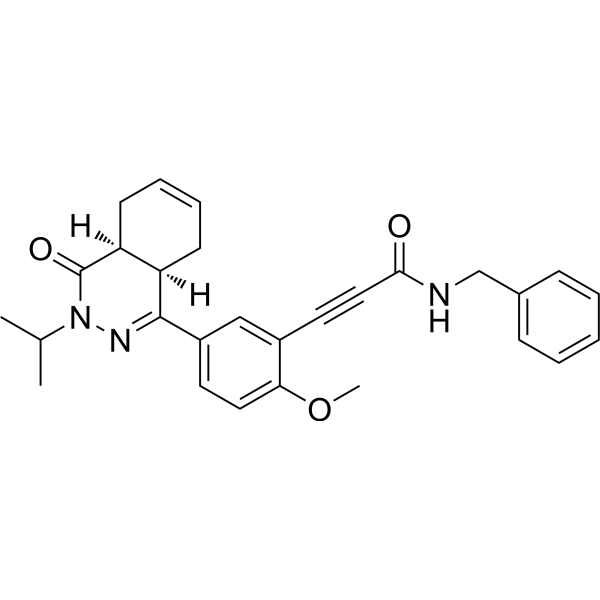
JR5-26B is an orally active apoptosis inducer. JR5-26B induces cell death through copper-mediated apoptosis and necroptosis. JR5-26B exhibits antiproliferative activity on MIA PaCa-2, PANC-1, PAN02, SU.86.86, and KPC-2 cells with IC50s of 0.6, 4.4, 8.0, 1.1, and 3.4μM, respectively .
loading...
    loading...
Cat. No.: HY-146314
CAS No.: 2416910-88-6
Purity:  99.70%
Research Areas:  

Neurological Disease

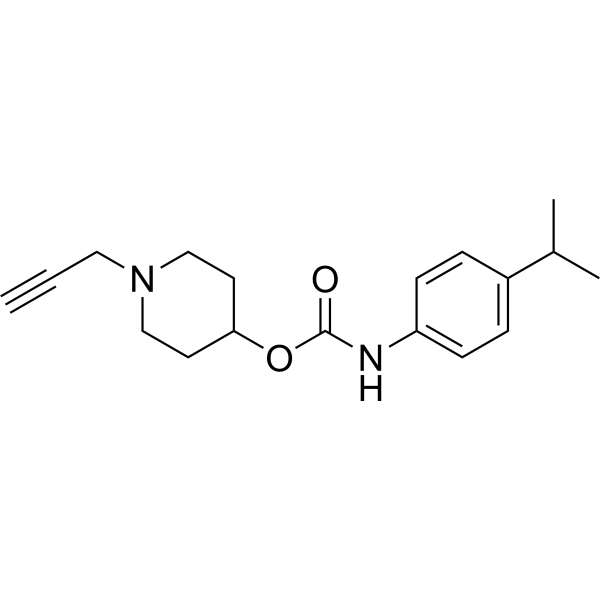
MAO-B-IN-9 (compound 16) is a potent, selective, BBB-penetrated, irreversible and time-dependent MAO-B (monoamine oxidase B) inhibitor, with an IC50 of 0.18 μM. MAO-B-IN-9 prevents Aβ1-42-induced neuronal cell death. MAO-B-IN-9 shows neuroprotective effects, which may be the result of its Aβ1-42 anti-aggregation effects . MAO-B-IN-9 is a click chemistry reagent, itcontains an Alkyne group and can undergo copper-catalyzed azide-alkyne cycloaddition (CuAAc) with molecules containing Azide groups.
loading...
    loading...
Cat. No.: HY-138185
CAS No.: 158792-24-6
Synonyms: SF 2738A
Target:  

Bacterial Apoptosis

Research Areas:  

Cancer

Collismycin A is a bacterial metabolite originally isolated from Streptomyces that has diverse biological activities, including antibacterial, antiproliferative, and neuroprotective properties. It is active against a variety of bacteria (MICs=6.25 and 100 μg/mL) and fungi (MICs=12.5-100 μg/mL). It inhibits proliferation of A549 lung, HCT116 colon, and HeLa cervical cancer cells (IC50s=0.3, 0.6, and 0.3 μM, respectively) and NIH373 fibroblasts (IC50=56.6 μM) but not MDA-MD-231 breast cancer cells (IC50=>100 μM). Collismycin A forms a complex with Fe(II) and Fe(III) at a 2:1 ratio, and the addition of iron ions inhibits the antiproliferative effect of collismycin A on HeLa cells, an effect that does not occur with the addition of zinc, manganese, copper, or magnesium ions.3 Collismycin A (1 μM) prevents apoptosis in the brain region of zebrafish larvae in a model of neuronal cell death induced by all-trans retinoic acid.
loading...
    loading...
Cat. No.: HY-L133
433 compounds

Copper is an important co-factor of all biological enzymes, but if the concentration exceeds the threshold of maintaining the homeostasis mechanism, copper will lead to cytotoxicity. This death mechanism has been named "Cuproptosis".

The mechanism of cuproptosis distinct from all other known mechanisms of regulated cell death, including apoptosis, pyroptosis, necroptosis, and ferroptosis.

Copper combine with the lipoylated components of the tricarboxylic acid cycle (TCA), leading to lipoylated protein aggregation and subsequent loss of iron-sulfur cluster proteins, ultimately resulting in protein toxicity stress and cell death. Studies have shown that the necessary factors for cuproptosis include the presence of glutathione, mitochondrial metabolism of galactose and pyruvate, and glutamine metabolism.

Targeted regulation of cuproptosis is a potential choice to treat cancer, rheumatoid arthritis, and other diseases. For example, up-regulation of LIPT1 may inhibit the occurrence and development of tumors by destroying TCA in mitochondria and then inducing cuproptosis.

MCE supplies a unique collection of 433 cuproptosis-related compounds, all of which act on the targets or signaling pathways related to cuproptosis and may have in inhibitory or activated effect on cuproptosis. MCE Cuproptosis Library is a useful tool for drug research related to cancer, rheumatoid arthritis, and other diseases.

Cat. No.: HY-W051530
CAS No.: 938-33-0
Target:  

Drug Derivative

Research Areas:  

Cancer


8-Methoxyquinoline is a structural analogue of 8-hydroxyquinoline (HY-B1005). 8-Methoxyquinoline does not bind copper. 8-Methoxyquinoline could neither inhibit the chymotrypsin-like activity of the proteasome in breast cancer cell cultures nor induce cancer cell death. 8-Methoxyquinoline can be used in the research of breast cancer .
loading...
    loading...
  • 1

