Search Result
Results for "
D-galactose
" in MedChemExpress (MCE) Product Catalog:
20
Biochemical Assay Reagents
21
Isotope-Labeled Compounds
| Cat. No. |
Product Name |
Target |
Research Areas |
Chemical Structure |
-
- HY-N0210
-
-
-
- HY-131892
-
|
|
Endogenous Metabolite
|
Metabolic Disease
Cancer
|
|
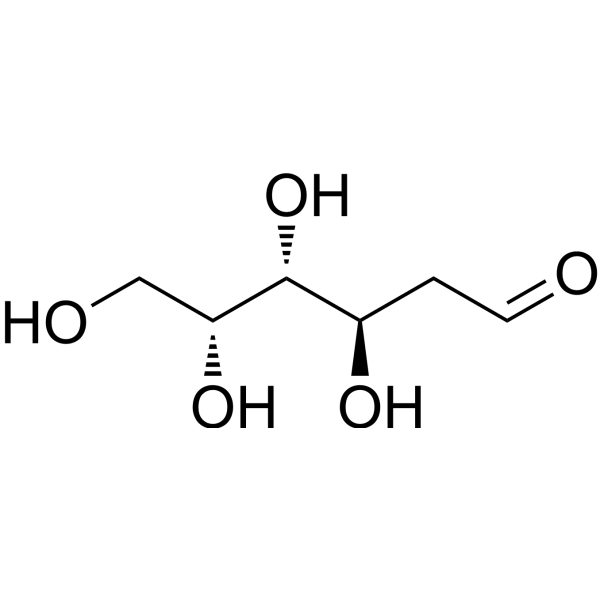
2-Deoxy-D-galactose is a glucose analog. 2-Deoxy-D-galactose inhibits glycolysis to inhibits tumor growth. 2-Deoxy-D-galactose is a substance interfering with the fucosylation of glycomacromolecules and impairing memory consolidation in various learning tasks. 2-Deoxy-d-galactose hinders glycoprotein fucosylation in vivo .
|
-
-
- HY-N0210R
-
-
-
- HY-121370
-
|
|
Drug Isomer
|
Others
|
|
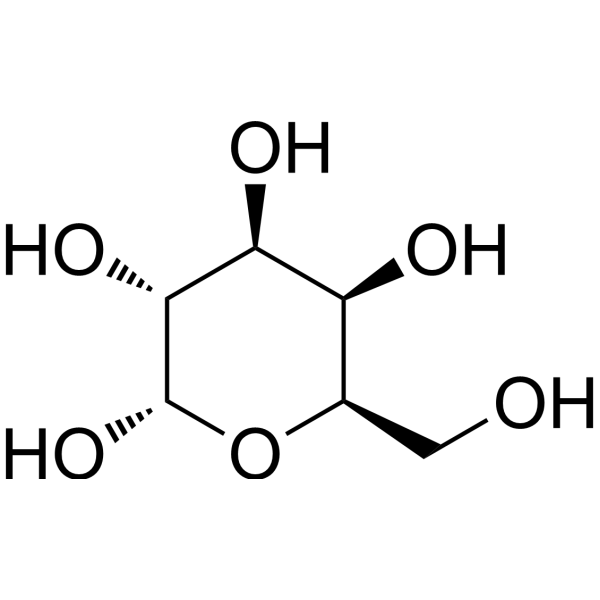
α-D-Galactose is a isomer of D-galactose (HY-N0210). α-D-Galactose is a polysaccharide and can be used as a carbon source .
|
-
-
- HY-W028813
-
-
-
- HY-N0210S16
-
-
-
- HY-W145673
-
|
D-galactose-6-O-sulphate sodium salt
|
Biochemical Assay Reagents
|
Others
|
|
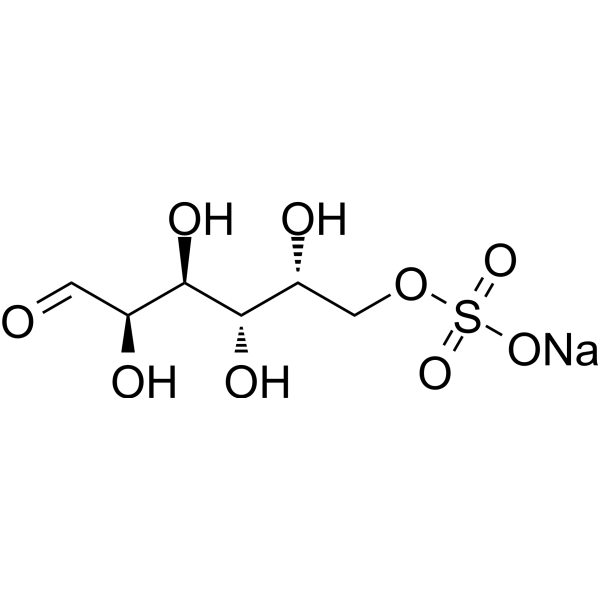
D-Galactose-6-O-sulfate sodium salt is a biochemical reagent that can be used as a biological material or organic compound for life science related research.
|
-
-
- HY-P3443
-
|
PNA
|
Biochemical Assay Reagents
|
Cancer
|
|
Peanut agglutinin (PNA) is a carbohydrate-recognition protein that binds competitively and irreversibly to cell-surface β-D-Gal (1-3)-GalNAc, and this binding can be inhibited by D-galactose and asialofetuin. Peanut agglutinin recognizes exposed glycoepitopes and reflects the glycosylation status of cells. Peanut agglutinin can label glycoconjugates at neuromuscular junctions to safely visualize synaptic structures. Peanut agglutinin can be used to synthesize dyes to distinguish between normal and tumor tissues. Peanut agglutinin provides support for research on leukemia, Burkitt's tumors, and cutaneous squamous lesions .
|
-
-
- HY-N0210S
-
-
-
- HY-W718137
-
|
|
Biochemical Assay Reagents
|
Others
|
|
6-Azido-6-deoxy-D-galactose, 95% can be used as a substrate in enzymology to study the activity and specificity of galactosyltransferases and other glycosylation enzymes.
|
-
-
- HY-W743751
-
|
|
Biochemical Assay Reagents
|
Others
|
|
2-Deoxy-2-fluoro-D-galactose is a class of biochemical reagents used in glycobiology research. Glycobiology studies the structure, synthesis, biology, and evolution of sugars. It involves carbohydrate chemistry, enzymology of glycan formation and degradation, protein-glycan recognition, and the role of glycans in biological systems. This field is closely related to basic research, biomedicine, and biotechnology .
|
-
-
- HY-P2889
-
|
|
Biochemical Assay Reagents
|
Others
|
|
Pyranose oxidase, Coriolus sp. is an oxidoreductase targeting monosaccharides (e.g., D-glucose, D-galactose). Pyranose oxidase, Coriolus sp. is promising for research of biosensors (glucose, 1,5-anhydroglucitol detection) and biofuel cells .
|
-
-
- HY-N9439
-
|
|
Endogenous Metabolite
|
Others
|
|
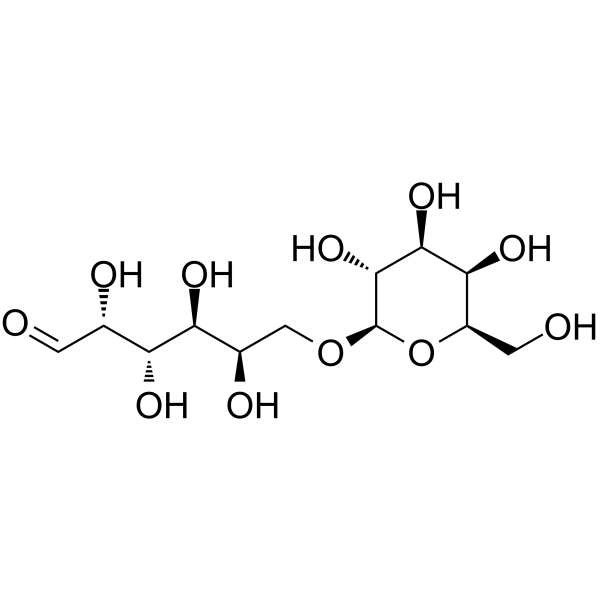
6-O-β-D-Galactopyranosyl-D-galactose, a disaccharide, is a part of the polysaccharide main chain with β-(1→6)-glycoside bonds with a side chain bonded to the main one by the β-(1→3) bond. 6-O-β-D-Galactopyranosyl-D-galactose can be isolated from enzyme-hydrolyzed peach gum .
|
-
-
- HY-W039921
-
|
N-Azidoacetylgalactosamine; GalNAz
|
Biochemical Assay Reagents
|
Others
|
|
2-[(Azidoacety)amino]-2-deoxy-D-galactose targets O-GlcNAc-modified proteins. By detecting and targeting O-GlcNAc-modified proteins, 2-[(Azidoacety)amino]-2-deoxy-D-galactose can serve as a chemical tag for intracellular sugar chain metabolism .
|
-
-
- HY-113043
-
-
-
- HY-W102387
-
|
Pentaacetyl-D-galactopyranose
|
Insulin Receptor
|
Metabolic Disease
|
|
D-Galactose pentaacetate inhibits leucine-induced insulin release. D-Galactose pentaacetate can be used for the research of persistent hyperinsulinemia in childhood or insulinoma .
|
-
-
- HY-N0210S11
-
-
-
- HY-W106550
-
|
Pentaacetyl-α-D-galactopyranose
|
Biochemical Assay Reagents
|
Others
|
|
α-D-Galactose pentaacetate (Pentaacetyl-α-D-galactopyranose) is a biochemical reagent that can be used as a biological material or organic compound for life science related research.
|
-
-
- HY-W039923
-
|
|
Insulin Receptor
|
Endocrinology
|
|
β-D-Galactose pentaacetate is a negative regulator of insulin with plasma membrane penetrating ability and can be hydrolyzed by intracellular esterases. β-D-Galactose pentaacetate inhibits Leucine (HY-N0486)-induced insulin release in Wistar rat islets, potentially preventing excessive insulin release in pathological conditions .
|
-
-
- HY-N0210S6
-
-
-
- HY-N0210S7
-
-
-
- HY-W039917
-
|
|
Biochemical Assay Reagents
|
Others
|
|
2-Azido-2-deoxy-D-galactose, 98% can be applied in glycobiology, can be glycosylated by glycopeptides, and can be used for the synthesis of glycoconjugates.
|
-
-
- HY-114364S
-
|
|
Isotope-Labeled Compounds
|
Others
|
|
UDP-α-D-Galactose- 13C disodium is the 13C labeled UDP-α-D-Galactose disodium. UDP-Galactose disodium is a monosaccharide and a key glycosyl donor molecule in cells that participates in nucleotide sugar metabolism. UDP-Galactose disodium is the natural agonist of the P2Y14 receptor coupled to Gi proteins in the immune system (IC50 = 0.67 μM, hP2Y14). UDP-Galactose disodium can be used to study cell signal transduction and substance metabolism .
|
-
-
- HY-N0210S4
-
-
-
- HY-N0210S3
-
-
-
- HY-N0210S2
-
-
-
- HY-N0210S12
-
-
-
- HY-E70034
-
-
-
- HY-N0210S9
-
-
-
- HY-136110
-
|
D-Galactosone
|
DNA/RNA Synthesis
|
Cancer
|
|
2-Keto-D-galactose (D-Galactosone) inhibits DNA synthesis, and inhibits proliferation of in vitro grown Ehrlich ascites tumor cells .
|
-
-
- HY-N0210S8
-
-
-
- HY-128930
-
|
|
ADC Linker
|
Cancer
|
|
6-O-2-Propyn-1-yl-D-galactose is a nonclaevable glycolinker for the functionalization of cytotoxic agents and applications in antibody-agent conjugation. 6-O-2-Propyn-1-yl-D-galactose is a click chemistry reagent, it contains an Alkyne group and can undergo copper-catalyzed azide-alkyne cycloaddition (CuAAc) with molecules containing Azide groups.
|
-
-
- HY-N0210S1
-
-
-
- HY-W353572
-
|
|
Biochemical Assay Reagents
|
Others
|
|
2-O-(6-Deoxy-α-L-galactopyranosyl)-D-galactose is a class of biochemical reagents used in glycobiology research. Glycobiology studies the structure, synthesis, biology, and evolution of sugars. It involves carbohydrate chemistry, enzymology of glycan formation and degradation, protein-glycan recognition, and the role of glycans in biological systems. This field is closely related to basic research, biomedicine, and biotechnology .
|
-
-
- HY-W142434S
-
-
-
- HY-W145672
-
|
|
Biochemical Assay Reagents
|
Others
|
|
D-Galactose-4-O-sulfate sodium salt is a biochemical reagent that can be used as a biological material or organic compound for life science related research.
|
-
-
- HY-W134141
-
|
2,3,4,6-Tetra-O-Benzyl-D-galactose
|
Biochemical Assay Reagents
|
Others
|
|
2,3,4,6-Tetra-O-benzyl-D-galactopyranose is a biochemical reagent that can be used as a biological material or organic compound for life science related research .
|
-
-
- HY-146279S
-
-
-
- HY-W768245
-
|
|
Isotope-Labeled Compounds
HIV
Endogenous Metabolite
|
Infection
Cancer
|
|
a-D-Galactose-1,2- 13C2 1-phosphate potassium is the 13C- and 15N-labeled a-D-Galactose (HY-121370). α-D-Galactose is a non-starch polysaccharide found in the bulb tissues of Lilium davidii var. unicolor Salisb. α-D-Galactose has anti-oxidation properties, anti-tumour activities, immunomodulatory effects and anti-HIV functions .
|
-
-
- HY-N0210S5
-
-
-
- HY-141135
-
|
|
PROTAC Linkers
|
Cancer
|
|
Propargyl-PEG4-tetra-Ac-beta-D-galactose is a PEG-based PROTAC linker that can be used in the synthesis of PROTACs .
|
-
-
- HY-W553070
-
|
|
Biochemical Assay Reagents
|
Others
|
|
1-Thio-β-D-galactose, Sodium Salt is a class of biochemical reagents used in glycobiology research. Glycobiology studies the structure, synthesis, biology, and evolution of sugars. It involves carbohydrate chemistry, enzymology of glycan formation and degradation, protein-glycan recognition, and the role of glycans in biological systems. This field is closely related to basic research, biomedicine, and biotechnology .
|
-
-
- HY-W698422
-
|
|
Biochemical Assay Reagents
|
Others
|
|
2-O-α-D-Glucopyranosyl-D-galactose is a class of biochemical reagents used in glycobiology research. Glycobiology studies the structure, synthesis, biology, and evolution of sugars. It involves carbohydrate chemistry, enzymology of glycan formation and degradation, protein-glycan recognition, and the role of glycans in biological systems. This field is closely related to basic research, biomedicine, and biotechnology .
|
-
-
- HY-W039910
-
-
-
- HY-W039920
-
|
β-D-Galactosylamine, 98%
|
Biochemical Assay Reagents
|
Others
|
|
1-Amino-1-deoxy-β-D-galactose, 98% is a galactose analog used as a competitive inhibitor to aid in the separation, purification, identification, differentiation, and characterization of β-D-galactosidase and galactose oxidase.
|
-
-
- HY-W768296
-
-
-
- HY-W768295
-
-
-
- HY-W415856
-
|
Beta-D-galactose
|
Drug Derivative
|
Others
|
β-D-galactose (Beta-D-galactose) is one of the two anomers of D-Galactose (HY-N0210). β-D-galactose efficiently binds to and inhibits the galactose repressor (GalR), thereby inducing the expression of the gal regulon. β-D-galactose acts as a persistent induction signal to trigger the synthesis of UDP-galactose for the biosynthetic glycosylation pathway, rather than serving as a carbon source in Yersinia pestis with inactivated GalM .
|
-
-
- HY-E70412
-
|
|
Endogenous Metabolite
|
Metabolic Disease
|
Galactose 1-dehydrogenase, E.coli is a dehydrogenase expressed in E. coli. Galactose 1-dehydrogenase, E.coli catalyzes the oxidation of L-arabinose and D-galactose using NADP +/NAD + as cofactors. Galactose 1-dehydrogenase, E.coli can be used in diagnostic tests to determine total galactose content and can also serve as a biocatalyst for producing galacturonate .
|
-
-
- HY-W039909S
-
-
- HY-W039909S1
-
-
- HY-N12719
-
|
|
Others
|
Others
|
|
Isocampneoside I is an acylated phenethyl oligosaccharide that can be isolated from Cistanche deserticola (Orobanchaceae). Isocampneoside I inhibits D-galactose-induced cytotoxicity and protects primary hepatocytes in mice .
|
-
- HY-D3165
-
|
|
Fluorescent Dye
|
Cancer
|
|
DCM-gal-CF is a fluorescent probe containing a DCM fluorophore scaffold and a D-galactose recognition moiety. DCM-gal-CF itself shows weak fluorescence, and its fluorescence is enhanced after cleavage by β-galactosidase. DCM-gal-CF can be used to detect β-galactosidase activity .
|
-
- HY-W345036
-
-
- HY-W415930
-
|
|
Biochemical Assay Reagents
|
Others
|
|
3-Deoxy-3-fluoro-D-galactose is a class of biochemical reagents used in glycobiology research. Glycobiology studies the structure, synthesis, biology, and evolution of sugars. It involves carbohydrate chemistry, enzymology of glycan formation and degradation, protein-glycan recognition, and the role of glycans in biological systems. This field is closely related to basic research, biomedicine, and biotechnology .
|
-
- HY-W698547
-
-
- HY-W698731
-
|
|
Biochemical Assay Reagents
|
Others
|
|
2-(Acetylamino)-2-deoxy-4,6-O-(phenylmethylene)-D-galactose is a class of biochemical reagents used in glycobiology research. Glycobiology studies the structure, synthesis, biology, and evolution of sugars. It involves carbohydrate chemistry, enzymology of glycan formation and degradation, protein-glycan recognition, and the role of glycans in biological systems. This field is closely related to basic research, biomedicine, and biotechnology .
|
-
- HY-E71350
-
|
|
Biochemical Assay Reagents
|
Others
|
|
κ-Carrageenase, Zobellia galactanivorans (EC 3.2.1.83) is an enzyme with systematic name kappa-carrageenan 4-beta-D-glycanohydrolase (configuration-retaining) . This enzyme catalyses the following chemical reaction: Endohydrolysis of (1->4)-beta-D-linkages between D-galactose 4-sulfate and 3,6-anhydro-D-galactose in kappa-carrageenans. The main products of hydrolysis are neocarrabiose-sulfate and neocarratetraose-sulfate.
|
-
- HY-161755
-
|
|
Endogenous Metabolite
|
Cancer
|
|
Anticancer agent 232 (compound 12f) is a glycohybrid designed using 1-azidoglycosides derived from d-glucose, d-galactose, and d-mannose. The IC50 values of anticancer agent 232 against MCF-7 and MDA-MB231 cells are 1.05 μM and 18.03 μM, respectively .
|
-
- HY-E70412A
-
|
|
Endogenous Metabolite
|
Metabolic Disease
|
Galactose 1-dehydrogenase, pseudomonas fluorescens is a dehydrogenase expressed in Pseudomonas fluorescens. Galactose 1-dehydrogenase, pseudomonas fluorescens catalyzes the oxidation of L-arabinose and D-galactose using NADP +/NAD + as a cofactor. Galactose 1-dehydrogenase, pseudomonas fluorescens can be used in diagnostic tests to measure total galactose content and can also act as a biocatalyst for producing galacturonic acid salts .
|
-
- HY-E70891
-
|
|
Endogenous Metabolite
|
Metabolic Disease
|
|
β-Galactose Dehydrogenase S, Pseudomonas fluorescens (EC 1.1.1.48) belongs to the oxidoreductase family and is an oxidoreductase that acts on the CH-OH group as a donor and uses NAD+ or NADP+ as an acceptor. β-Galactose Dehydrogenase S, Pseudomonas fluorescens, is involved in galactose metabolism. The enzyme's two substrates are D-galactose and NAD+, while its three products are D-galactonide-1,4-lactone, NADH, and H+.
|
-
- HY-E71287
-
|
|
Biochemical Assay Reagents
|
Others
|
|
β-D-Galactosyl-(1-4)-L-rhamnose phosphorylase (EC 2.4.1.247) from Clostridium phytofermentans is also active towards towards β-D-Galactosyl derivatives of L-mannose, L-lyxose, D-glucose, 2-deoxy-D-glucose, and D-galactose in this order. Differs from 1,3-β-Galactosyl-N-acetylhexosamine phosphorylase (EC 2.4.1.211) in being active towards L-rhamnose and inactive towards N-acetyl hexosamine derivatives.
|
-
- HY-E71301
-
|
|
Biochemical Assay Reagents
|
Others
|
|
The terminal β-D-galactose residues of glycoprotein oligosaccharides, as well as lactose, can both serve as acceptors for β-Galactoside α-2,6-sialyltransferase (EC 2.4.99.1).
|
-
- HY-N19793
-
|
|
Drug Derivative
|
Cardiovascular Disease
Metabolic Disease
|
|
Derrisaponin B is an oleanane-type triterpenoid saponin and sweetener found in the stems of Derris eriocarpa How, with sweetness intensity approximately 2 times that of Sucrose (HY-B1779) at 1% concentration. Derrisaponin B exhibits sweet taste activity. Derrisaponin B can be used for research on hypertension, hyperglycemia, and obesity .
|
-
- HY-N19794
-
|
|
Drug Derivative
|
Cardiovascular Disease
Metabolic Disease
|
|
Derrisaponin A is an oleanane-type triterpenoid saponin and sweetener found in the stems of Derris eriocarpa, with sweetness intensity approximately 80 times that of Sucrose (HY-B1779) at 1% concentration. Derrisaponin A shows no acute toxic activity. Derrisaponin A can be used for research on hypertension, hyperglycemia, and obesity .
|
-
| Cat. No. |
Product Name |
Type |
-
- HY-D3165
-
|
|
Fluorescent Dyes
|
|
DCM-gal-CF is a fluorescent probe containing a DCM fluorophore scaffold and a D-galactose recognition moiety. DCM-gal-CF itself shows weak fluorescence, and its fluorescence is enhanced after cleavage by β-galactosidase. DCM-gal-CF can be used to detect β-galactosidase activity .
|
| Cat. No. |
Product Name |
Type |
-
- HY-W145673
-
|
D-galactose-6-O-sulphate sodium salt
|
Biochemical Assay Reagents
|
|
D-Galactose-6-O-sulfate sodium salt is a biochemical reagent that can be used as a biological material or organic compound for life science related research.
|
-
- HY-P3443
-
|
PNA
|
Biochemical Assay Reagents
|
|
Peanut agglutinin (PNA) is a carbohydrate-recognition protein that binds competitively and irreversibly to cell-surface β-D-Gal (1-3)-GalNAc, and this binding can be inhibited by D-galactose and asialofetuin. Peanut agglutinin recognizes exposed glycoepitopes and reflects the glycosylation status of cells. Peanut agglutinin can label glycoconjugates at neuromuscular junctions to safely visualize synaptic structures. Peanut agglutinin can be used to synthesize dyes to distinguish between normal and tumor tissues. Peanut agglutinin provides support for research on leukemia, Burkitt's tumors, and cutaneous squamous lesions .
|
-
- HY-W718137
-
|
|
Biochemical Assay Reagents
|
|
6-Azido-6-deoxy-D-galactose, 95% can be used as a substrate in enzymology to study the activity and specificity of galactosyltransferases and other glycosylation enzymes.
|
-
- HY-W743751
-
|
|
Biochemical Assay Reagents
|
|
2-Deoxy-2-fluoro-D-galactose is a class of biochemical reagents used in glycobiology research. Glycobiology studies the structure, synthesis, biology, and evolution of sugars. It involves carbohydrate chemistry, enzymology of glycan formation and degradation, protein-glycan recognition, and the role of glycans in biological systems. This field is closely related to basic research, biomedicine, and biotechnology .
|
-
- HY-W039921
-
|
N-Azidoacetylgalactosamine; GalNAz
|
Biochemical Assay Reagents
|
|
2-[(Azidoacety)amino]-2-deoxy-D-galactose targets O-GlcNAc-modified proteins. By detecting and targeting O-GlcNAc-modified proteins, 2-[(Azidoacety)amino]-2-deoxy-D-galactose can serve as a chemical tag for intracellular sugar chain metabolism .
|
-
- HY-W102387
-
|
Pentaacetyl-D-galactopyranose
|
Biochemical Assay Reagents
|
|
D-Galactose pentaacetate inhibits leucine-induced insulin release. D-Galactose pentaacetate can be used for the research of persistent hyperinsulinemia in childhood or insulinoma .
|
-
- HY-W106550
-
|
Pentaacetyl-α-D-galactopyranose
|
Biochemical Assay Reagents
|
|
α-D-Galactose pentaacetate (Pentaacetyl-α-D-galactopyranose) is a biochemical reagent that can be used as a biological material or organic compound for life science related research.
|
-
- HY-W039923
-
|
|
Biochemical Assay Reagents
|
|
β-D-Galactose pentaacetate is a negative regulator of insulin with plasma membrane penetrating ability and can be hydrolyzed by intracellular esterases. β-D-Galactose pentaacetate inhibits Leucine (HY-N0486)-induced insulin release in Wistar rat islets, potentially preventing excessive insulin release in pathological conditions .
|
-
- HY-W039917
-
|
|
Biochemical Assay Reagents
|
|
2-Azido-2-deoxy-D-galactose, 98% can be applied in glycobiology, can be glycosylated by glycopeptides, and can be used for the synthesis of glycoconjugates.
|
-
- HY-W353572
-
|
|
Biochemical Assay Reagents
|
|
2-O-(6-Deoxy-α-L-galactopyranosyl)-D-galactose is a class of biochemical reagents used in glycobiology research. Glycobiology studies the structure, synthesis, biology, and evolution of sugars. It involves carbohydrate chemistry, enzymology of glycan formation and degradation, protein-glycan recognition, and the role of glycans in biological systems. This field is closely related to basic research, biomedicine, and biotechnology .
|
-
- HY-W145672
-
|
|
Biochemical Assay Reagents
|
|
D-Galactose-4-O-sulfate sodium salt is a biochemical reagent that can be used as a biological material or organic compound for life science related research.
|
-
- HY-W134141
-
|
2,3,4,6-Tetra-O-Benzyl-D-galactose
|
Biochemical Assay Reagents
|
|
2,3,4,6-Tetra-O-benzyl-D-galactopyranose is a biochemical reagent that can be used as a biological material or organic compound for life science related research .
|
-
- HY-W553070
-
|
|
Biochemical Assay Reagents
|
|
1-Thio-β-D-galactose, Sodium Salt is a class of biochemical reagents used in glycobiology research. Glycobiology studies the structure, synthesis, biology, and evolution of sugars. It involves carbohydrate chemistry, enzymology of glycan formation and degradation, protein-glycan recognition, and the role of glycans in biological systems. This field is closely related to basic research, biomedicine, and biotechnology .
|
-
- HY-W698422
-
|
|
Biochemical Assay Reagents
|
|
2-O-α-D-Glucopyranosyl-D-galactose is a class of biochemical reagents used in glycobiology research. Glycobiology studies the structure, synthesis, biology, and evolution of sugars. It involves carbohydrate chemistry, enzymology of glycan formation and degradation, protein-glycan recognition, and the role of glycans in biological systems. This field is closely related to basic research, biomedicine, and biotechnology .
|
-
- HY-W039910
-
-
- HY-W039920
-
|
β-D-Galactosylamine, 98%
|
Biochemical Assay Reagents
|
|
1-Amino-1-deoxy-β-D-galactose, 98% is a galactose analog used as a competitive inhibitor to aid in the separation, purification, identification, differentiation, and characterization of β-D-galactosidase and galactose oxidase.
|
-
- HY-W345036
-
-
- HY-W415930
-
|
|
Biochemical Assay Reagents
|
|
3-Deoxy-3-fluoro-D-galactose is a class of biochemical reagents used in glycobiology research. Glycobiology studies the structure, synthesis, biology, and evolution of sugars. It involves carbohydrate chemistry, enzymology of glycan formation and degradation, protein-glycan recognition, and the role of glycans in biological systems. This field is closely related to basic research, biomedicine, and biotechnology .
|
-
- HY-W698547
-
|
GalNAcβ1-3Gal
|
Biochemical Assay Reagents
|
|
2-(Acetylamino)-2-deoxy-3-O-α-D-galactopyranosyl-D-galactose (GalNAcβ1-3Gal) is a biochemical assay reagent.
|
-
- HY-W698731
-
|
|
Biochemical Assay Reagents
|
|
2-(Acetylamino)-2-deoxy-4,6-O-(phenylmethylene)-D-galactose is a class of biochemical reagents used in glycobiology research. Glycobiology studies the structure, synthesis, biology, and evolution of sugars. It involves carbohydrate chemistry, enzymology of glycan formation and degradation, protein-glycan recognition, and the role of glycans in biological systems. This field is closely related to basic research, biomedicine, and biotechnology .
|
| Cat. No. |
Product Name |
Category |
Target |
Chemical Structure |
| Cat. No. |
Product Name |
Chemical Structure |
-
- HY-N0210S16
-
|
|
|
D-Galactose- 13C6 is the C13 labeled D-Galactose (HY-N0210). D-Galactose is a natural aldohexose and C-4 epimer of glucose .
|
-
-
- HY-N0210S
-
|
|
|
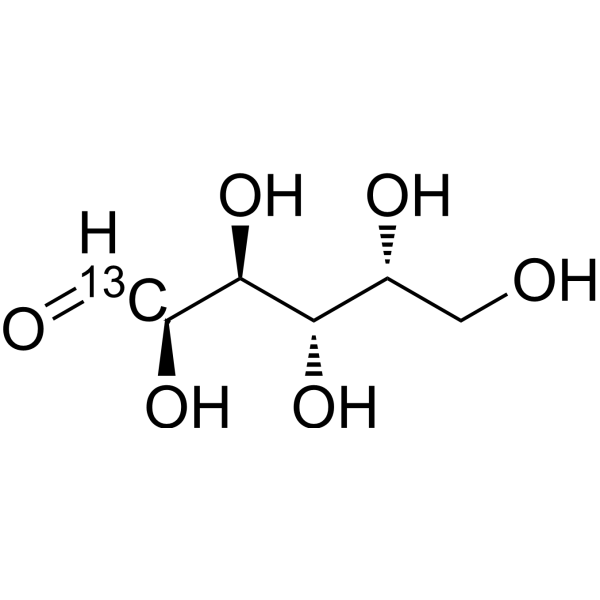
D-Galactose- 13C is the 13C labeled D-Galactose. D-Galactose is a natural aldohexose and C-4 epimer of glucose .
|
-
-
- HY-N0210S11
-
|
|
|
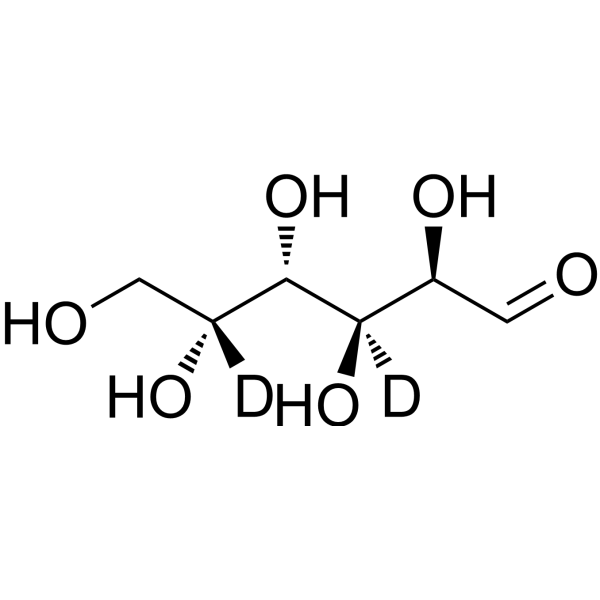
D-Galactose-d2-1 is the deuterium labeled D-Galactose. D-Galactose is a natural aldohexose and C-4 epimer of glucose.
|
-
-
- HY-N0210S6
-
|
|
|
D-Galactose-d-1 is the deuterium labeled D-Galactose. D-Galactose is a natural aldohexose and C-4 epimer of glucose.
|
-
-
- HY-N0210S7
-
|
|
|
D-Galactose-d-2 is the deuterium labeled D-Galactose. D-Galactose is a natural aldohexose and C-4 epimer of glucose.
|
-
-
- HY-114364S
-
|
|
|
UDP-α-D-Galactose- 13C disodium is the 13C labeled UDP-α-D-Galactose disodium. UDP-Galactose disodium is a monosaccharide and a key glycosyl donor molecule in cells that participates in nucleotide sugar metabolism. UDP-Galactose disodium is the natural agonist of the P2Y14 receptor coupled to Gi proteins in the immune system (IC50 = 0.67 μM, hP2Y14). UDP-Galactose disodium can be used to study cell signal transduction and substance metabolism .
|
-
-
- HY-N0210S4
-
|
|
|
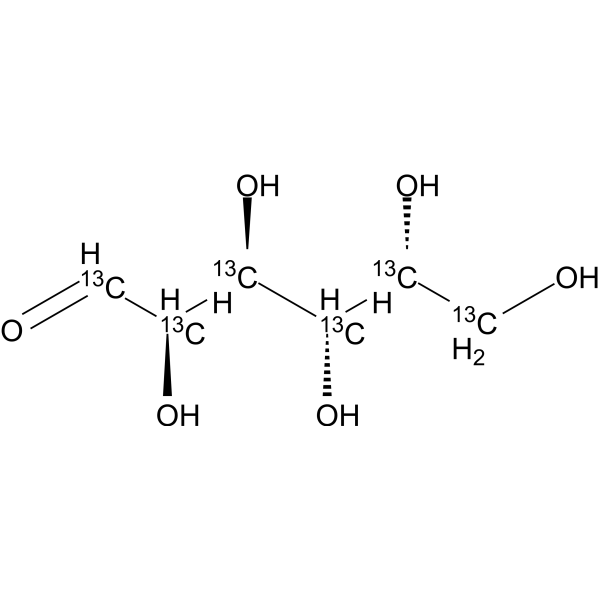
D-Galactose- 13C-5 is the 13C labeled D-Galactose. D-Galactose is a natural aldohexose and C-4 epimer of glucose .
|
-
-
- HY-N0210S3
-
|
|
|
D-Galactose- 13C-4 is the 13C labeled D-Galactose. D-Galactose is a natural aldohexose and C-4 epimer of glucose .
|
-
-
- HY-N0210S2
-
|
|
|
D-Galactose- 13C-3 is the 13C labeled D-Galactose. D-Galactose is a natural aldohexose and C-4 epimer of glucose .
|
-
-
- HY-N0210S12
-
|
|
|
D-Galactose- 13C,d is the deuterium and 13C labeled D-Galactose. D-Galactose is a natural aldohexose and C-4 epimer of glucose.
|
-
-
- HY-N0210S9
-
|
|
|
D-Galactose-d2 is the deuterium labeled D-Galactose. D-Galactose is a natural aldohexose and C-4 epimer of glucose.
|
-
-
- HY-N0210S8
-
|
|
|
D-Galactose-d-3 is the deuterium labeled D-Galactose. D-Galactose is a natural aldohexose and C-4 epimer of glucose.
|
-
-
- HY-N0210S1
-
|
|
|
D-Galactose- 13C-2 is the 13C labeled D-Galactose. D-Galactose is a natural aldohexose and C-4 epimer of glucose .
|
-
-
- HY-W142434S
-
|
|
|
D-Galactose- 13C-1 is the 13C labeled D-galactopyranose .
|
-
-
- HY-146279S
-
|
|
|
Amino-2-deoxy-D-galactose- 15N (hydrochloride) is the 15N labeled Amino-2-deoxy-D-galactose hydrochloride .
|
-
-
- HY-W768245
-
|
|
|
a-D-Galactose-1,2- 13C2 1-phosphate potassium is the 13C- and 15N-labeled a-D-Galactose (HY-121370). α-D-Galactose is a non-starch polysaccharide found in the bulb tissues of Lilium davidii var. unicolor Salisb. α-D-Galactose has anti-oxidation properties, anti-tumour activities, immunomodulatory effects and anti-HIV functions .
|
-
-
- HY-N0210S5
-
|
|
|
D-Galactose-d is the deuterium labeled D-Galactose. D-Galactose is a natural aldohexose and C-4 epimer of glucose.
|
-
-
- HY-W768296
-
|
|
|
D-Lactose monohydrate- 13C12 is the 13C-labeled D-Lactose (hydrate) (HY-W115740). D-Lactose monohydrate is a type of lactose. D-Lactose is composed of D-galactose and D-glucose. D-Lactose monohydrate can be used as sweetener or excipient .
|
-
-
- HY-W768295
-
|
|
|
D-Lactose monohydrate- 13C6 is the 13C-labeled D-Lactose (hydrate) (HY-W115740). D-Lactose monohydrate is a type of lactose. D-Lactose is composed of D-galactose and D-glucose. D-Lactose monohydrate can be used as sweetener or excipient .
|
-
-
- HY-W039909S
-
|
|
|
Tri-O-acetyl-D-galactal- 13C is the 13C labeled Tri-O-Acetyl-D-galactose .
|
-
-
- HY-W039909S1
-
|
|
|
Tri-O-acetyl-D-galactal- 13C-1 is the 13C labeled Tri-O-Acetyl-D-galactose .
|
-
| Cat. No. |
Product Name |
|
Classification |
-
- HY-W039921
-
|
N-Azidoacetylgalactosamine; GalNAz
|
|
Azide
|
|
2-[(Azidoacety)amino]-2-deoxy-D-galactose targets O-GlcNAc-modified proteins. By detecting and targeting O-GlcNAc-modified proteins, 2-[(Azidoacety)amino]-2-deoxy-D-galactose can serve as a chemical tag for intracellular sugar chain metabolism .
|
-
- HY-W039917
-
|
|
|
Azide
|
|
2-Azido-2-deoxy-D-galactose, 98% can be applied in glycobiology, can be glycosylated by glycopeptides, and can be used for the synthesis of glycoconjugates.
|
-
- HY-128930
-
|
|
|
ADC Synthesis
Alkynes
|
|
6-O-2-Propyn-1-yl-D-galactose is a nonclaevable glycolinker for the functionalization of cytotoxic agents and applications in antibody-agent conjugation. 6-O-2-Propyn-1-yl-D-galactose is a click chemistry reagent, it contains an Alkyne group and can undergo copper-catalyzed azide-alkyne cycloaddition (CuAAc) with molecules containing Azide groups.
|
-
- HY-141135
-
|
|
|
Alkynes
|
|
Propargyl-PEG4-tetra-Ac-beta-D-galactose is a PEG-based PROTAC linker that can be used in the synthesis of PROTACs .
|
Your information is safe with us. * Required Fields.
Inquiry Information
- Product Name:
- Cat. No.:
- Quantity:
- MCE Japan Authorized Agent: