7 Results for "

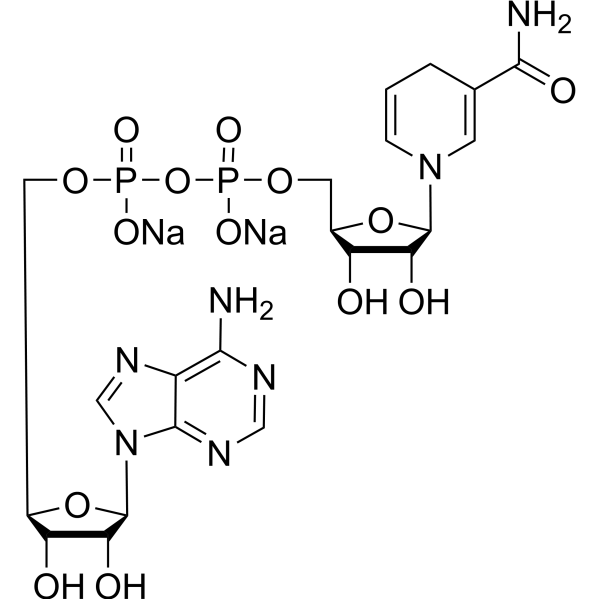
Disodium NADH

" in MedChemExpress (MCE) Product Catalog:
Products (7)

7 Results for "Disodium NADH" in MCE Product Catalog:

10
10 Publications Verification
Cat. No.: HY-F0001
CAS No.: 606-68-8
Synonyms: Disodium NADH
NADH disodium salt (Disodium NADH) is an orally active reduced coenzyme. NADH disodium salt is a donor of ADP-ribose units in ADP-ribosylaton reactions and a precursor of cyclic ADP-ribose. NADH disodium salt plays a role as a regenerative electron donor in cellular energy metabolism, including glycolysis, β-oxidation and the tricarboxylic acid (TCA) cycle .
loading...
    loading...
1
1 Cited Publications
Cat. No.: HY-F0001R
CAS No.: 606-68-8
Synonyms: Disodium NADH (Standard)
NADH (disodium salt) (Standard) is the analytical standard of NADH (disodium salt). This product is intended for research and analytical applications. NADH disodium salt (Disodium NADH) is an orally active reduced coenzyme. NADH disodium salt is a donor of ADP-ribose units in ADP-ribosylaton reactions and a precursor of cyclic ADP-ribose. NADH disodium salt plays a role as a regenerative electron donor in cellular energy metabolism, including glycolysis, β-oxidation and the tricarboxylic acid (TCA) cycle .
loading...
    loading...
Cat. No.: HY-W615108B
CAS No.: 108347-85-9
Synonyms: NMNH Disodium
β-Nicotinamide mononucleotide, reduced form (NMNH) disodium is an orally active reduced version of β-Nicotinamide mononucleotide (HY-F0004). β-Nicotinamide mononucleotide, reduced form disodium can significantly increase the levels of NAD + and NADH, inhibit glycolysis, the tricarboxylic acid cycle, and cell growth, with its effects being dependent on nicotinamide mononucleotide adenylyltransferase (NMNAT) .
loading...
    loading...
Cat. No.: HY-113128S
Purity:  98.7%
sn-Glycerol 3-phosphate- 13C3 disodium is the 13C-labeled sn-Glycerol 3-phosphate disodium. sn-Glycerol 3-phosphate disodium is produced by cytosolic glycerol 3-phosphate dehydrogenase pathway through the reduction of dihydroxyacetone phosphate using NADH formed during glycolysis .
loading...
    loading...
Cat. No.: HY-W008646R
CAS No.: 6779-87-9
NADH (disodium salt) (Standard) is the analytical standard of NADH (disodium salt). This product is intended for research and analytical applications. 7,8-Dihydro-L-biopterin is a NOS uncoupling inducer with blood-brain barrier permeability, and it is a reduced non-conjugated pteridine. 7,8-Dihydro-L-biopterin is the main metabolite of 4-amino-tetrahydro-L-biopterin, and it undergoes photooxidation to form biopterin. 7,8-Dihydro-L-biopterin promotes the conversion of nitric oxide synthase to a superoxide-producing form, thereby increasing oxidative stress levels in the renal outer medulla and inducing apoptosis. 7,8-Dihydro-L-biopterin is sensitive to the inhibitory effect of SOD, and it can be applied to research related to salt-sensitive hypertension, moderate to severe traumatic brain injury, and neurodegenerative diseases .
loading...
    loading...
Cat. No.: HY-F0001A
CAS No.: 1949720-50-6
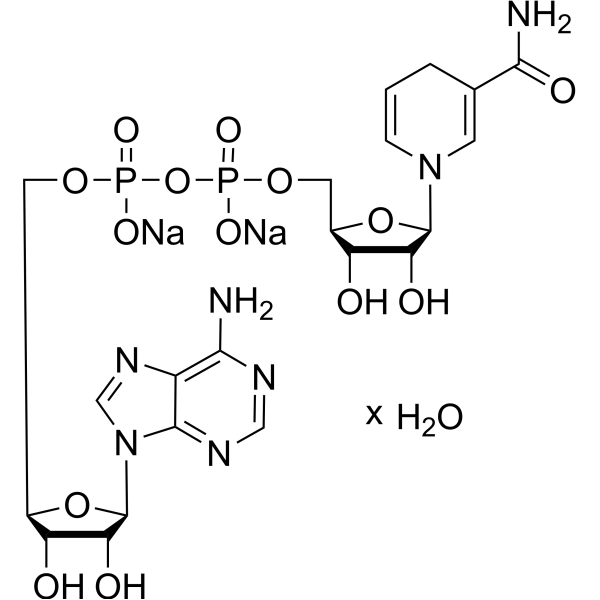
Synonyms: Disodium NADH hydrate
Target:  

Endogenous Metabolite

Research Areas:  

Metabolic Disease

NADH disodium salt (Disodium NADH) hydrate is an orally active reduced coenzyme. NADH disodium salt hydrate is a donor of ADP-ribose units in ADP-ribosylaton reactions and a precursor of cyclic ADP-ribose. NADH disodium salt hydrate plays a role as a regenerative electron donor in cellular energy metabolism, including glycolysis, β-oxidation and the tricarboxylic acid (TCA) cycle .
loading...
    loading...
Cat. No.: HY-W615108BR
CAS No.: 108347-85-9
β-Nicotinamide mononucleotide, reduced form (disodium) (Standard) is the analytical standard of β-Nicotinamide mononucleotide, reduced form (disodium) (HY-W615108B). This product is intended for research and analytical applications. β-Nicotinamide mononucleotide, reduced form (NMNH) disodium is an orally active reduced version of β-Nicotinamide mononucleotide (HY-F0004). β-Nicotinamide mononucleotide, reduced form disodium can significantly increase the levels of NAD+ and NADH, inhibit glycolysis, the tricarboxylic acid cycle, and cell growth, with its effects being dependent on nicotinamide mononucleotide adenylyltransferase (NMNAT) .
loading...
    loading...

