



606-68-8
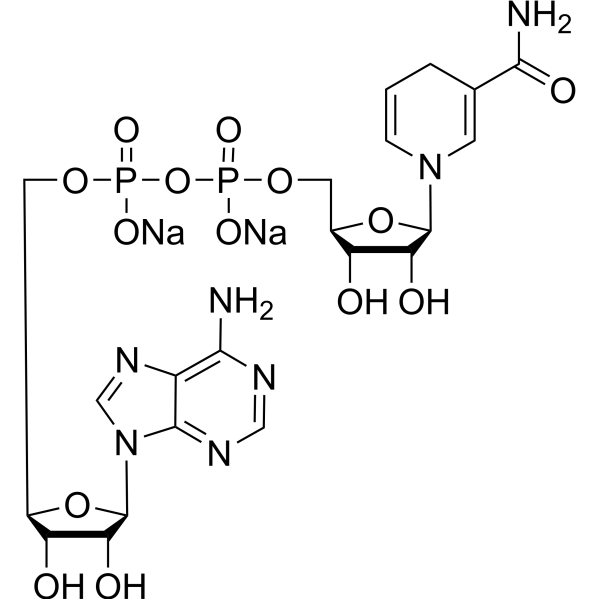
Chemical Structure
NADH disodium salt
Synonym(s): Disodium NADH
- CAS No.: 606-68-8
- Formula:C21H27N7Na2O14P2
- Molecular Weight:709.40
InChIKey: QRGNQKGQENGQSE-WUEGHLCSSA-L
SMILES: O[C@H]1[C@@H](O)[C@H](N2C=C(C(N)=O)CC=C2)O[C@@H]1COP(OP(OC[C@@H]3[C@@H](O)[C@@H](O)[C@H](N(C4=NC=N5)C=NC4=C5N)O3)(O[Na])=O)(O[Na])=O
Biological Activity: NADH disodium salt (Disodium NADH) is an orally effective reduced coenzyme. NADH disodium salt plays a role in regenerating electron donors during cellular energy metabolism, including glycolysis, β-oxidation, and the tricarboxylic acid (TCA) cycle. NADH disodium salt regulates calcium homeostasis by promoting the opening of IP3-gated Ca2+ channels and inhibiting Ryanodine receptor, and affects mitochondrial function through direct interaction with VDAC. NADH disodium salt is used in cytoprotective studies related to cerebral ischemic injury, neurodegenerative diseases, aging, and signal transduction[1][2][3].
| Cat. No. | Product Name | Purity | Description | Pricing | |||||||||||||||||||
|---|---|---|---|---|---|---|---|---|---|---|---|---|---|---|---|---|---|---|---|---|---|---|---|
|
|
NADH disodium salt | 99.98% | NADH disodium salt (Disodium NADH) is an orally effective reduced coenzyme. NADH disodium salt plays a role in regenerating electron donors during cellular energy metabolism, including glycolysis, β-oxidation, and the tricarboxylic acid (TCA) cycle. NADH disodium salt regulates calcium homeostasis by promoting the opening of IP3-gated Ca2+ channels and inhibiting Ryanodine receptor, and affects mitochondrial function through direct interaction with VDAC. NADH disodium salt is used in cytoprotective studies related to cerebral ischemic injury, neurodegenerative diseases, aging, and signal transduction. | ||||||||||||||||||||
|
loading...
/
|
|||||||||||||||||||||||
|
|
NADH disodium salt (Standard) | 98.83% | NADH disodium salt (Disodium NADH) Standard is the analytical standard of NADH disodium salt (HY-F0001). This product is intended for research and analytical applications. NADH disodium salt (Disodium NADH) is an orally effective reduced coenzyme. NADH disodium salt plays a role in regenerating electron donors during cellular energy metabolism, including glycolysis, β-oxidation, and the tricarboxylic acid (TCA) cycle. NADH disodium salt regulates calcium homeostasis by promoting the opening of IP3-gated Ca2+ channels and inhibiting Ryanodine receptor, and affects mitochondrial function through direct interaction with VDAC. NADH disodium salt is used in cytoprotective studies related to cerebral ischemic injury, neurodegenerative diseases, aging, and signal transduction. | ||||||||||||||||||||
|
loading...
/
|
|||||||||||||||||||||||
-
Similarity Score 0.94
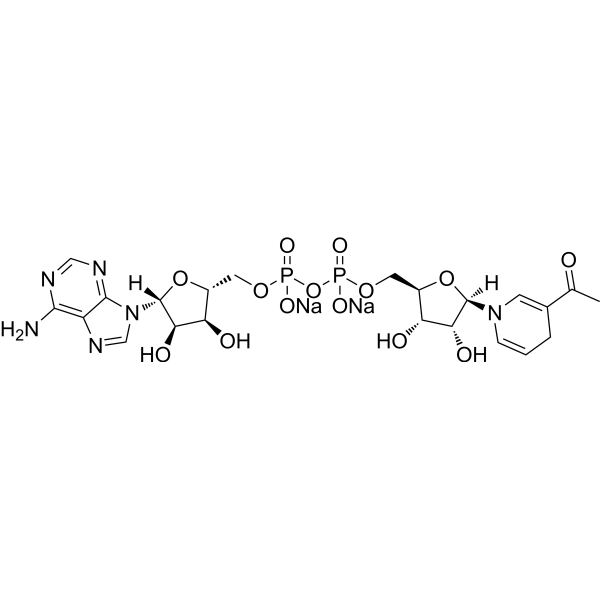 HY-W2501563-Acetylpyridine adenine dinucleotide disodium
-
Similarity Score 0.90
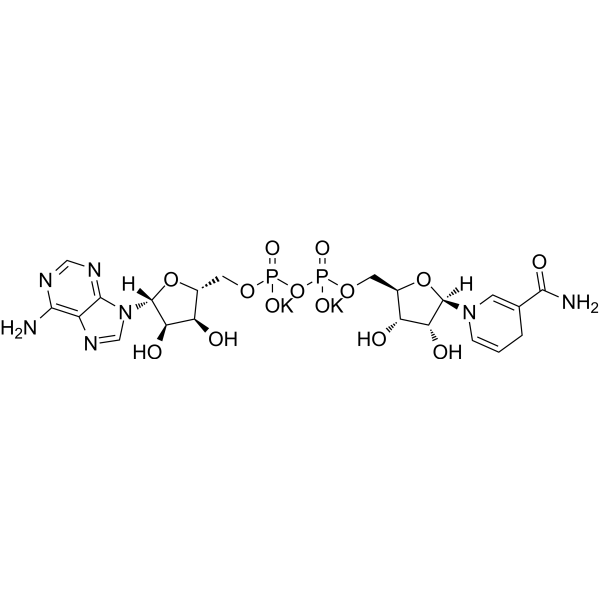 HY-W250154β-Nicotinamide adenine dinucleotide reduced dipotassium
-
Similarity Score 0.87
 HY-113355NADH
-
Similarity Score 0.86
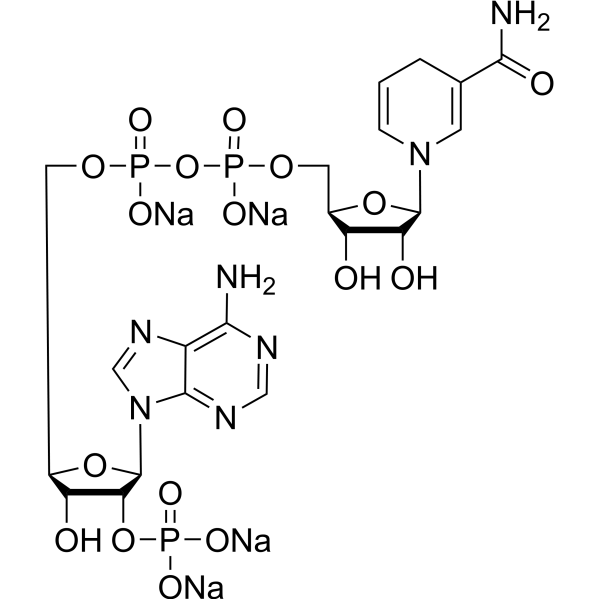 HY-F0003NADPH tetrasodium salt
-
Similarity Score 0.82
 HY-154925Thio-NADH
-
Similarity Score 0.80
 HY-113324NADPH
-
Similarity Score 0.73
 HY-134367Ap2A disodium
-
Similarity Score 0.70
 HY-B0445ANAD sodium
-
Similarity Score 0.70
 HY-136830ADP-Glucose disodium
-

Explore the MedChemAI to find more analogs


References
- [1]. Ying W. NAD+ and NADH in cellular functions and cell death. Front Biosci. 2006 Sep 1;11:3129-48. [Content Brief]
- [2]. Nagababu E, et al. Assessment of antioxidant activity of eugenol in vitro and in vivo. Methods Mol Biol. 2010;610:165-80.
- [3]. Murata T, et al. ATP-dependent affinity change of Na+-binding sites of V-ATPase. The Journal of biological chemistry. 2001 Dec 21;276(51):48337-40.



