6 Results for "

Fischer rats

" in MedChemExpress (MCE) Product Catalog:
Products (6)

6 Results for "Fischer rats" in MCE Product Catalog:

1
1 Cited Publications
Cat. No.: HY-W269593
CAS No.: 335-76-2
Synonyms: PFDA
Research Areas:  

Metabolic Disease

Perfluorodecanoic acid (PFDA) is an orally active perfluoroalkyl substance. Perfluorodecanoic acid causes dysfunction of rat fetal Leydig cells via endoplasmic reticulum stress-mediated changes in lipid components. Perfluorodecanoic acid reduces testosterone biosynthesis in rat R2C Leydig cells by inducing endoplasmic reticulum stress. Perfluorodecanoic acid can be used in studies related to fetal Leydig cell dysfunction .
loading...
    loading...
1
1 Cited Publications
Cat. No.: HY-B1022
CAS No.: 16208-51-8
Synonyms: BNP-7787
Target:  

Drug Derivative

Research Areas:  

Endocrinology Cancer

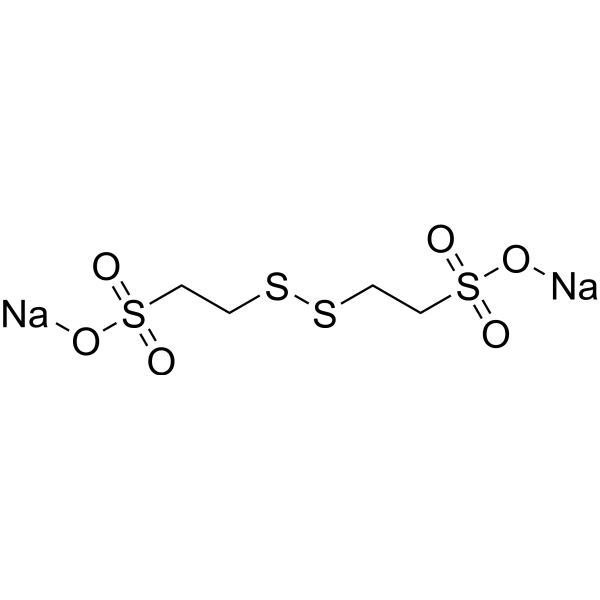
Dimesna (BNP-7787), the disulfide form of Mesna (HY-13679), is a platinum-related toxicity protective agent. Dimesna converts to Mesna, which in turn inactivates toxic platinum substances. Dimesna does not interfere with the antitumor activity of platinum compounds. Dimesna does not affect the antiproliferative effects of Cisplatin (HY-17394) or Carboplatin (HY-17393). Dimesna counteracts Cisplatin-induced nephrotoxicity. Dimesna exerts selective protective effects on the kidneys. Dimesna can be used in studies related to ovarian cancer and Cisplatin-induced nephrotoxicity .
loading...
    loading...
Cat. No.: HY-116439
CAS No.: 28553-12-0
Purity:  ≥98.0%
Synonyms: DINP
Diisononyl phthalate (DINP) is an orally active polyvinyl chloride plasticizer and indirect food additive. Diisononyl phthalate activates the ACE/AT1R axis and inhibits the production of NO. Diisononyl phthalate reduces the expression of eNOS. Diisononyl phthalate induces increased blood pressure in mice. Diisononyl phthalate induces monocytic leukemia in rats. Diisononyl phthalate can be used in hypertension-related research .
loading...
    loading...
Cat. No.: HY-P2040
CAS No.: 118399-22-7
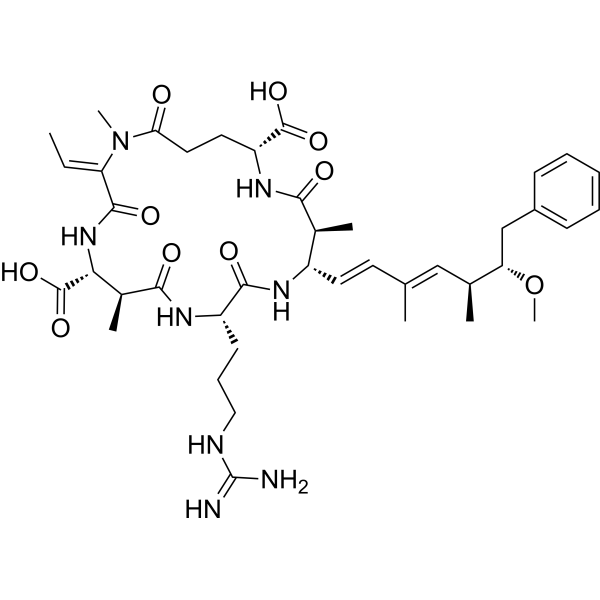
Nodularin is a hepatotoxin, tumor promoter, and protein phosphatase inhibitor. Nodularin induces apoptosis (apoptosis) in normal cells (including caspase activation, upregulation of Bcl-XS, and upregulation of BAX/P53), triggers hyperphosphorylation of the MAPK/ERK, mTOR/S6K and p38 MAPK signaling pathways, and induces oxidative stress, endoplasmic reticulum membrane instability, peroxisome proliferation and increased lysosomal enzyme activity. Nodularin promotes DEN (HY-N7434)-initiated hepatocyte proliferation and adenoma formation, and inhibits proliferation, phagocytosis and chemotaxis of normal lymphocytes, oocyte maturation and vitellogenesis, as well as angiogenesis. Nodularin exhibits hepatotoxicity, reproductive and endocrine toxicity, and embryonic developmental toxicity in various animal models. Nodularin can be used in studies related to liver cancer, hepatotoxicity and reproductive endocrine toxicity .
loading...
    loading...
Cat. No.: HY-103537A
CAS No.: 1257396-73-8
Target:  

γ-secretase Amyloid-β

Research Areas:  

Neurological Disease

BIIB042 is a potent, orally active, brain-penetrant, and selective γ-secretase modulator (GSM). BIIB042 reduces Aβ42 and increases Aβ38 levels in cells. BIIB042 significantly reduces brain Aβ42 levels in CF-1 mice and Fischer rats, as well as plasma Aβ42 levels in cynomolgus monkeys. BIIB042 reduces Aβ42 levels and Aβ plaque burden in Tg2576 mice. BIIB042 can be used for alzheimer's disease (AD) research .
loading...
    loading...
Cat. No.: HY-186105A
CAS No.: 1597443-57-6
Research Areas:  

Neurological Disease

(-)-P7C3-S243 is an orally active, blood-brain barrier permeable neuroprotective agent. (-)-P7C3-S243 binds to μ-opioid Receptor and TSPO. (-)-P7C3-S243 inhibits the premature apoptosis death of newborn hippocampal neurons, protects mature nigral dopaminergic neurons, promotes neuronal survival and prevents cognitive impairment. (-)-P7C3-S243 ameliorates depression-like behaviors in rat models. (-)-P7C3-S243 is applicable to research related to Parkinson's disease and Alzheimer's disease .
loading...
    loading...

