1. Search Result
Search Result
Results for "

ICR-mice

" in MedChemExpress (MCE) Product Catalog:

10

Inhibitors & Agonists

1

Peptides

4

Natural
Products

Cat. No. Product Name Target Research Areas Chemical Structure
  • HY-N2255
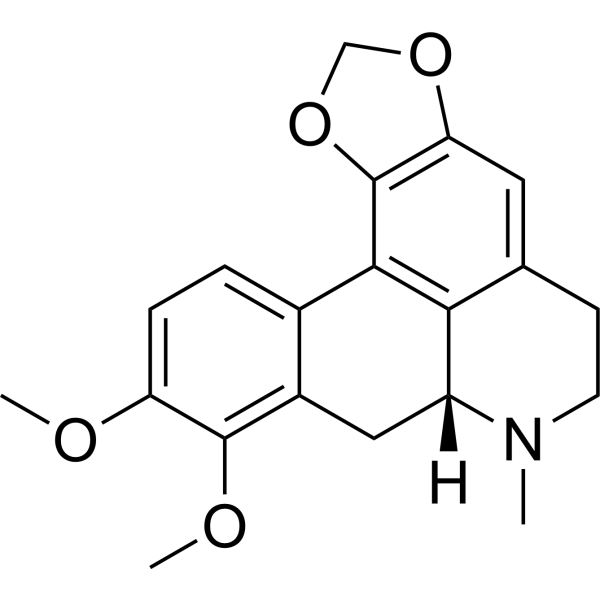
    Crebanine
    4 Publications Verification

    Akt Apoptosis NF-κB Reactive Oxygen Species (ROS) p38 MAPK ERK Interleukin Related TNF Receptor NO Synthase nAChR Bacterial Cancer
    Crebanine is an isoquinoline-like alkaloid that can be derived from Stephania. Crebanine is an antagonist of the α7-nAChR with an IC50 of 19.1 μM. Crebanine suppresses the proliferation, migration, and invasion of cancer cells, triggers reactive oxygen species (ROS) burst, and promotes apoptosis. Crebanine inhibits the AKT/FoxO3a, NF-κB and MAPK signaling pathways. Crebanine attenuates NOX2 hyperactivation, exhibits antioxidant properties by reducing reactive oxygen species and peroxidation in microglia cells. Crebanine inhibits voltage-dependent Na + current in guinea-pig ventricular myocytes. Crebanine has high inhibitory activity against gram-positive animal pathogenic bacteria. Crebanine ameliorates ischemia-reperfusion brain damage in middle cerebral artery occlusion and reperfusion (MCAO/R) rats. Crebanine significantly improves Scopolamine (HY-N0296)-induced cognitive deficits in ICR mice. Crebanine can be used for the study of hepatocellular carcinoma (HCC), cerebral ischemia and Alzheimer's disease .
    Crebanine
  • HY-N2542
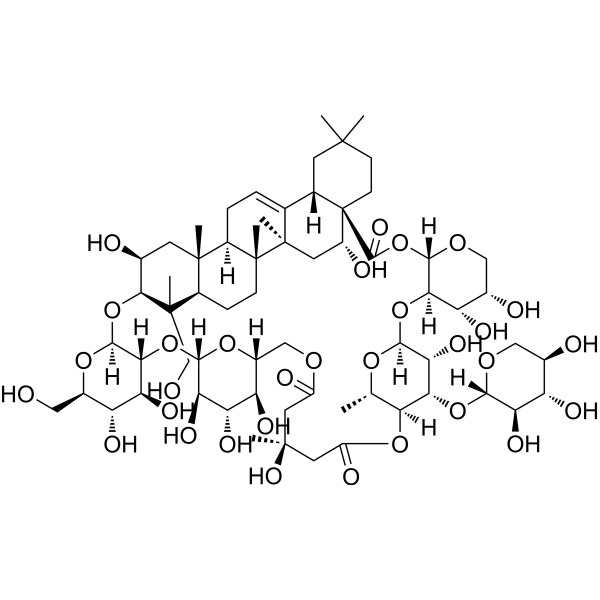
    Tubeimoside III
    2 Publications Verification

    Interleukin Related NO Synthase Metabolic Disease Inflammation/Immunology Cancer
    Tubeimoside III is a triterpenoid saponin. Tubeimoside III has anti-inflammatory and antitumor effects. Tubeimoside III has an LD50 of 15 mg/kg by intraperitoneal injection in ICR mice. Tubeimoside III can be used for the research of tumors and inflammatory diseases .
    Tubeimoside III
  • HY-P1684
    Peptide P60
    1 Publications Verification

    FOXP3 inhibitor P60

    NF-κB Nuclear Factor of activated T Cells (NFAT) Infection Inflammation/Immunology Cancer
    Peptide P60 is a FOXP3 inhibitor. Peptide P60 reduces the nuclear translocation of FOXP3 and impairs FOXP3-mediated inhibition of NF-κB and NFAT activity. Peptide P60 inhibits the immunosuppressive activity of regulatory T cells and restores the proliferation and activation of effector T cells. Peptide P60 induces lymphoproliferative autoimmune syndrome in neonatal ICR mice and reduces the number of CD4 +CD25 +Foxp3 + T cells in the spleen. Peptide P60 enhances the efficacy of AH1 (HY-P4193) peptide vaccine and recombinant adenovirus-based HCV NS3 vaccine in BALB/c mice, including protective effects against CT26 tumor implantation. Peptide P60 can be used in studies related to tumor immunity, viral infection and lymphoproliferative autoimmune syndrome .
    Peptide P60
  • HY-174383

    Phosphodiesterase (PDE) Inflammation/Immunology
    PDE3/4-IN-2 is a dual PDE3A and PDE4B1 inhibitor, with an IC50 of 0.13 nM against PDE3A and 50 nM against PDE4B1. PDE3/4-IN-2 exhibits higher systemic exposure and longer retention time in lung tissues in ICR mice. PDE3/4-IN-2 can be used in research on respiratory diseases such as asthma and chronic obstructive pulmonary disease, as well as autoimmune inflammation-related studies .
    PDE3/4-IN-2
  • HY-168131

    PROTACs Histone Methyltransferase Apoptosis Cancer
    PROTAC EZH2 Degrader-3 (compound ZJ-20) is a EZH2 PROTAC degrader. PROTAC EZH2 Degrader-3 (5 μM, 24 h) not only potently inhibits the expression of EZH2 protein, but also had a strong inhibits effect on the expression levels of other subunits of PRC2 as well as H3k27me3 protein. PROTAC EZH2 Degrader-3 shows anti-proliferative activity and blocks the cell cycle in the G0-G1 phase and induces cell apoptosis((Blue: cereblon ligand Pomalidomide (HY-10984), Black: linker HY-W361751;Pink: EZH2 inhibitor Tazemetostat (HY-13803)) .
    PROTAC EZH2 Degrader-3
  • HY-137570

    Monoamine Oxidase Neurological Disease
    Ethyl homovanillate (Compound 24) is an structural analog of Eugenol. Ethyl homovanillate is an inhibitor of monoamine oxidase A (MAOA) with an IC50 of 8.1 μM. Ethyl homovanillate significantly increases the forced swim test score in ICR mice. Ethyl homovanillate can be studied in research on neurological diseases such as Alzheimer’s disease .
    Ethyl homovanillate
  • HY-W150182

    Environmental Pollutants Neurological Disease Inflammation/Immunology
    p-Cymen-8-ol is an alcohol. p-Cymen-8-ol can be used to make essential oils. Essential oils containing p-Cymen-8-ol exhibit immunomodulatory activity. p-Cymen-8-ol, when used in combination with other substances to make essential oils, exerts an anxiolytic-like effect and reduces hepatic lipid peroxidation levels in ICR mice. p-Cymen-8-ol may be used in research on anxiolytic and other neurological and immune system disorders .
    p-Cymen-8-ol
  • HY-N2542R

    Reference Standards Interleukin Related NO Synthase Metabolic Disease Inflammation/Immunology Cancer
    Tubeimoside III (Standard) is the analytical standard of Tubeimoside III (HY-N2542). This product is intended for research and analytical applications. Tubeimoside III is a triterpenoid saponin. Tubeimoside III has anti-inflammatory and antitumor effects. Tubeimoside III has an LD50 of 15 mg/kg by intraperitoneal injection in ICR mice. Tubeimoside III can be used for the research of tumors and inflammatory diseases .
    Tubeimoside III (Standard)
  • HY-175491

    HIV Reverse Transcriptase Infection
    HIV-1-IN-85 is an orally active HIV-1 inhibitor (IC50 = 72 nM). HIV-1-IN-85 exhibits strong inhibitory activity against wild-type (WT) HIV-1 and NNRTI-resistant single mutant strains (L100I, K103N, Y181C, Y188L, E138K) and moderate efficacy against double mutant strains (F227L+V106A, RES056). HIV-1-IN-85 shows good in vivo safety in ICR mice. HIV-1-IN-85 can be used for the study of HIV-1 infection .
    HIV-1-IN-85
  • HY-N14350

    Bacterial
    Hydroxychlorothricin is an antibiotic of the chlorothricin group. Hydroxychlorothricin can be found in Streptomyces sp. K818. Hydroxychlorothricin has anti-tumor effect and can prolong the survival period of ICR mice inoculated with Ehrlich cancer cells .
    2'''-Hydroxychlorothricin

Inquiry Online

Your information is safe with us. * Required Fields.

Salutation


Country or Region *

Applicant Name *


Organization Name *

Department *


Email Address *


Product Name *

Cat. No.


Requested quantity *

Phone Number *


Remarks

Inquiry Online

Inquiry Information

Product Name:
Cat. No.:
Quantity:
MCE Japan Authorized Agent:

