8 Results for "

Multi-target directed ligands

" in MedChemExpress (MCE) Product Catalog:
Products (8)

8 Results for "Multi-target directed ligands" in MCE Product Catalog:

Cat. No.: HY-144635
CAS No.: 3035124-25-2
Purity:  98.44%
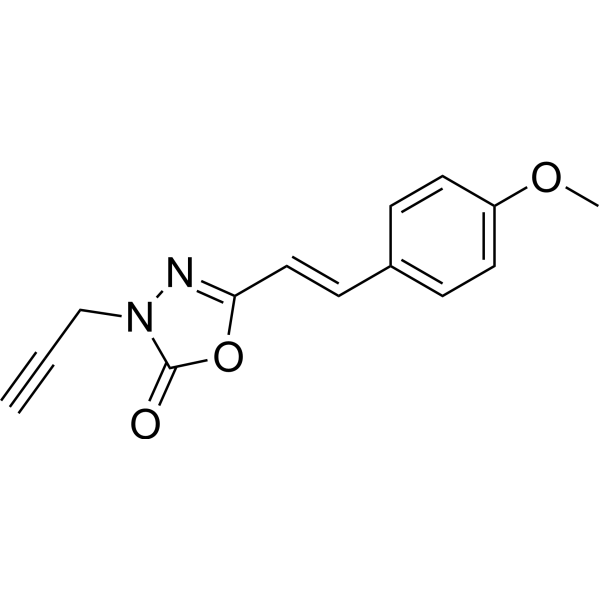
Nrf2-ARE/hMAO-B/QR2 modulator 1 is a Resveratrol-based multitarget-directed ligands with IC50s of 8.05, 9.83 and 0.57 μM for hMAO-B, NRF2 and QR2. Nrf2-ARE/hMAO-B/QR2 modulator 1 has neuroprotection, decreasing ROS production in okadaic acid-treated mice hippocampal slices . Nrf2-ARE/hMAO-B/QR2 modulator 1 is a click chemistry reagent, it contains an Alkyne group and can undergo copper-catalyzed azide-alkyne cycloaddition (CuAAc) with molecules containing Azide groups.
loading...
    loading...
Cat. No.: HY-122080
CAS No.: 616885-87-1
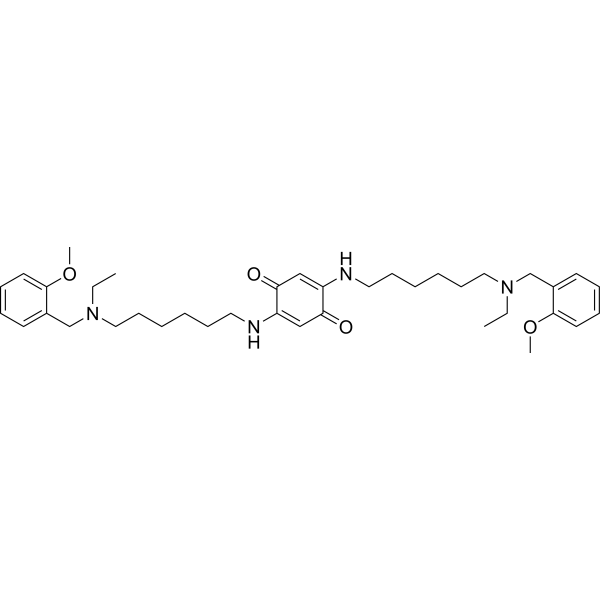
Memoquin is an anti-amyloid and anti-oxidant multi-target-directed ligand. Memoquin is an orally active inhibitor of BACE-1 and AChE with IC50 values of 108 and 1.55 nM, respectively. Memoquin is a cognitive enhancer that prevents the Aβ-induced neurotoxicity mediated by oxidative stress. Memoquin can be used for the research of Alzheimer’s disease (AD) .
loading...
    loading...
Cat. No.: HY-143499
CAS No.: 2581113-51-9
Target:  

Monoamine Oxidase

Research Areas:  

Neurological Disease

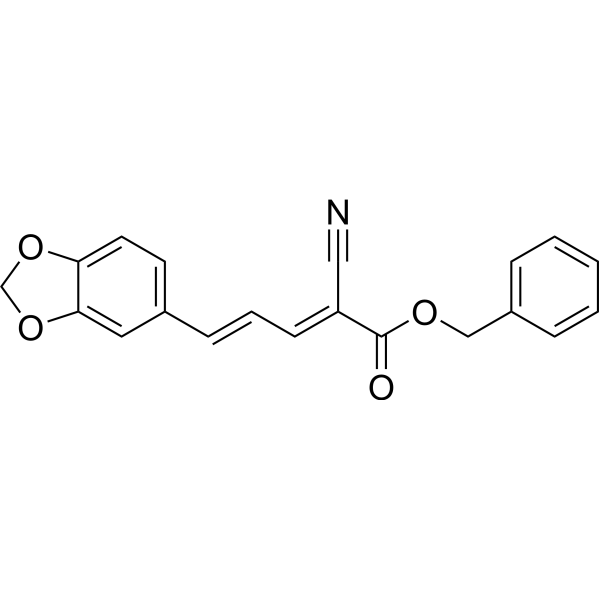
hMAO-B-IN-3 (Compound 15) is a potent inhibitor of hMAO-B with an IC50 of 47.4 nM. hMAO-B-IN-3 is playing favourable agent-like properties and a broad safety window. hMAO-B-IN-3 is thus a suitable candidate for lead optimization and the development of multitarget-directed ligands .
loading...
    loading...
Cat. No.: HY-161466
Research Areas:  

Neurological Disease

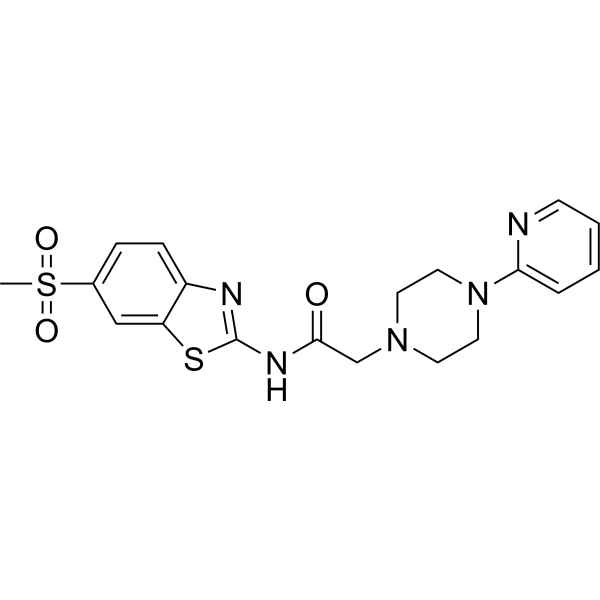
AChE-IN-62 (Compound 1) is an effective mixed and selective acetylcholinesterase (AChE) inhibitor with an IC50 value of 0.421 μM. AChE-IN-62 exhibits excellent blood-brain barrier permeability and neuroprotective effects. Additionally, AChE-IN-62 can inhibit the aggregation of 1-42 with an IC50 value of 44.64 μM. AChE-IN-62 is also an effective multi-target-directed ligand (MTDL) that can be utilized in the research of Alzheimer's disease .
loading...
    loading...
Cat. No.: HY-160481
CAS No.: 2567913-75-9
Target:  

Tau Protein MicroRNA

Research Areas:  

Neurological Disease

MG-1102 is first-in-class dual binder of monomeric tau and pre-miRNA-146a. MG-1102 shows specific inhibition of miRNA146a with IC50s of 0.21 mM and 0.36 mM specific inhibition of doublelabeled pre-miRNA146a and mono-labeled pre-miRNA146a, respectively. MG-1102 interacts with tau monomers with a Kd of 3.21 mM by surface plasmon resonance (SPR). MG-1102 is a potential multi-target-directed ligands (MTDLs) for Alzheimer’s disease (AD) .
loading...
    loading...
Cat. No.: HY-180891
Multitarget AD-IN-4 (compound IIIj) is a multitarget-directed ligand (MTDL), with the ability to simultaneously inhibit ChE enzymes (EeAChE IC50 = 0.157 μM, eqBuChE IC50 = 0.147 μM, hAChE IC50 = 1.551 μM, hBuChE IC50 = 2.152 μM), exhibit antioxidant activity, provide neuroprotection, and inhibit calcium channels (Ca 2+ channel blockade: IC50 = 30.59 μM). Multitarget AD-IN-4 reverses Scopolamine (HY-N0296)-induced amnesia in a mouse model. Multitarget AD-IN-4 can be used for Alzheimer’s disease (AD) research .
loading...
    loading...
Cat. No.: HY-182786
MAO-B-IN-56 is a multi-target-directed ligand with AChE, BChE, MAO-B, and BACE1 inhibitory activity, with IC50 values of 0.35 μM, 3.22 μM, 0.14 μM, and 3.85 μM respectively, and shows selectivity for AChE over BChE and MAO-B over MAO-A.MAO-B-IN-56 reduces amyloid-beta production, reduces paw edema, improves spatial memory, and enhances Alzheimer's disease hallmarks and associated histopathological alterations.MAO-B-IN-56 can be used for the research of alzheimer's disease .
loading...
    loading...
Cat. No.: HY-180114
NSS-18 is a potent and reversible inhibitor of AChE and MAO-B, with IC50 values of 1.53 and 1.51 μM respectively. NSS-18 can inhibit the self-aggregation of . NSS-18 inhibits the intracellular generation of ROS induced by Aβ. NSS-18 shows a moderate neuroprotective effect against 6-OHDA (HY-B1081)-induced neurotoxicity. NSS-18 can form chelates with metal ions such as Cu²⁺, Fe³⁺, and Zn²⁺, with the strongest chelation being with Cu²⁺. NSS-18 can be used for the study of Alzheimer's disease .
loading...
    loading...

