12 Results for "

N14

" in MedChemExpress (MCE) Product Catalog:
Products (12)

12 Results for "N14" in MCE Product Catalog:

Cat. No.: HY-165603
CAS No.: 3006860-57-4
Si5-N14 is a key component of siloxane-incorporated lipid nanoparticles (SiLNP), possessing pro-vascular repair and anti-tumor activities. In the transgenic GFP mouse model, Si5-N14 can mediate CRISPR-Cas9 editing. In the Lewis lung carcinoma (LLC) tumor-bearing mouse model, Si5-N14 can knock out the expression of Vascular Endothelial Growth Factor Receptor 2 (VEGFR2) to exert an anti-tumor effect. In a mouse model of lung injury induced by viral infection, the delivery of Fibroblast Growth Factor-2 (FGF-2) mRNA via Si5-N14 can promote vascular repair, increase blood oxygen levels, and improve lung function. Si5-N14 shows promise for research in the fields of oncology, pneumonia, and cardiovascular diseases .
loading...
    loading...
Cat. No.: HY-D0404
CAS No.: 6300-50-1
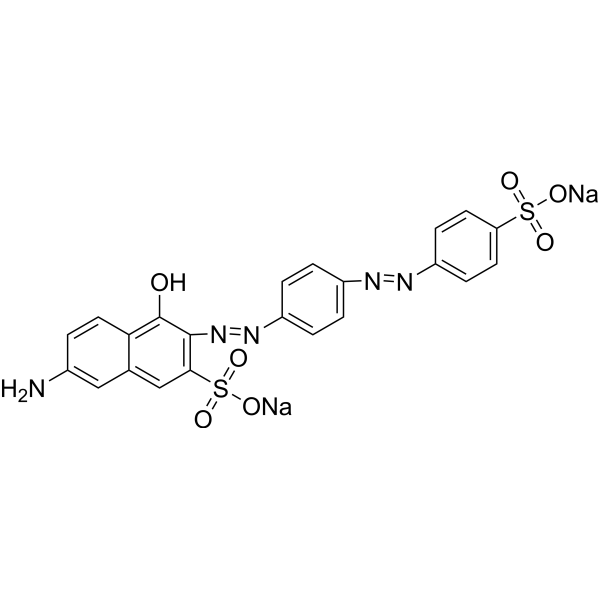
Direct Red 254 is a bisazo dye for textile applications. Direct Red 254 can be used for amyloid tissue staining in basic research on neurodegenerative diseases (e.g., Alzheimer's disease) .
loading...
    loading...
Cat. No.: HY-170651
Target:  

CDK HDAC Apoptosis

Research Areas:  

Cancer

CDK4/6/HDAC-IN-1 (Compound N14) is a dual-targeting inhibitor of CDK4/6 and HDAC (IC50: CDK4 = 7.23 nM, CDK6 = 13.20 nM, HDAC1 = 55.66 nM, HDAC6 = 48.38 nM). CDK4/6/HDAC-IN-1 induces cell Apoptosis and G0/G1 phase arrest through HDAC-p21-CDK signaling pathway. CDK4/6/HDAC-IN-1 inhibits hepatocellular carcinoma .
loading...
    loading...
Cat. No.: HY-D2730
N14G-Fe, the Fe 3+-chelated form of N14G, identifies Mtb in sputum samples with tuberculosis, exhibiting exceptional fluorescence. N14G-Fe can effectively traverse the cell wall and inner membrane region where IrtAB is located .
loading...
    loading...
Cat. No.: HY-RS13812
Research Areas:  

Others

SSNA1 Human Pre-designed siRNA Set A contains three designed siRNAs for SSNA1 gene (Human), as well as a negative control, a positive control, and a FAM-labeled negative control.

loading...
    loading...
Cat. No.: HY-W191560S
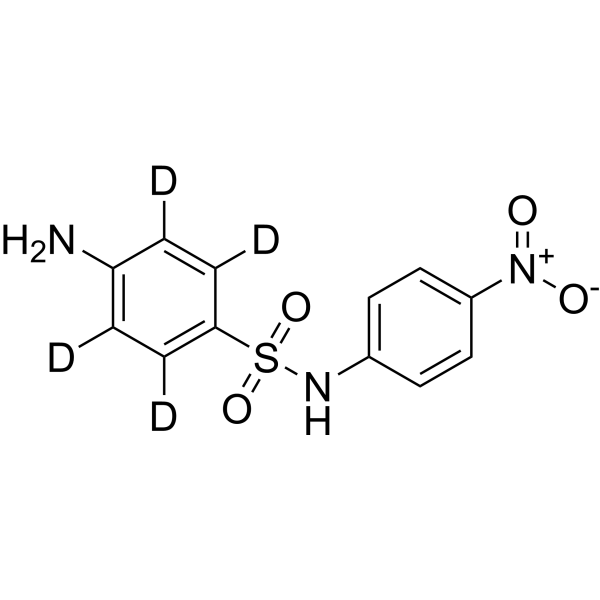
Synonyms: 4-Amino-N-(4-nitrophenyl)benzenesulfonamide-d4
N1-(4-Nitrophenyl)sulfanilamide-d4 is the deuterium labeled N1-(4-Nitrophenyl)sulfanilamide.
loading...
    loading...
Cat. No.: HY-D2733
N14G is a fluorescent dye that can be used to stain bacteria such as Mycobacterium tuberculosis .
loading...
    loading...
Cat. No.: HY-W002671R
CAS No.: 70918-74-0
Target:  

Reference Standards

N-(1,4-Benzodioxan-2-carbonyl)piperazine hydrochloride (Standard) is the analytical standard of N-(1,4-Benzodioxan-2-carbonyl)piperazine hydrochloride. This product is intended for research and analytical applications.
loading...
    loading...
Cat. No.: HY-P83835
Synonyms: UTX; KABUK2; bA386N14.2

Host:  

Mouse

Application:  

WB, ELISA

Reactivity:  

Human, Rat

loading...
    loading...
Cat. No.: HY-P83835A
Synonyms: UTX; KABUK2; bA386N14.2

Host:  

Mouse

Application:  

WB, ELISA

Reactivity:  

Human, Rat

loading...
    loading...
Cat. No.: HY-184600
Reactive oxygen species responsive hydrogels are a novel class of smart hydrogels, formed by the cross-linking of ROS-responsive modules through covalent, coordination, or supramolecular interactions. Due to the introduction of these ROS-responsive modules, these hydrogels exhibit a sensitive response to the oxidative stress microenvironment present in organisms. PVA-TSPBA hydrogel is a hydrogel formed by the cross-linking polymerization of polyvinyl alcohol (PVA) and the reactive oxygen species-sensitive cross-linking agent N1-(4-benzyl borate)-N3-(4-phenyl borate)N1,N1,N3,N3-tetramethyl-1,3-propanediamine (TSPBA). This hydrogel consists of two parts: a boric acid precursor (TSPBA) and an aqueous solution of PVA. The boric acid bonds on TSPBA and the hydroxyl groups on PVA rapidly cross-link to form borate ester bonds, thus forming the hydrogel.
loading...
    loading...
Cat. No.: HY-P810967
Synonyms: ATP6IP2, CAPER, ELDF10, HT028, MSTP009, PSEC0072, ATP6AP2, Renin receptor, ATPase H(+)-transporting lysosomal accessory protein 2, ATPase H(+)-transporting lysosomal-interacting protein 2, ER-localized type I transmembrane adapter, Embryonic liver differentiation factor 10, N14F, Renin/prorenin receptor, Vacuolar ATP synthase membrane sector-associated protein M8-9, ATP6M8-9, V-ATPase M8.9 subunit

Host:  

Rabbit

Application:  

WB, IHC-P, ICC/IF

Reactivity:  

Human, Mouse, Rat, Chicken, Pig, Dog, Bovine

loading...
    loading...
  • 1

