


Search Result
Results for "
PEG hydrogel
" in MedChemExpress (MCE) Product Catalog:
37
Biochemical Assay Reagents
| Cat. No. |
Product Name |
Target |
Research Areas |
Chemical Structure |
-
- HY-W440896
-
|
|
Liposome
|
Others
|
|
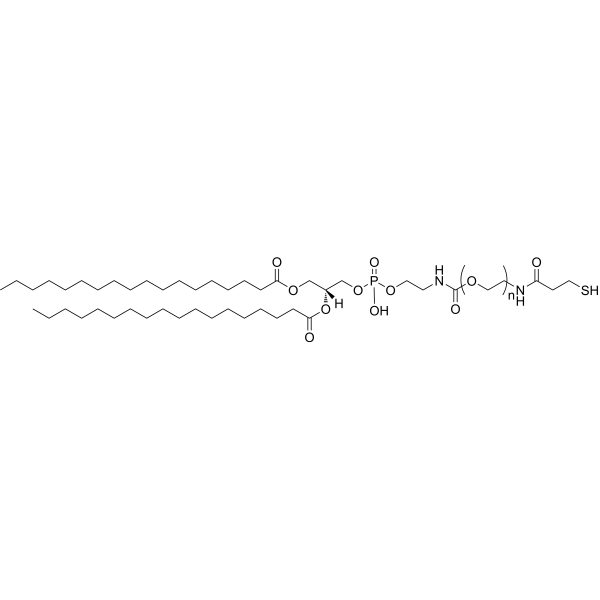
DSPE-PEG2000-SH is an amphiphilic thiol-functionalized DSPE-PEG molecule. DSPE-PEG2000-SH inserts into extracellular vesicle (EV) bilayer membranes via hydrophobic interactions, displaying surface thiol groups to form EV-SH crosslinkers.DSPE-PEG2000-SH enables crosslinking of EV-SH with 8-arm PEG-norbornene via thiol-ene photochemistry to construct hydrogels, with hydrogel mechanical properties tunable via PEG segment molecular weight variation.DSPE-PEG2000-SH can be used to encapsulate agents for drug delivery system, such as mRNA vaccine .
|
-
-
- HY-P3159
-
|
|
Biochemical Assay Reagents
|
Others
|
|
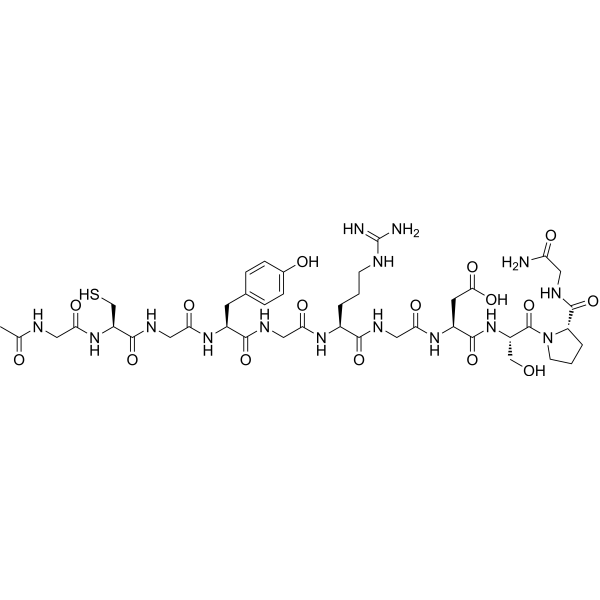
VPM peptide is a dithiol protease-cleavable peptide cross-linker. VPM peptide can be incorporated into the backbone of the PEG-diacrylate (PEG-DA) macromer to form PEG hydrogel .
|
-
-
- HY-156829B
-
|
|
Biochemical Assay Reagents
|
Others
|
|
PLGA-PEG-PLGA (hydrogel) (LA:GA 7:1) is a biodegradable thermosensitive hydrogel product that can undergo phase transition at a specific temperature. PLGA-PEG-PLGA (hydrogel) (LA:GA 7:1) can be widely used in drug delivery systems, tissue engineering, wound dressings, and biosensors. The gelation temperature varies with concentration. The gelation temperature varies with the concentration; the higher the concentration, the lower the gelation temperature .
|
-
-
- HY-156829I
-
|
|
Biochemical Assay Reagents
|
Others
|
|
PLGA-PEG-PLGA (hydrogel) (LA:GA 3:1) (15% solution) is a biodegradable thermosensitive hydrogel product that can undergo phase transition at a specific temperature. PLGA-PEG-PLGA (hydrogel) (LA:GA 3:1) (15% solution) can be widely used in drug delivery systems, tissue engineering, wound dressings, and biosensors . The gelation temperature varies with the concentration; the higher the concentration, the lower the gelation temperature.
|
-
-
- HY-168941A
-
-
-
- HY-P2532
-
|
|
Integrin
|
Others
|
|
Integrin Binding Peptide is derived by fibronectin. Integrin Binding Peptide can be used for PEG hydrogel preparation .
|
-
-
- HY-156829J
-
|
|
Biochemical Assay Reagents
|
Others
|
|
PLGA-PEG-PLGA (hydrogel) (LA:GA 3:1) (20% solution) is a biodegradable thermosensitive hydrogel product that can undergo phase transition at a specific temperature. PLGA-PEG-PLGA (hydrogel) (LA:GA 3:1) (20% solution) can be widely used in drug delivery systems, tissue engineering, wound dressings, and biosensors. The gelation temperature varies with the concentration; the higher the concentration, the lower the gelation temperature .
|
-
-
- HY-172355A
-
|
|
Biochemical Assay Reagents
|
Others
|
|
Azide-PEG-NHS (Mn 5000) is an azide PEG NHS ester that can be used for click chemistry reactions and can also be used to synthesize PEG hydrogels .
|
-
-
- HY-168937
-
|
|
PROTAC Linkers
|
Others
|
|
HS-PEG2000-NH2 hydrochloride is a bifunctional cross-linker that can be used to synthesize PEG hydrogels .
|
-
-
- HY-172380A
-
|
|
Biochemical Assay Reagents
|
Others
|
|
PCL-PEG-PCL diacrylate (MW 800) is an amphiphilic triblock copolymer composed of PEG and two polycaprolactones (PCL). PCL-PEG-PCL diacrylate (MW 800) can be cross-linked by free radical polymerization and/or photopolymerization to form a cross-linked hydrogel network .
|
-
-
- HY-W156324
-
|
|
PROTAC Linkers
Liposome
|
Others
|
|
Biotin-PEGn-NHS ester is a biotin-labeled PROTAC linker, which belongs to the PEG class and can be used to synthesize PROTAC molecules. Biotin-PEGn-NHS ester can interact with free neutral avidin in solution and successfully target malignant glioma cells. Biotin-PEGn-NHS ester can also be grafted onto the amino group of GelMA to prepare biotin-modified functionalized hydrogel, gelatin methacryloyl (Bio-GelMA) .
|
-
-
- HY-145485
-
|
|
PROTAC Linkers
|
Others
|
|
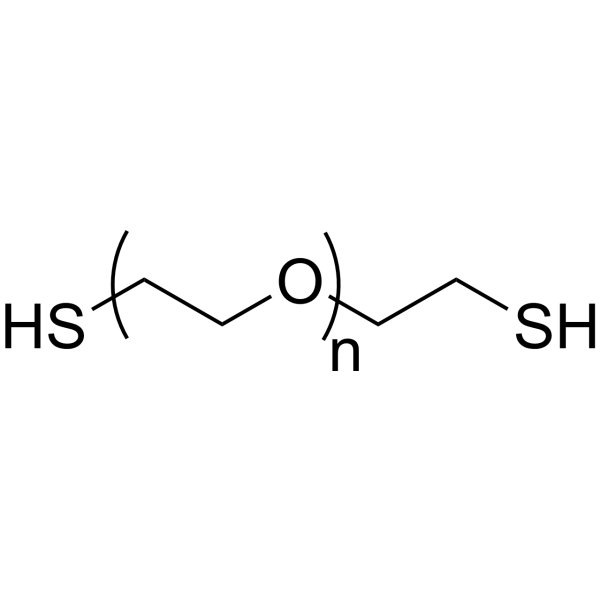
HS-PEG3400-SH, a linear homobifunctional PEG, is a cross-linker. HS-PEG-SH can be used for drug delivery and preparation of PEG hydrogels .
|
-
-
- HY-168940
-
-
-
- HY-172354
-
|
|
Biochemical Assay Reagents
|
Others
|
|
Acrylate-PEG2000-NHS is a photosensitive PEG compound that can be cross-linked when exposed to ultraviolet light and is used to synthesize PEG hydrogels .
|
-
-
- HY-172380
-
|
|
Biochemical Assay Reagents
|
Others
|
|
PCL-PEG-PCL diacrylate (MW 800) is an amphiphilic triblock copolymer composed of PEG and two polycaprolactones (PCL). PCL-PEG-PCL diacrylate (MW 800) can be cross-linked by free radical polymerization and/or photopolymerization to form a cross-linked hydrogel network .
|
-
-
- HY-156829H
-
|
|
Biochemical Assay Reagents
|
Others
|
|
PLGA-PEG-PLGA (hydrogel) (LA:GA 7:1) (20% solution) is a biodegradable thermosensitive hydrogel product that can undergo phase transition at a specific temperature. PLGA-PEG-PLGA (hydrogel) (LA:GA 7:1) (20% solution) can be widely used in drug delivery systems, tissue engineering, wound dressings, and biosensors. The gelation temperature varies with concentration. The gelation temperature varies with the concentration; the higher the concentration, the lower the gelation temperature .
|
-
-
- HY-168941
-
-
-
- HY-168937D
-
|
|
PROTAC Linkers
|
Others
|
|
HS-PEG-NH2 (Mn 3500) hydrochloride is a bifunctional cross-linker that can be used to synthesize PEG hydrogels .
|
-
-
- HY-172354A
-
|
|
Biochemical Assay Reagents
|
Others
|
|
Acrylate-PEG3500-NHS is a photosensitive PEG compound that can be cross-linked when exposed to ultraviolet light and is used to synthesize PEG hydrogels .
|
-
-
- HY-168939A
-
|
|
Biochemical Assay Reagents
|
Others
|
|
Poly(ethylene glycol) 2-mercaptoethyl ether acetic acid (Mn 2000) is a derivative of polyethylene glycol, which can be used for bioconjugation, drug delivery, PEG hydrogel, crosslinker and surface functionalization .
|
-
-
- HY-168940A
-
-
-
- HY-156829E
-
|
|
Biochemical Assay Reagents
|
Others
|
|
PLGA-PEG-PLGA (hydrogel) (LA:GA 7:1) (15% solution) is a biodegradable thermosensitive hydrogel product that can undergo phase transition at a specific temperature. PLGA-PEG-PLGA (hydrogel) (LA:GA 7:1) (15% solution) can be widely used in drug delivery systems, tissue engineering, wound dressings, and biosensors. The gelation temperature varies with concentration. The gelation temperature varies with the concentration; the higher the concentration, the lower the gelation temperature .
|
-
-
- HY-P3159A
-
|
|
Biochemical Assay Reagents
|
Others
|
|
VPM peptide TFA is a dithiol protease-cleavable peptide cross-linker. VPM peptide TFA can be incorporated into the backbone of the PEG-diacrylate (PEG-DA) macromer to form PEG hydrogel .
|
-
-
- HY-135963
-
-
-
- HY-172355
-
|
|
Biochemical Assay Reagents
|
Others
|
|
Azide-PEG-NHS (Mn 3500) is an azide PEG NHS ester that can be used for click chemistry reactions and can also be used to synthesize PEG hydrogels .
|
-
-
- HY-168937A
-
|
|
PROTAC Linkers
|
Others
|
|
HS-PEG5000-NH2 hydrochloride is a bifunctional cross-linker that can be used to synthesize PEG hydrogels .
|
-
-
- HY-168940C
-
-
-
- HY-172354B
-
|
|
Biochemical Assay Reagents
|
Others
|
|
Acrylate-PEG5000-NHS is a photosensitive PEG compound that can be cross-linked when exposed to ultraviolet light and is used to synthesize PEG hydrogels .
|
-
-
- HY-168939
-
|
|
Biochemical Assay Reagents
|
Others
|
|
Poly(ethylene glycol) 2-mercaptoethyl ether acetic acid (Mn 1000) is a derivative of polyethylene glycol, which can be used for bioconjugation, drug delivery, PEG hydrogel, crosslinker and surface functionalization .
|
-
-
- HY-168937C
-
|
|
PROTAC Linkers
|
Others
|
|
HS-PEG7500-NH2 hydrochloride is a bifunctional cross-linker that can be used to synthesize PEG hydrogels .
|
-
-
- HY-179320
-
|
|
Biochemical Assay Reagents
|
Others
|
|
mPEG-Amide-tri(DPCA) is a PEG-DPCA conjugate that can self-assemble into a supramolecular polymer hydrogel with nanofiber structures. mPEG-Amide-tri(DPCA) supramolecular polymer hydrogel exhibits shear-thinning behavior for injectable delivery, high drug loading, and degrades in vivo to release only DPCA and PEG. mPEG-Amide-tri(DPCA) supramolecular polymer hydrogel induces in vivo earhole regeneration in adult non-healing mice. mPEG-Amide-tri(DPCA) can be used for tissue regeneration research .
|
-
-
- HY-179313
-
|
|
Biochemical Assay Reagents
|
Others
|
|
PEG-DPCA conjugate 1 is a PEG-DPCA conjugate that can co-assemble with mPEG-Amide-tri(DPCA) (HY-179320) into a supramolecular polymer hydrogel with nanofiber structures. The supramolecular polymer hydrogel exhibits shear-thinning behavior for injectable delivery, high drug loading, and degrades in vivo to release only DPCA and PEG, induces in vivo earhole regeneration in adult non-healing mice. PEG-DPCA conjugate 1 can be used for tissue regeneration research .
|
-
-
- HY-182834
-
|
|
Biochemical Assay Reagents
|
Others
|
|
4-Arm-PEG2000-Dopamine is a four-armed PEG derivative. Its core structure consists of four PEG chains, each terminal of which is modified with dopamine (DA) molecules. 4-Arm-PEG2000-Dopamine is used for surface modification, functional hydrogel preparation, and composite material construction.
|
-
-
- HY-182834A
-
|
|
Biochemical Assay Reagents
|
Others
|
|
4-Arm-PEG5000-Dopamine is a four-armed PEG derivative. Its core structure consists of four PEG chains, each terminal of which is modified with dopamine (DA) molecules. 4-Arm-PEG5000-Dopamine is used for surface modification, functional hydrogel preparation, and composite material construction.
|
-
-
- HY-182834B
-
|
|
Biochemical Assay Reagents
|
Others
|
|
4-Arm-PEG10000-Dopamine is a four-armed PEG derivative. Its core structure consists of four PEG chains, each terminal of which is modified with dopamine (DA) molecules. 4-Arm-PEG10000-Dopamine is used for surface modification, functional hydrogel preparation, and composite material construction.
|
-
-
- HY-182834C
-
|
|
Biochemical Assay Reagents
|
Others
|
|
4-Arm-PEG20000-Dopamine is a four-armed PEG derivative. Its core structure consists of four PEG chains, each terminal of which is modified with dopamine (DA) molecules. 4-Arm-PEG20000-Dopamine is used for surface modification, functional hydrogel preparation, and composite material construction.
|
-
-
- HY-168939C
-
|
|
Biochemical Assay Reagents
|
Others
|
|
Poly(ethylene glycol) 2-mercaptoethyl ether acetic acid (Mn 5000) is a derivative of polyethylene glycol, which can be used for bioconjugation, drug delivery, PEG hydrogel, crosslinker and surface functionalization .
|
-
-
- HY-168939B
-
|
|
Biochemical Assay Reagents
|
Others
|
|
Poly(ethylene glycol) 2-mercaptoethyl ether acetic acid (Mn 3400) is a derivative of polyethylene glycol, which can be used for bioconjugation, drug delivery, PEG hydrogel, crosslinker and surface functionalization .
|
-
-
- HY-182837
-
|
8-Arm-PEG10000-AC
|
Biochemical Assay Reagents
|
Others
|
|
8-Arm-PEG10000-Acrylate (8-Arm-PEG10000-AC) is an eight-arm PEG derivative. The core structure of 8-Arm-PEG10000-Acrylate consists of eight PEG chains, each modified at the end with an acrylate (acrylate) group. 8-Arm-PEG10000-Acrylate can be used for research on hydrogel preparation and drug delivery.
|
-
-
- HY-182837A
-
|
8-Arm-PEG20000-AC
|
Biochemical Assay Reagents
|
Others
|
|
8-Arm-PEG20000-Acrylate (8-Arm-PEG20000-AC) is an eight-arm PEG derivative. The core structure of 8-Arm-PEG20000-Acrylate consists of eight PEG chains, each modified at the end with an acrylate (acrylate) group. 8-Arm-PEG20000-Acrylate can be used for research on hydrogel preparation and drug delivery.
|
-
-
- HY-182837B
-
|
8-Arm-PEG40000-AC
|
Biochemical Assay Reagents
|
Others
|
|
8-Arm-PEG40000-Acrylate (8-Arm-PEG40000-AC) is an eight-arm PEG derivative. The core structure of 8-Arm-PEG40000-Acrylate consists of eight PEG chains, each modified at the end with an acrylate (acrylate) group. 8-Arm-PEG40000-Acrylate can be used for research on hydrogel preparation and drug delivery.
|
-
-
- HY-182839A
-
|
8-Arm-PEG20000-MAc
|
Biochemical Assay Reagents
|
Others
|
|
8-Arm-PEG20000-Methyl acrylate (8-Arm-PEG20000-MAc) is an eight-arm PEG derivative. The core structure of 8-Arm-PEG20000-Methyl acrylate consists of eight PEG chains, each modified at the end with a methyl acrylate group. 8-Arm-PEG20000-Methyl acrylate can be used in research on the preparation of hydrogels and drug delivery.
|
-
-
- HY-182839B
-
|
8-Arm-PEG40000-MAc
|
Biochemical Assay Reagents
|
Others
|
|
8-Arm-PEG40000-Methyl acrylate (8-Arm-PEG40000-MAc) is an eight-arm PEG derivative. The core structure of 8-Arm-PEG40000-Methyl acrylate consists of eight PEG chains, each modified at the end with a methyl acrylate group. 8-Arm-PEG40000-Methyl acrylate can be used in research on the preparation of hydrogels and drug delivery.
|
-
-
- HY-182839
-
|
8-Arm-PEG10000-MAc
|
Biochemical Assay Reagents
|
Others
|
|
8-Arm-PEG10000-Methyl acrylate (8-Arm-PEG10000-MAc) is an eight-arm PEG derivative. The core structure of 8-Arm-PEG10000-Methyl acrylate consists of eight PEG chains, each modified at the end with a methyl acrylate group. 8-Arm-PEG10000-Methyl acrylate can be used in research on the preparation of hydrogels and drug delivery.
|
-
| Cat. No. |
Product Name |
Type |
-
- HY-W440896
-
|
|
Biochemical Assay Reagents
|
|
DSPE-PEG2000-SH is an amphiphilic thiol-functionalized DSPE-PEG molecule. DSPE-PEG2000-SH inserts into extracellular vesicle (EV) bilayer membranes via hydrophobic interactions, displaying surface thiol groups to form EV-SH crosslinkers.DSPE-PEG2000-SH enables crosslinking of EV-SH with 8-arm PEG-norbornene via thiol-ene photochemistry to construct hydrogels, with hydrogel mechanical properties tunable via PEG segment molecular weight variation.DSPE-PEG2000-SH can be used to encapsulate agents for drug delivery system, such as mRNA vaccine .
|
-
- HY-156829B
-
|
|
Biochemical Assay Reagents
|
|
PLGA-PEG-PLGA (hydrogel) (LA:GA 7:1) is a biodegradable thermosensitive hydrogel product that can undergo phase transition at a specific temperature. PLGA-PEG-PLGA (hydrogel) (LA:GA 7:1) can be widely used in drug delivery systems, tissue engineering, wound dressings, and biosensors. The gelation temperature varies with concentration. The gelation temperature varies with the concentration; the higher the concentration, the lower the gelation temperature .
|
-
- HY-156829I
-
|
|
Biochemical Assay Reagents
|
|
PLGA-PEG-PLGA (hydrogel) (LA:GA 3:1) (15% solution) is a biodegradable thermosensitive hydrogel product that can undergo phase transition at a specific temperature. PLGA-PEG-PLGA (hydrogel) (LA:GA 3:1) (15% solution) can be widely used in drug delivery systems, tissue engineering, wound dressings, and biosensors . The gelation temperature varies with the concentration; the higher the concentration, the lower the gelation temperature.
|
-
- HY-168941A
-
|
|
Biochemical Assay Reagents
|
|
HS-PEG-COOH (Mn 3500) is a bi-functional PEG derivative. HS-PEG-COOH (Mn 3500) is used to synthesize PEG hydrogels .
|
-
- HY-156829J
-
|
|
Biochemical Assay Reagents
|
|
PLGA-PEG-PLGA (hydrogel) (LA:GA 3:1) (20% solution) is a biodegradable thermosensitive hydrogel product that can undergo phase transition at a specific temperature. PLGA-PEG-PLGA (hydrogel) (LA:GA 3:1) (20% solution) can be widely used in drug delivery systems, tissue engineering, wound dressings, and biosensors. The gelation temperature varies with the concentration; the higher the concentration, the lower the gelation temperature .
|
-
- HY-172355A
-
|
|
Biochemical Assay Reagents
|
|
Azide-PEG-NHS (Mn 5000) is an azide PEG NHS ester that can be used for click chemistry reactions and can also be used to synthesize PEG hydrogels .
|
-
- HY-168937
-
|
|
Biochemical Assay Reagents
|
|
HS-PEG2000-NH2 hydrochloride is a bifunctional cross-linker that can be used to synthesize PEG hydrogels .
|
-
- HY-172380A
-
|
|
Biochemical Assay Reagents
|
|
PCL-PEG-PCL diacrylate (MW 800) is an amphiphilic triblock copolymer composed of PEG and two polycaprolactones (PCL). PCL-PEG-PCL diacrylate (MW 800) can be cross-linked by free radical polymerization and/or photopolymerization to form a cross-linked hydrogel network .
|
-
- HY-168940
-
-
- HY-172354
-
|
|
Biochemical Assay Reagents
|
|
Acrylate-PEG2000-NHS is a photosensitive PEG compound that can be cross-linked when exposed to ultraviolet light and is used to synthesize PEG hydrogels .
|
-
- HY-172380
-
|
|
Biochemical Assay Reagents
|
|
PCL-PEG-PCL diacrylate (MW 800) is an amphiphilic triblock copolymer composed of PEG and two polycaprolactones (PCL). PCL-PEG-PCL diacrylate (MW 800) can be cross-linked by free radical polymerization and/or photopolymerization to form a cross-linked hydrogel network .
|
-
- HY-156829H
-
|
|
Biochemical Assay Reagents
|
|
PLGA-PEG-PLGA (hydrogel) (LA:GA 7:1) (20% solution) is a biodegradable thermosensitive hydrogel product that can undergo phase transition at a specific temperature. PLGA-PEG-PLGA (hydrogel) (LA:GA 7:1) (20% solution) can be widely used in drug delivery systems, tissue engineering, wound dressings, and biosensors. The gelation temperature varies with concentration. The gelation temperature varies with the concentration; the higher the concentration, the lower the gelation temperature .
|
-
- HY-168941
-
|
|
Biochemical Assay Reagents
|
|
HS-PEG-COOH (Mn 7500) is a bi-functional PEG derivative. HS-PEG-COOH (Mn 7500) is used to synthesize PEG hydrogels .
|
-
- HY-168937D
-
|
|
Biochemical Assay Reagents
|
|
HS-PEG-NH2 (Mn 3500) hydrochloride is a bifunctional cross-linker that can be used to synthesize PEG hydrogels .
|
-
- HY-172354A
-
|
|
Biochemical Assay Reagents
|
|
Acrylate-PEG3500-NHS is a photosensitive PEG compound that can be cross-linked when exposed to ultraviolet light and is used to synthesize PEG hydrogels .
|
-
- HY-168939A
-
|
|
Biochemical Assay Reagents
|
|
Poly(ethylene glycol) 2-mercaptoethyl ether acetic acid (Mn 2000) is a derivative of polyethylene glycol, which can be used for bioconjugation, drug delivery, PEG hydrogel, crosslinker and surface functionalization .
|
-
- HY-168940A
-
-
- HY-156829E
-
|
|
Biochemical Assay Reagents
|
|
PLGA-PEG-PLGA (hydrogel) (LA:GA 7:1) (15% solution) is a biodegradable thermosensitive hydrogel product that can undergo phase transition at a specific temperature. PLGA-PEG-PLGA (hydrogel) (LA:GA 7:1) (15% solution) can be widely used in drug delivery systems, tissue engineering, wound dressings, and biosensors. The gelation temperature varies with concentration. The gelation temperature varies with the concentration; the higher the concentration, the lower the gelation temperature .
|
-
- HY-135963
-
|
Bis-PEG3-thiol
|
Biochemical Assay Reagents
|
|
Thiol-PEG3-thiol (Bis-PEG3-thiol) is a thiol crosslinker used in the synthesis of PEG hydrogels.
|
-
- HY-172355
-
|
|
Biochemical Assay Reagents
|
|
Azide-PEG-NHS (Mn 3500) is an azide PEG NHS ester that can be used for click chemistry reactions and can also be used to synthesize PEG hydrogels .
|
-
- HY-168937A
-
|
|
Biochemical Assay Reagents
|
|
HS-PEG5000-NH2 hydrochloride is a bifunctional cross-linker that can be used to synthesize PEG hydrogels .
|
-
- HY-168940C
-
-
- HY-172354B
-
|
|
Biochemical Assay Reagents
|
|
Acrylate-PEG5000-NHS is a photosensitive PEG compound that can be cross-linked when exposed to ultraviolet light and is used to synthesize PEG hydrogels .
|
-
- HY-168939
-
|
|
Biochemical Assay Reagents
|
|
Poly(ethylene glycol) 2-mercaptoethyl ether acetic acid (Mn 1000) is a derivative of polyethylene glycol, which can be used for bioconjugation, drug delivery, PEG hydrogel, crosslinker and surface functionalization .
|
-
- HY-168937C
-
|
|
Biochemical Assay Reagents
|
|
HS-PEG7500-NH2 hydrochloride is a bifunctional cross-linker that can be used to synthesize PEG hydrogels .
|
-
- HY-182834
-
|
|
Biochemical Assay Reagents
|
|
4-Arm-PEG2000-Dopamine is a four-armed PEG derivative. Its core structure consists of four PEG chains, each terminal of which is modified with dopamine (DA) molecules. 4-Arm-PEG2000-Dopamine is used for surface modification, functional hydrogel preparation, and composite material construction.
|
-
- HY-182834A
-
|
|
Biochemical Assay Reagents
|
|
4-Arm-PEG5000-Dopamine is a four-armed PEG derivative. Its core structure consists of four PEG chains, each terminal of which is modified with dopamine (DA) molecules. 4-Arm-PEG5000-Dopamine is used for surface modification, functional hydrogel preparation, and composite material construction.
|
-
- HY-182834B
-
|
|
Biochemical Assay Reagents
|
|
4-Arm-PEG10000-Dopamine is a four-armed PEG derivative. Its core structure consists of four PEG chains, each terminal of which is modified with dopamine (DA) molecules. 4-Arm-PEG10000-Dopamine is used for surface modification, functional hydrogel preparation, and composite material construction.
|
-
- HY-182834C
-
|
|
Biochemical Assay Reagents
|
|
4-Arm-PEG20000-Dopamine is a four-armed PEG derivative. Its core structure consists of four PEG chains, each terminal of which is modified with dopamine (DA) molecules. 4-Arm-PEG20000-Dopamine is used for surface modification, functional hydrogel preparation, and composite material construction.
|
-
- HY-168939C
-
|
|
Biochemical Assay Reagents
|
|
Poly(ethylene glycol) 2-mercaptoethyl ether acetic acid (Mn 5000) is a derivative of polyethylene glycol, which can be used for bioconjugation, drug delivery, PEG hydrogel, crosslinker and surface functionalization .
|
-
- HY-168939B
-
|
|
Biochemical Assay Reagents
|
|
Poly(ethylene glycol) 2-mercaptoethyl ether acetic acid (Mn 3400) is a derivative of polyethylene glycol, which can be used for bioconjugation, drug delivery, PEG hydrogel, crosslinker and surface functionalization .
|
-
- HY-182837
-
|
8-Arm-PEG10000-AC
|
Biochemical Assay Reagents
|
|
8-Arm-PEG10000-Acrylate (8-Arm-PEG10000-AC) is an eight-arm PEG derivative. The core structure of 8-Arm-PEG10000-Acrylate consists of eight PEG chains, each modified at the end with an acrylate (acrylate) group. 8-Arm-PEG10000-Acrylate can be used for research on hydrogel preparation and drug delivery.
|
-
- HY-182837A
-
|
8-Arm-PEG20000-AC
|
Biochemical Assay Reagents
|
|
8-Arm-PEG20000-Acrylate (8-Arm-PEG20000-AC) is an eight-arm PEG derivative. The core structure of 8-Arm-PEG20000-Acrylate consists of eight PEG chains, each modified at the end with an acrylate (acrylate) group. 8-Arm-PEG20000-Acrylate can be used for research on hydrogel preparation and drug delivery.
|
-
- HY-182837B
-
|
8-Arm-PEG40000-AC
|
Biochemical Assay Reagents
|
|
8-Arm-PEG40000-Acrylate (8-Arm-PEG40000-AC) is an eight-arm PEG derivative. The core structure of 8-Arm-PEG40000-Acrylate consists of eight PEG chains, each modified at the end with an acrylate (acrylate) group. 8-Arm-PEG40000-Acrylate can be used for research on hydrogel preparation and drug delivery.
|
-
- HY-182839A
-
|
8-Arm-PEG20000-MAc
|
Biochemical Assay Reagents
|
|
8-Arm-PEG20000-Methyl acrylate (8-Arm-PEG20000-MAc) is an eight-arm PEG derivative. The core structure of 8-Arm-PEG20000-Methyl acrylate consists of eight PEG chains, each modified at the end with a methyl acrylate group. 8-Arm-PEG20000-Methyl acrylate can be used in research on the preparation of hydrogels and drug delivery.
|
-
- HY-182839B
-
|
8-Arm-PEG40000-MAc
|
Biochemical Assay Reagents
|
|
8-Arm-PEG40000-Methyl acrylate (8-Arm-PEG40000-MAc) is an eight-arm PEG derivative. The core structure of 8-Arm-PEG40000-Methyl acrylate consists of eight PEG chains, each modified at the end with a methyl acrylate group. 8-Arm-PEG40000-Methyl acrylate can be used in research on the preparation of hydrogels and drug delivery.
|
-
- HY-182839
-
|
8-Arm-PEG10000-MAc
|
Biochemical Assay Reagents
|
|
8-Arm-PEG10000-Methyl acrylate (8-Arm-PEG10000-MAc) is an eight-arm PEG derivative. The core structure of 8-Arm-PEG10000-Methyl acrylate consists of eight PEG chains, each modified at the end with a methyl acrylate group. 8-Arm-PEG10000-Methyl acrylate can be used in research on the preparation of hydrogels and drug delivery.
|
| Cat. No. |
Product Name |
Target |
Research Area |
-
- HY-P3159
-
|
|
Biochemical Assay Reagents
|
Others
|
|
VPM peptide is a dithiol protease-cleavable peptide cross-linker. VPM peptide can be incorporated into the backbone of the PEG-diacrylate (PEG-DA) macromer to form PEG hydrogel .
|
-
- HY-P2532
-
|
|
Integrin
|
Others
|
|
Integrin Binding Peptide is derived by fibronectin. Integrin Binding Peptide can be used for PEG hydrogel preparation .
|
-
- HY-P3159A
-
|
|
Biochemical Assay Reagents
|
Others
|
|
VPM peptide TFA is a dithiol protease-cleavable peptide cross-linker. VPM peptide TFA can be incorporated into the backbone of the PEG-diacrylate (PEG-DA) macromer to form PEG hydrogel .
|
| Cat. No. |
Product Name |
|
Classification |
-
- HY-172355A
-
|
|
|
Azide
|
|
Azide-PEG-NHS (Mn 5000) is an azide PEG NHS ester that can be used for click chemistry reactions and can also be used to synthesize PEG hydrogels .
|
-
- HY-172355
-
|
|
|
Azide
|
|
Azide-PEG-NHS (Mn 3500) is an azide PEG NHS ester that can be used for click chemistry reactions and can also be used to synthesize PEG hydrogels .
|
| Cat. No. |
Product Name |
|
Classification |
-
- HY-W440896
-
|
|
|
Pegylated Lipids
|
|
DSPE-PEG2000-SH is an amphiphilic thiol-functionalized DSPE-PEG molecule. DSPE-PEG2000-SH inserts into extracellular vesicle (EV) bilayer membranes via hydrophobic interactions, displaying surface thiol groups to form EV-SH crosslinkers.DSPE-PEG2000-SH enables crosslinking of EV-SH with 8-arm PEG-norbornene via thiol-ene photochemistry to construct hydrogels, with hydrogel mechanical properties tunable via PEG segment molecular weight variation.DSPE-PEG2000-SH can be used to encapsulate agents for drug delivery system, such as mRNA vaccine .
|
-
- HY-156829B
-
|
|
|
Polymers
|
|
PLGA-PEG-PLGA (hydrogel) (LA:GA 7:1) is a biodegradable thermosensitive hydrogel product that can undergo phase transition at a specific temperature. PLGA-PEG-PLGA (hydrogel) (LA:GA 7:1) can be widely used in drug delivery systems, tissue engineering, wound dressings, and biosensors. The gelation temperature varies with concentration. The gelation temperature varies with the concentration; the higher the concentration, the lower the gelation temperature .
|
-
- HY-156829J
-
|
|
|
Polymers
|
|
PLGA-PEG-PLGA (hydrogel) (LA:GA 3:1) (20% solution) is a biodegradable thermosensitive hydrogel product that can undergo phase transition at a specific temperature. PLGA-PEG-PLGA (hydrogel) (LA:GA 3:1) (20% solution) can be widely used in drug delivery systems, tissue engineering, wound dressings, and biosensors. The gelation temperature varies with the concentration; the higher the concentration, the lower the gelation temperature .
|
-
- HY-156829H
-
|
|
|
Polymers
|
|
PLGA-PEG-PLGA (hydrogel) (LA:GA 7:1) (20% solution) is a biodegradable thermosensitive hydrogel product that can undergo phase transition at a specific temperature. PLGA-PEG-PLGA (hydrogel) (LA:GA 7:1) (20% solution) can be widely used in drug delivery systems, tissue engineering, wound dressings, and biosensors. The gelation temperature varies with concentration. The gelation temperature varies with the concentration; the higher the concentration, the lower the gelation temperature .
|
-
- HY-156829E
-
|
|
|
Polymers
|
|
PLGA-PEG-PLGA (hydrogel) (LA:GA 7:1) (15% solution) is a biodegradable thermosensitive hydrogel product that can undergo phase transition at a specific temperature. PLGA-PEG-PLGA (hydrogel) (LA:GA 7:1) (15% solution) can be widely used in drug delivery systems, tissue engineering, wound dressings, and biosensors. The gelation temperature varies with concentration. The gelation temperature varies with the concentration; the higher the concentration, the lower the gelation temperature .
|
Your information is safe with us. * Required Fields.
Inquiry Information
- Product Name:
- Cat. No.:
- Quantity:
- MCE Japan Authorized Agent:

