12 Results for "

PK-PD

" in MedChemExpress (MCE) Product Catalog:
Products (12)

12 Results for "PK-PD" in MCE Product Catalog:

10
10 Cited Publications
Cat. No.: HY-135303
CAS No.: 1445847-37-9
Purity:  99.94%
Target:  

GPR84

Research Areas:  

Inflammation/Immunology

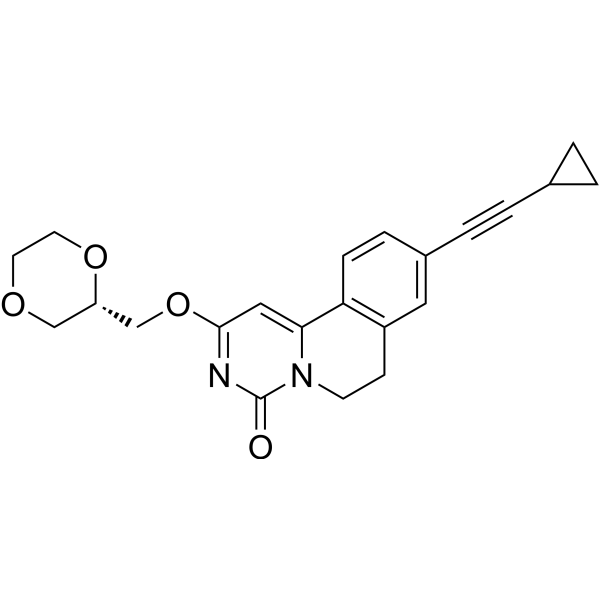
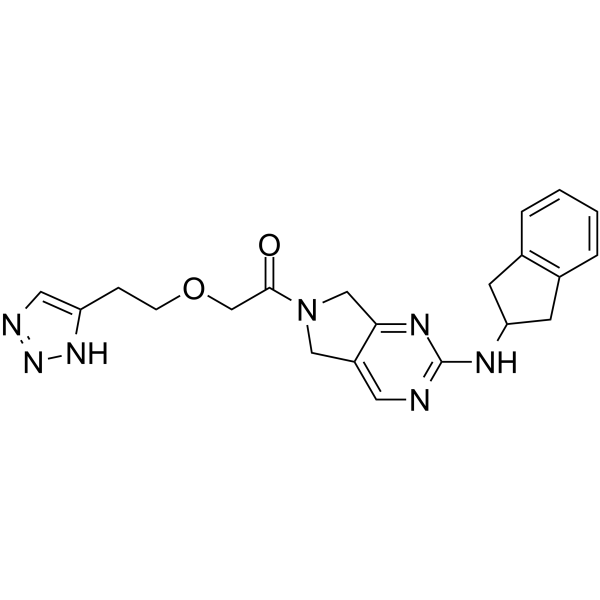
GLPG1205 is potent, selective and orally active GPR84 (a G-protein-coupled receptor) antagonist with a favorable PK/PD profile. GLPG1205 has anti-inflammatory activity and is used for the treatment of pulmonary fibrosis . GLPG1205 is a click chemistry reagent, it contains an Alkyne group and can undergo copper-catalyzed azide-alkyne cycloaddition (CuAAc) with molecules containing Azide groups.
loading...
    loading...
2
2 Cited Publications
Cat. No.: HY-132296
CAS No.: 2743427-26-9
Purity:  99.26%
Target:  

FAK PROTACs

Research Areas:  

Cancer

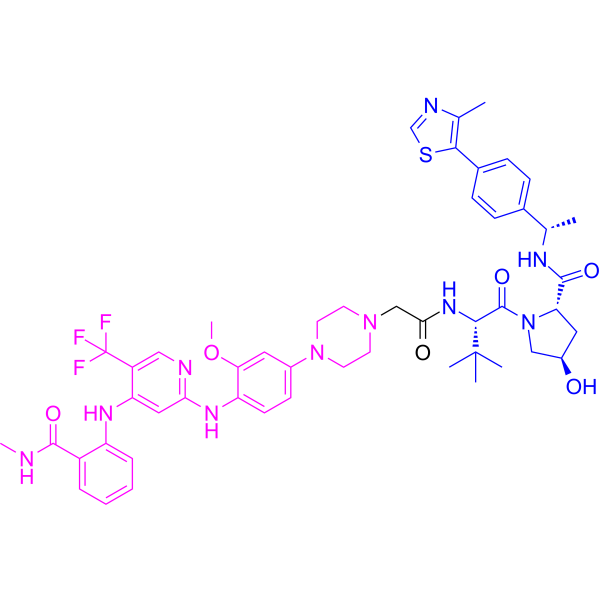
GSK215 is a potent and selective PROTAC focal adhesion kinase (FAK) degrader with a pDC50 of 8.4. GSK215 is designed by a binder for the VHL E3 ligase and the FAK inhibitor VS-4718. GSK215 induces rapid and prolonged FAK degradation, giving a long-lasting effect on FAK levels and a marked pharmacokinetic/pharmacodynamics (PK/PD) disconnect .
loading...
    loading...
Cat. No.: HY-151813
CAS No.: 2947393-64-6
Purity:  99.35%
Target:  

Fluorescent Dye

Research Areas:  

Cancer

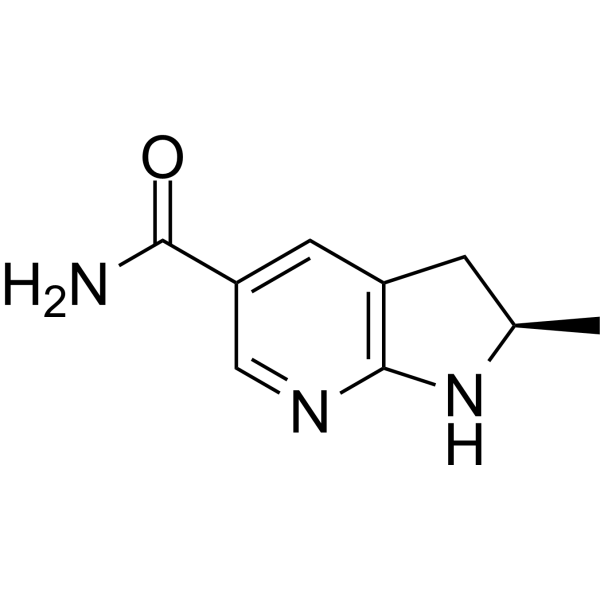
NNMT-IN-4 (compound 38) is a selective, uncompetitive and membrane permeability nicotinamide N-methyltransferase (NNMT) inhibitor with IC50 values of 42 and 38 nM in vitro biochemical and cell-based assays, respectively. NNMT-IN-4 shows favorable PK/PD and safety profiles as well as excellent oral bioavailability and pharmaceutical properties. NNMT-IN-4 can be used as a vivo chemical probe of NNMT .
loading...
    loading...
Cat. No.: HY-117482
CAS No.: 1914989-49-3
Purity:  99.96%
Target:  

γ-secretase

Research Areas:  

Neurological Disease

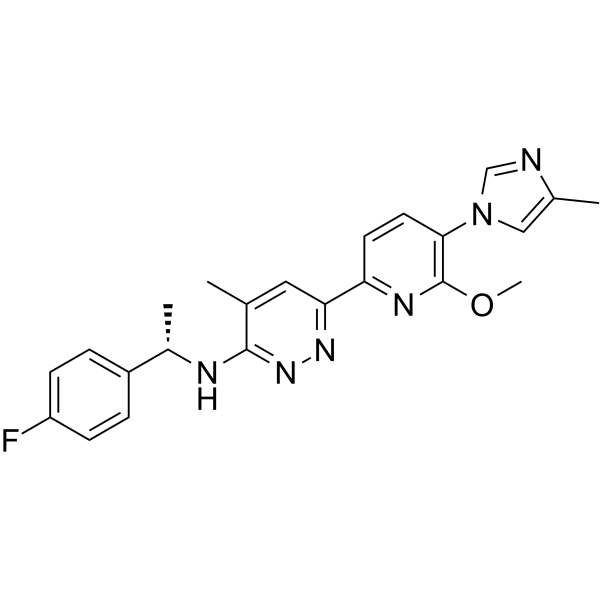
BPN-15606 is a highly potent, orally active γ-secretase modulator (GSM), attenuates the production of Aβ42 and Aβ40 by SHSY5Y neuroblastoma cells with IC50 values of 7 nM and 17nM, respectively. BPN-15606 lowers Aβ42 and Aβ40 levels in the central nervous system of rats and mice. BPN-15606 has acceptable PK/PD properties, including bioavailability, half-life, and clearance .
loading...
    loading...
Cat. No.: HY-146260
CAS No.: 1453082-52-4
Target:  

PI3K

Research Areas:  

Cancer

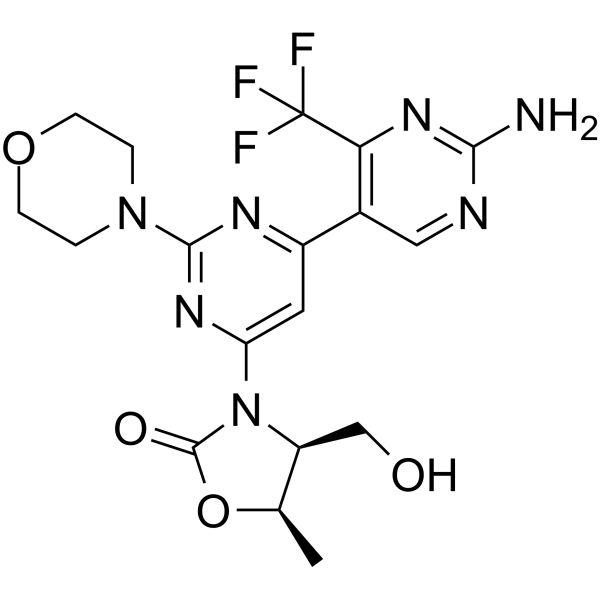
NVP-CLR457 (compound 40) is an orally active, potent and balanced pan-class I PI3K inhibitor. NVP-CLR457 shows a clear dose-dependent PK/PD/efficacy relationship. NVP-CLR457 has antitumor activity .
loading...
    loading...
Cat. No.: HY-178980
CAS No.: 2830619-57-1
Target:  

Casein Kinase

Research Areas:  

Cancer

APL-5125 (Compound 61f) is a potent, selective and orally active ATP-competitive CK2α inhibitor with an IC50 of 0.348 nM and a Ki of 0.095 nM. APL-5125 binds to CK2α in a bivalent manner, simultaneously interacting with the ATP-binding site and the αD pocket. APL-5125 exhibits antitumor activity and can be used for the research of cancer, such as colon cancer .
loading...
    loading...
Cat. No.: HY-19500
CAS No.: 215122-74-0
Target:  

COX

Research Areas:  

Others

SC-75416 is a selective cyclooxygenase-2 inhibitor. Its pharmacokinetic/pharmacodynamic (PK/PD) model was used for development and clinical trial simulation to design a study protocol to verify its analgesic effect in a post-oral surgery pain model. The simulation results showed that 360 mg of SC-75416 may provide better pain relief than 400 mg of ibuprofen. The actual clinical trial results confirmed this hypothesis, and 360 mg of SC-75416 was indeed superior to 400 mg of ibuprofen in pain relief. The PK/PD model of SC-75416 showed good predictive performance and successfully predicted its clinical effect. These research results show that SC-75416, as a new selective COX-2 inhibitor, has potential clinical application value in the management of post-oral surgery pain.
loading...
    loading...
Cat. No.: HY-16622A
CAS No.: 1005407-76-0
Target:  

LPL Receptor

Research Areas:  

Others

GSK1842799, an alkyl-substituted biaryl amino alcohol, is a selective S1P1 modulator developed for multiple sclerosis (MS). Upon phosphorylation, GSK1842799-P exhibited subnanomolar S1P1 agonist activity with over 1000-fold selectivity over S1P3. The compound showed good oral bioavailability, rapid in vivo conversion to GSK1842799-P, and significant lymphocyte count reduction at 0.1 mg/kg. It matched FTY720 efficacy at 3 mg/kg in the mouse EAE model and achieved comparable plasma levels to FTY-720 phosphate in cynomolgus monkeys. With favorable ADME, PK/PD properties, and toxicology, GSK1842799 advanced to further clinical development .
loading...
    loading...
Cat. No.: HY-15495B
CAS No.: 2517855-91-1
Synonyms: (3S)-CC-930 hydrochloride
Research Areas:  

Inflammation/Immunology

(3S)-Tanzisertib (hydrochloride) ((3S)-CC-930 (hydrochloride)) is an orally active JNK inhibitor (IC50 values for JNK1, JNK2, and JNK3 are 61, 7, and 6 nM, respectively). (3S)-Tanzisertib (hydrochloride) selectively inhibits ERK1, p38α, and EGFR (IC50 = 0.48, 3.4, and 0.38 μM, respectively). (3S)-Tanzisertib (hydrochloride) inhibits LPS-induced TNFα production in an acute rat PK-PD model. (3S)-Tanzisertib (hydrochloride) can be used in idiopathic pulmonary fibrosis (IPF) research .
loading...
    loading...
Cat. No.: HY-123637
CAS No.: 1619971-30-0
Research Areas:  

Inflammation/Immunology

Autotaxin-IN-1 is a potent autotaxin inhibitor, which has favorable potency (IC50=2.2 nM), PK properties, and a robust PK/PD relationship. Autotaxin-IN-1 is used in treatment of osteoarthritis pain .
loading...
    loading...
Cat. No.: HY-117482A
CAS No.: 2436239-00-6
Target:  

γ-secretase

Research Areas:  

Neurological Disease

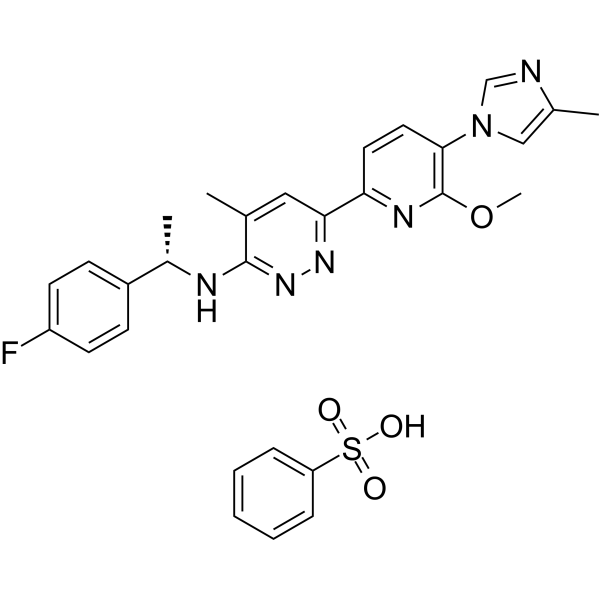
BPN-15606 besylate is a highly potent, orally active γ-secretase modulator (GSM), attenuates the production of Aβ42 and Aβ40 by SHSY5Y neuroblastoma cells with IC50 values of 7 nM and 17nM, respectively. BPN-15606 besylate lowers Aβ42 and Aβ40 levels in the central nervous system of rats and mice. BPN-15606 besylate has acceptable PK/PD properties, including bioavailability, half-life, and clearance .
loading...
    loading...
Cat. No.: HY-L904
1,387 compounds

The MCE 1K Drug Fragment Library consists of 1,387 drug fragments. These drug fragments are derived from 2,946 FDA-approved drug molecules, and fragments from one drug can appear in other drugs, so these fragments are somewhat correlated with good PK/PD properties. Fragment-based screening can reserve enough chemical space for subsequent structural optimization. This compound library is an essential tool for drug screening based on FBDD (Fragment-Based Drug Discovery).

  • 1

