



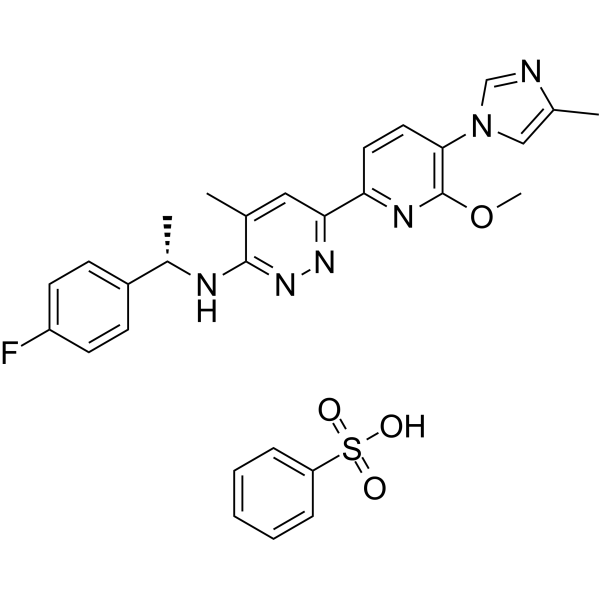
BPN-15606 besylate
BPN-15606 besylate is a highly potent, orally active γ-secretase modulator (GSM), attenuates the production of Aβ42 and Aβ40 by SHSY5Y neuroblastoma cells with IC50 values of 7 nM and 17nM, respectively. BPN-15606 besylate lowers Aβ42 and Aβ40 levels in the central nervous system of rats and mice. BPN-15606 besylate has acceptable PK/PD properties, including bioavailability, half-life, and clearance.
商品は「研究用試薬」です。人や動物の医療用・臨床診断用・食品用の製品ではありません。
研究用途以外に使用した場合、当社は一切の責任を負いかねます。
- CAS 番号: 2436239-00-6
- 分子式: C29H29FN6O4S
- 分子量:576.64
-
保管条件:
Please store the product under the recommended conditions in the Certificate of Analysis.

To place orders, for customer services and technical support, please contact: MedChemExpress USA
Tel: 609-228-6898 E-mail: [email protected] [email protected]


-
 生物活性
生物活性
-
化学情報
- プロトコル
- 純度とドキュメンテーション
- 参考文献
-
 Help & FAQs




生物活性
製品説明
IC50 & Target
γ-secretase[1]
体外実験
BPN-15606 besylate (oral administration; 10 mg/kg, 25 mg/kg and 50 mg/kg; 7 days) shows excellent dose-dependent efficacy in both plasma and brain on lowering of Aβ42 and Aβ40 levels in mice[1]. BPN-15606 besylate (oral administration; 5 mg/kg, 25 mg/kg and 50 mg/kg; 9 days) dose-dependently reduces CSF on lowering of Aβ42 and Aβ40 levels in rats[1]. BPN-15606 besylate (oral administration; 25 mg/kg; single dose) shows a robust effect on both brain and plasma Aβ 42 and Aβ40 levels, which begins approximately 30–60 minutes following the single dose administration and lasted for ≥24 hours in C57BL/6 mice[1].
MedChemExpress (MCE) has not independently confirmed the accuracy of these methods. They are for reference only. Further protocols information, click here.


化学情報
-
CAS 番号 2436239-00-6
-
分子量 576.64
-
分子式 C29H29FN6O4S
-
SMILES
O=S(C1=CC=CC=C1)(O)=O.CC2=CC(C3=NC(OC)=C(N4C=C(C)N=C4)C=C3)=NN=C2N[C@H](C5=CC=C(F)C=C5)C
-
輸送条件
Room temperature in continental US; may vary elsewhere.
-
保管条件
Please store the product under the recommended conditions in the Certificate of Analysis.

プロトコル
-
Cell Cytotoxicity Assay
Cytotoxicity assays are usually based on the assessment of cell membrane damage, which can also be indirectly detected by measuring cell viability. Detection methods include MTT assay, CKK-8 assay, LDH assay and ATP assay, etc.
-
Protocol for Pharmacokinetic Study
Pharmacokinetic studies quantify how an organism handles a drug over time through absorption, distribution, metabolism, and excretion, and the core experimental readout is the concentration-time profile of parent drug and, when relevant, metabolites in biological matrices such as plasma, whole blood, urine, bile, or tissue. Pharmacokinetic analysis links dose, route, exposure, clearance, half-life, distribution, bioavailability, and systemic exposure to drug efficacy and toxicity hypotheses rather than measuring a signaling pathway directly. The literature links pharmacokinetics to drug-development phenotypes by showing that drug metabolism and pharmacokinetics influence compound progression, exposure-response interpretation, safety margins, dosing strategy, and failure risk during discovery and development. DMPK science contributes to compound optimization by integrating physicochemical properties, in vitro metabolism, transporter behavior, in vivo exposure, and pharmacodynamic contex
-
Notch Pathway Solutions
The Notch pathway is a contact-dependent signaling pathway that controls cell-fate decisions, differentiation, proliferation, and tissue patterning through interactions between membrane-bound Notch receptors and membrane-bound ligands on neighboring cells. Canonical Notch signaling is activated when ligand engagement triggers proteolytic release of the Notch intracellular domain, which enters the nucleus and regulates transcription together with DNA-binding transcriptional complexes. In the canonical mechanism, ligand-dependent Notch activation leads to release of the intracellular Notch domain, and presenilin-dependent γ-secretase activity is required for production of the active intracellular signaling fragment. The released intracellular domain functions as a nuclear signal that converts Notch receptor activation at the membrane into transcriptional regulation of target programs such as HES/HEY-family genes and other context-dependent downstream targets. The literature links Notch p


純度とドキュメンテーション
参考文献

Calculators
濃度 (開始) × 体積 (開始) = 濃度 (終了) × 体積 (終了)


BPN-15606 besylate 関連分類
HY-117482A 関連分類
 Powered by Bioz