1. Search Result
Search Result
Isoforms Recommended: PKMYT1
Results for "

PKMYT1

" in MedChemExpress (MCE) Product Catalog:

34

阻害剤およびアゴニスト

2

組換えタンパク質

2

抗体

3

オリゴヌクレオチド

製品番号 製品名 Target 研究分野 構造式
  • HY-145817A
    lunresertib
    5+ Cited Publications

    RP-6306

    Wee1 Cancer
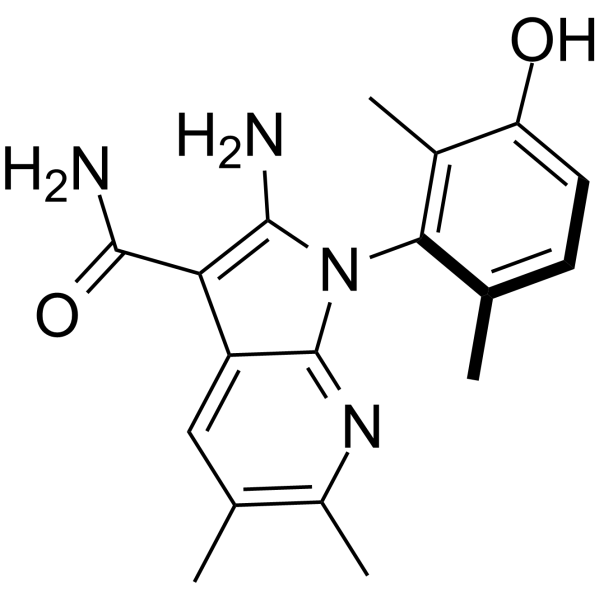
    lunresertib (RP-6306) is a potent, selective and orally active PKMYT1 inhibitor with an IC50 of 14 nM. lunresertib shows a high degree of selectivity over other kinases in cellular binding assays. lunresertib shows anticancer effects [1].
    lunresertib
  • HY-147312

    Wee1 Cancer
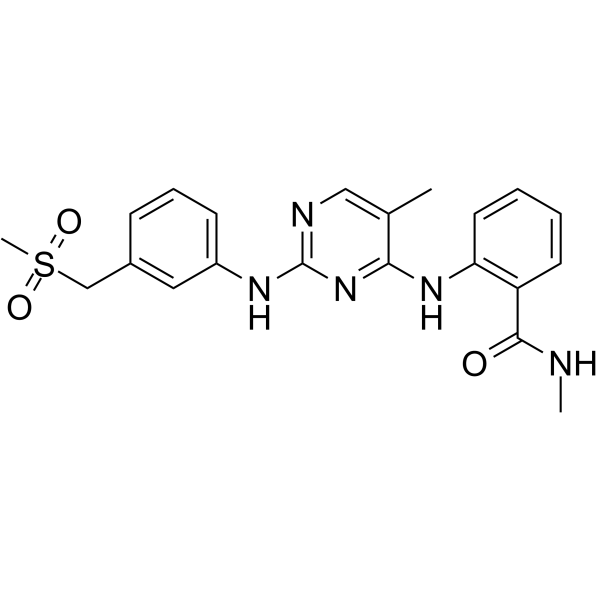
    GSK-1520489A is a PKMYT1 (active protein kinase) inhibitor (IC50=115 nM, Ki=10.94 nM) [1].
    GSK-1520489A
  • HY-169946

    Wee1 Cancer
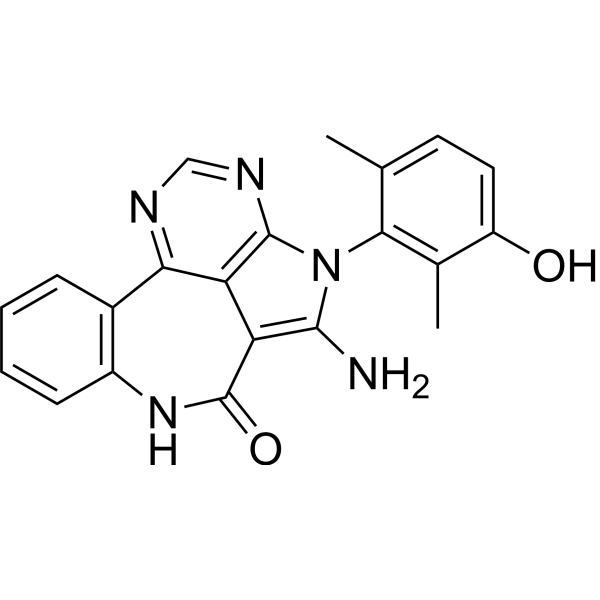
    WEE1/PKMYT1-IN-1 (compound 75) is a potent and orally active WEE1 and PKMYT1 inhibitor. WEE1/PKMYT1-IN-1 shows antiproliferation activity [1].
    WEE1/PKMYT1-IN-1
  • HY-170517

    Wee1 Ephrin Receptor Cancer
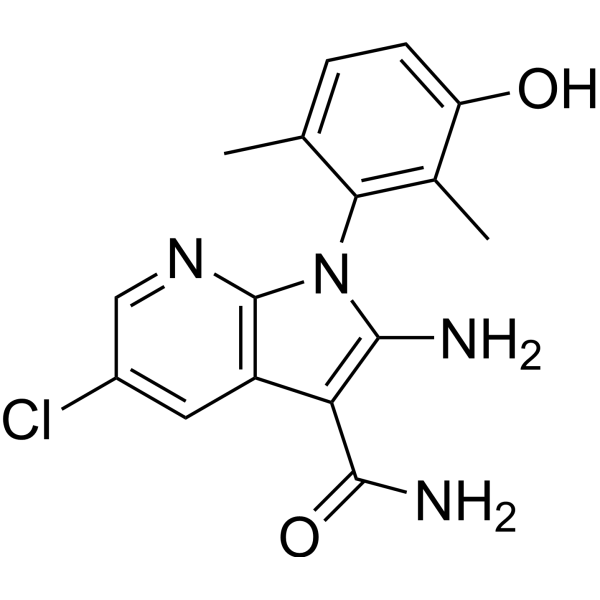
    PKMYT1-IN-8 (Compound 137) is the inhibitor for PKMYT1 with an IC50 of 9 nM. PKMYT1-IN-8 inhibits EPHB3, EPHA1, KIT, EPHB1, EPHA2, EPHA3, and EPHB2with IC50s of 1.79, 3.17, 4.29, 6.32, 6.83, 8.10, and 10.9 μM, respectively. PKMYT1-IN-8 inhibits the proliferation of cancer cell OVCAR3 with GI50 of 2.02 μM [1].
    PKMYT1-IN-8
  • HY-145817

    (Rac)-RP-6306

    Wee1 Cancer
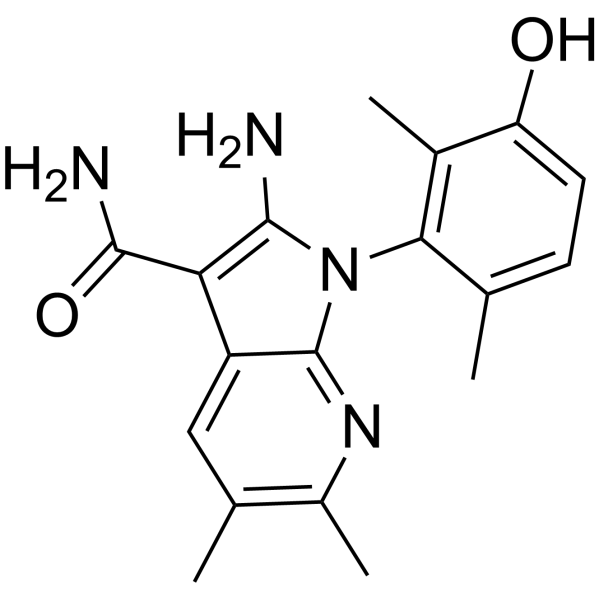
    (Rac)-lunresertib (compound 181) is a potent membrane-associated tyrosine and threonine-specific cdc2-inhibitory kinase (Myt1) (Gene name PKMYT1) inhibitor with an IC50 of <10 nM. (Rac)-lunresertib (compound 181) has anticancer effects [1].
    (Rac)-lunresertib
  • HY-145817B

    (R)-RP-6306

    Wee1 Cancer
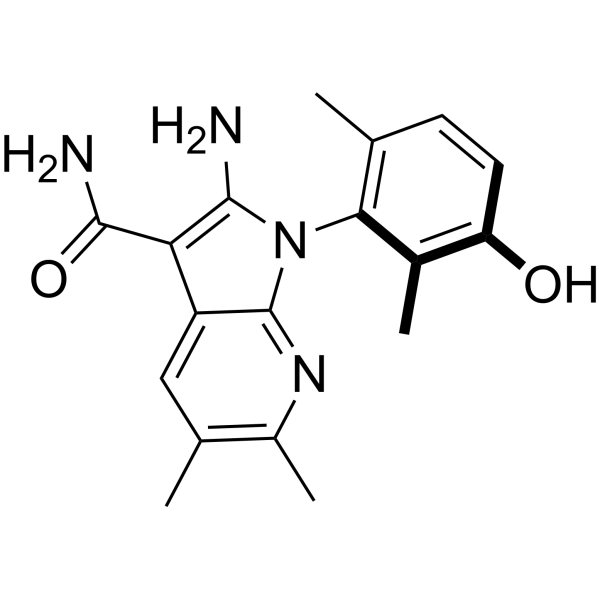
    (R)-lunresertib is a membrane-associated tyrosine and threonine-specific cdc2-inhibitory kinase (Myt1) (Gene name PKMYT1) inhibitor, with IC50 of 1360 nM. (R)-lunresertib can be used in the study of Myt1-mediated cancers [1].
    (R)-lunresertib
  • HY-163491

    Wee1 Cancer
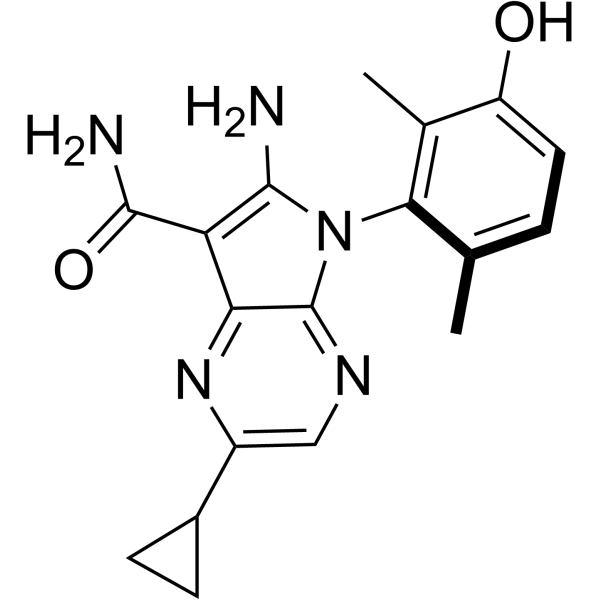
    PKMYT1-IN-2 (compound 2) is a potent PKMYT1 inhibitor with an IC50 of 5.7 nM. PKMYT1-IN-2 inhibits the growth of HCC1569 cells with an IC50 of 22 nM [1].
    PKMYT1-IN-2
  • HY-175819

    Wee1 Apoptosis Cancer
    PD-166285 is a PKMYT1 inhibitor, with an IC50 value of 17 nM. PD166285 shows strong antiproliferative effects against CCNE1-amplified OVCAR3 cells (IC50 = 0.14 μM) and HCC1569 cells (IC50 = 0.21 μM). PD166285 induces apoptosis and arrests CCNE1-amplified HCC1569 cells at the G1/S phase of the cell cycle. PD166285 can be used for the research of PKMYT1-targeted therapies for CCNE1-amplified cancers [1].
    PD-166285
  • HY-RS23175

    Small Interfering RNA (siRNA) Others

    Pkmyt1 Rat Pre-designed siRNA Set A contains three designed siRNAs for Pkmyt1 gene (Rat), as well as a negative control, a positive control, and a FAM-labeled negative control.

    Pkmyt1 Rat Pre-designed siRNA Set A
    Pkmyt1 Rat Pre-designed siRNA Set A
  • HY-RS10605

    Small Interfering RNA (siRNA) Others

    PKMYT1 Human Pre-designed siRNA Set A contains three designed siRNAs for PKMYT1 gene (Human), as well as a negative control, a positive control, and a FAM-labeled negative control.

    PKMYT1 Human Pre-designed siRNA Set A
    PKMYT1 Human Pre-designed siRNA Set A
  • HY-RS16738

    Small Interfering RNA (siRNA) Others

    Pkmyt1 Mouse Pre-designed siRNA Set A contains three designed siRNAs for Pkmyt1 gene (Mouse), as well as a negative control, a positive control, and a FAM-labeled negative control.

    Pkmyt1 Mouse Pre-designed siRNA Set A
    Pkmyt1 Mouse Pre-designed siRNA Set A
  • HY-172759

    Wee1 Cancer
    PKMYT1-IN-9 is a highly selective and orally active PKMYT1 inhibitor (IC50: 4.4 nM). PKMYT1-IN-9 shows more selective for PKMYT1 than WEE1 (IC50: 32.4 μM). PKMYT1-IN-9 exhibits antitumor activity [1].
    PKMYT1-IN-9
  • HY-175817

    Wee1 Apoptosis Cancer
    PKMYT1-IN-10 is a selective PKMYT1 inhibitor with an IC50 of 3 nM. PKMYT1-IN-10 inhibits colony formation, induces apoptosis, and induces S-phase cancer cell cycle arrest. PKMYT1-IN-10 exhibits liver microsomal stability, favorable plasma stability, minimal CYPs inhibition. PKMYT1-IN-10 can be used for the studies of ovarian cancer and breast cancer [1].
    PKMYT1-IN-10
  • HY-163490

    Wee1 Cancer
    PKMYT1-IN-1 (Compound 1) is an inhibitor for membrane-associated tyrosine and threonine kinase (PKMYT1), with an IC50 of 8.8 nM. PKMYT1-IN-1 inhibits proliferation of tumor cell HCC1569 with IC50 of 42 nM [1].
    PKMYT1-IN-1
  • HY-169946A

    Wee1 Cancer
    WEE1/PKMYT1-IN-2 is the axial chiral P configuration of WEE1/PKMYT1-IN-1 (HY-169946). WEE1/PKMYT1-IN-1 is a potent and orally active WEE1 and PKMYT1 inhibitor. WEE1/PKMYT1-IN-1 shows antiproliferation activity [1].
    WEE1/PKMYT1-IN-2
  • HY-169946B

    Wee1 Cancer
    WEE1/PKMYT1-IN-3 is the axial chiral M configuration of WEE1/PKMYT1-IN-1 (HY-169946). WEE1/PKMYT1-IN-1 is a potent and orally active WEE1 and PKMYT1 inhibitor. WEE1/PKMYT1-IN-1 shows antiproliferation activity [1].
    WEE1/PKMYT1-IN-3
  • HY-145664

    Wee1 Cancer
    Myt1-IN-1 is a potent membrane-associated tyrosine and threonine-specific cdc2-inhibitory kinase (Myt1) (Gene name PKMYT1) inhibitor with an IC50 of <10 nM. Myt1-IN-1 has anticancer effects (WO2021195782A1; compound 132) [1].
    Myt1-IN-1
  • HY-162849

    Wee1 Cancer
    PKMYT1-IN-3 (compound 8ma) is a potent and selective PKMYT1 inhibitor with an IC50 value of 16.5 nM. PKMYT1-IN-3 has antitumor activity [1].
    PKMYT1-IN-3
  • HY-145666

    Wee1 Cancer
    Myt1-IN-3 is a potent membrane-associated tyrosine and threonine-specific cdc2-inhibitory kinase (Myt1) (Gene name PKMYT1) inhibitor with an IC50s of <10 nM (WO2021195782 A1, compound 95) [1].
    Myt1-IN-3
  • HY-159937

    Wee1 CDK Cancer
    PKMYT1-IN-7 (compound 7) is an orally active PKMYT1 inhibitor with IC50 values of 1.6 nM and 0.06 μM against of PKMYT1 and pCDK1, respectively. PKMYT1-IN-7 suppresses the phosphorylation of CDK1 at T14 and Y15. PKMYT1-IN-7 shows anticancer activity both < and < [1].
    PKMYT1-IN-7
  • HY-162987

    Wee1 Cancer
    PKMYT1-IN-6 (compund 98) is a PKMYT1 inhibitor with IC50 less than 50 nM [1].
    PKMYT1-IN-6
  • HY-162986

    Wee1 Cancer
    PKMYT1-IN-4 (compund 27) is a PKMYT1 inhibitor with IC50 less than 50 nM [1].
    PKMYT1-IN-4
  • HY-162988

    Wee1 Cancer
    Myt1-IN-5 (compound 4) is a membrane-associated tyrosine and threonine-specific cdc2-inhibitory kinase (Myt1) (Gene name PKMYT1) inhibitor with an IC50 of less than 200 nM.
    Myt1-IN-5
  • HY-145665

    Wee1 Cancer
    Myt1-IN-2 is a potent membrane-associated tyrosine and threonine-specific cdc2-inhibitory kinase (Myt1) (Gene name PKMYT1) inhibitor with an IC50 of <10 nM. Myt1-IN-2 has anticancer effects (WO2021195782A1; compound 28) [1].
    Myt1-IN-2
  • HY-176957

    Wee1 Cancer
    PKMYT1-IN-11 (Example 1) is a PKMYT1 inhibitor with an IC50 of 4.49 nM. PKMYT1-IN-11 inhibits the proliferation of HCC1569 cells. When combined with Gemcitabine (HY-17026), PKMYT1-IN-11 shows a significant anti-tumor effect in the OVCAR3 xenograft mouse model. PKMYT1-IN-11 can be used for the study of various cancers such as breast cancer and ovarian cancer [1].
    PKMYT1-IN-11
  • HY-180484

    Wee1 CDK Ligands for Target Protein for PROTAC Cancer
    PKMYT1-IN-12 (Compound 4) is a selective inhibitor of PKMYT1, with an IC₅₀ of 2.6 nM. PKMYT1-IN-12 can effectively inhibit the phosphorylation of CDK1, with an IC₅₀ of 44 nM. PKMYT1-IN-12 is a target protein ligand that can be used for the synthesis of PROTAC D16-M1P2 (HY-180485) [1].
    PKMYT1-IN-12
  • HY-183547

    Wee1 CDK Cancer
    WEE1/PKMYT1-IN-4 is a selective WEE1/PKMYT1 inhibitor, with IC50 values of 0.185 μM and 2.2 nM for human WEE1 and PKMYT1, respectively. WEE1/PKMYT1-IN-4 inhibits phosphorylation of CDK1 at T14 and Y15, disrupting the G2/M cell cycle checkpoint. WEE1/PKMYT1-IN-4 can be used for the research of colorectal cancer and amplified breast cancer [1].
    WEE1/PKMYT1-IN-4
  • HY-181004

    CDK Cancer
    PKMYT1-IN-13 is a potent, orally active and selective PKMYT1 inhibitor that inhibits PKMYT1 with IC50 values < 10.0 nM in ADP-Glo assay and 19.9 nM in NanoBRET cellular assay. PKMYT1-IN-13 exhibits high selectivity over WEE1. PKMYT1-IN-13 shows selective antiproliferative activity in CCNE1-amplified cells, while showing minimal wild-type effects. PKMYT1-IN-13 shows antitumor efficacy in HCC1569 mouse xenografts. PKMYT1-IN-13 can be used for the research of CCNE1-amplified cancers, such as gastric, ovarian, and breast cancer [1].
    PKMYT1-IN-13
  • HY-157443

    Wee1 Cancer
    Myt1-IN-4 (21) is an orally active and selective membrane-associated tyrosine and threonine-specific cdc2-inhibitory kinase (Myt1) (Gene name PKMYT1) inhibitor, with an IC50 of 2.6 nM. Myt1-IN-4 (21) possesses antitumor activity [1].
    Myt1-IN-4
  • HY-180485

    PROTACs Wee1 CDK Cancer
    PROTAC D16-M1P2 is an orally active PKMYT1 PROTAC degrader with a DC50 of 0.7 nM. PROTAC D16-M1P2 also inhibits the activity of PKMYT1 with an IC50 of 7.6 nM. PROTAC D16-M1P2 inhibits pCDK1 with an IC50 of 9 nM. PROTAC D16-M1P2 has demonstrated significant anti-tumor efficacy in mouse models and can be used for research on breast cancer [1].
    PROTAC D16-M1P2
  • HY-182906

    Wee1 CDK Cancer
    XL495 is an potent, selective and orally active PKMYT1 inhibitor. XL495 inhibits CDK1 Thr14 phosphorylation and induces KAP1 Ser824 phosphorylation in xenograft tumors. XL495 reduces tumor growth in colorectal and breast cancer xenograft models, and achieves tumor regression with DNA-damaging agents in colorectal cancer xenograft models. XL495 can be used for the research of cancer, such as breast cancer and colorectal cancer [1] .
    XL495
  • HY-182791

    Wee1 Cancer
    BAA-009 is a selective and orally active PKMYT1 inhibitor with an IC50 of <50 nM. BAA-009 inhibits cancer cells proliferation and inhibits tumor growth in OVCAR3 xenograft mice. BAA-009 can be used for the research of cancer, such as ovarian cancer [1].
    BAA-009
  • HY-182790

    Wee1 Cancer
    BAA-065 is a selective and orally active PKMYT1 inhibitor with an IC50 of <50 nM. BAA-065 inhibits cancer cells proliferation, induces γH2AX expression and DNA damage. BAA-065 inhibits tumor growth in OVCAR3 xenograft mice. BAA-065 can be used for the research of cancer, such as ovarian cancer [1].
    BAA-065
  • HY-180893

    Wee1 Apoptosis Cancer
    XH-30 is a potent, selective, and orally active PKMYT1 inhibitor, with an IC50 of 4.1 nM. XH-30 suppresses the proliferation of P53-mutated triple-negative breast cancer (TNBC) cells by inducing G2/M phase release, DNA damage, and apoptosis. XH-30 demonstrates antitumor effects in an MDA-MB-231 mouse model. XH-30 can be used for P53-mutated TNBC research [1].
    XH-30

オンラインお問い合わせ

入力情報は安全に管理されます. 必須入力項目.

タイトル


国或いは地域 *

お名前 *


組纖名 *

デパートメント *


メールアドレス *


製品名 *

製品番号


カスタマ需要量 *

電話番号 *


必ず会社名を記載ください。個人への返信は行いません。

備考

バルクお問い合わせ

Inquiry Information

製品名:
製品番号:
数量:
MCE 日本正規代理店:

