1. Search Result
Search Result
Results for "

Paromomycin

" in MedChemExpress (MCE) Product Catalog:

7

Inhibitors & Agonists

6

Natural
Products

Cat. No. Product Name Target Research Areas Chemical Structure
  • HY-B0956
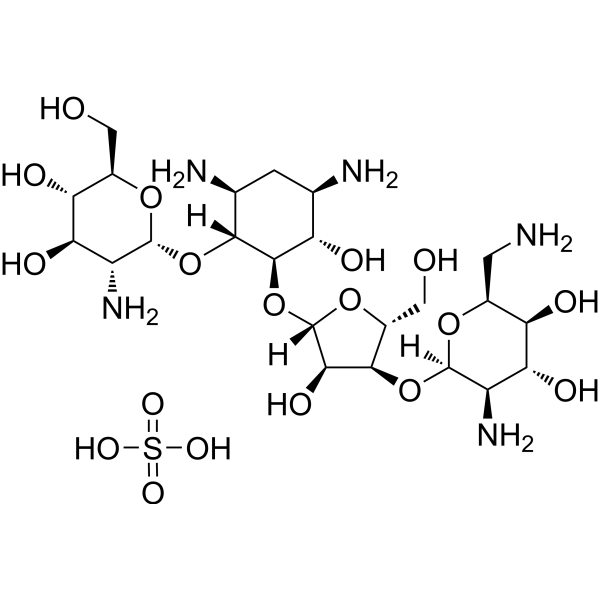
    Paromomycin sulfate
    4 Publications Verification

    Aminosidine sulfate

    Antibiotic Parasite Bacterial Infection
    Paromomycin (Aminosidine) sulfate, a neomycin (HY-B0470) derivative, is a broad spectrum aminoglycoside antibiotic with amebicidal and bactericidal effects. Paromomycin sulfate prematures termination of translation of mRNA and inhibits protein synthesis by specifically binds to the RNA oligonucleotide at the A site of bacterial 30S ribosomes. Paromomycin sulfate can be used for the research of bacterial and parasitic infections .
    Paromomycin sulfate
  • HY-B0956A

    Aminosidine

    Bacterial Parasite Endogenous Metabolite Infection
    Paromomycin (Aminosidine) is an orally active broad-spectrum aminoglycoside aminocyclitol. Paromomycin is produced by Streptomyces riomosus var. Paromomycinus. Paromomycin binding induces local conformational changes in the 16S rRNA A-site. Paromomycin exhibits inhibitory activity against C. parvum. Paromomycin can be used in research related to leishmaniasis, amoebiasis and cryptosporidiosis .
    Paromomycin
  • HY-B0956R

    Aminosidine sulfate (Standard)

    Reference Standards Antibiotic Parasite Bacterial Infection
    Paromomycin (sulfate) (Standard) is the analytical standard of Paromomycin (sulfate). This product is intended for research and analytical applications. Paromomycin (Aminosidine) sulfate, a neomycin (HY-B0470) derivative, is a broad spectrum aminoglycoside antibiotic with amebicidal and bactericidal effects. Paromomycin sulfate prematures termination of translation of mRNA and inhibits protein synthesis?by specifically binds to the RNA oligonucleotide at the A site of bacterial 30S ribosomes. Paromomycin sulfate can be used for the research of bacterial and parasitic infections .
    Paromomycin sulfate (Standard)
  • HY-Z16212

    Paromomycin Ⅱ; Aminosidine II; Zygomycin A2

    Antibiotic Bacterial Infection
    Paromomycin II is an aminoglycoside antibiotic. Paromomycin II has activity against Gram-positive, negative bacteria, mycobacterium and protozoa. Paromomycin II has good curative effect for amebic dysentery and a few bacillary dysentery .
    Neomycin F
  • HY-N0677AR

    Potassium dehydroandrographolide succinate (Standard)

    Antibiotic Reference Standards Infection Inflammation/Immunology Cancer
    Paromomycin (sulfate) (Standard) is the analytical standard of Paromomycin (sulfate). This product is intended for research and analytical applications. Paromomycin (Aminosidine) sulfate, a neomycin (HY-B0470) derivative, is a broad spectrum aminoglycoside antibiotic with amebicidal and bactericidal effects. Paromomycin sulfate prematures termination of translation of mRNA and inhibits protein synthesis?by specifically binds to the RNA oligonucleotide at the A site of bacterial 30S ribosomes. Paromomycin sulfate can be used for the research of bacterial and parasitic infections .
    Kalii Dehydrographolidi Succinas (Standard)
  • HY-N14758

    Antibiotic Bacterial Infection
    6"'-Deamino-6"'-hydroxyparomomycin I is an amino glycosyl antibiotic that can be produced by Streptomyces rimosus forma paromomycinus A67 15. It is active against both Gram-positive and Gram-negative bacteria. 6"'-Deamino-6"'-hydroxyparomomycin I can be used as an intermediate in the biosynthesis of paromomycin .
    6
  • HY-129262

    Antibiotic Bacterial Infection
    Deoxypheganomycin D is a specific antimycobacterial inhibitor with no cross-resistance to other antibiotics such as Paromomycin (HY-B0956), Capreomycin (HY-P3270), Viomycin (HY-A0155), Streptothricin (HY-129065), Kanamycin (HY-16566), and Streptomycin (HY-B1906). Deoxypheganomycin D (28 μM) partially inhibits the growth of Mycobacterium 607, with no significant inhibitory effects on DNA, RNA, or protein synthesis. Deoxypheganomycin D (7 μM) affects leucine influx, not thymidine, and has the opposite effect on efflux. The effects of Deoxypheganomycin D may be related to cell membrane and specific mycobacterial lipid components.
    Deoxypheganomycin D

Inquiry Online

Your information is safe with us. * Required Fields.

Salutation


Country or Region *

Applicant Name *


Organization Name *

Department *


Email Address *


Product Name *

Cat. No.


Requested quantity *

Phone Number *


Remarks

Inquiry Online

Inquiry Information

Product Name:
Cat. No.:
Quantity:
MCE Japan Authorized Agent:

